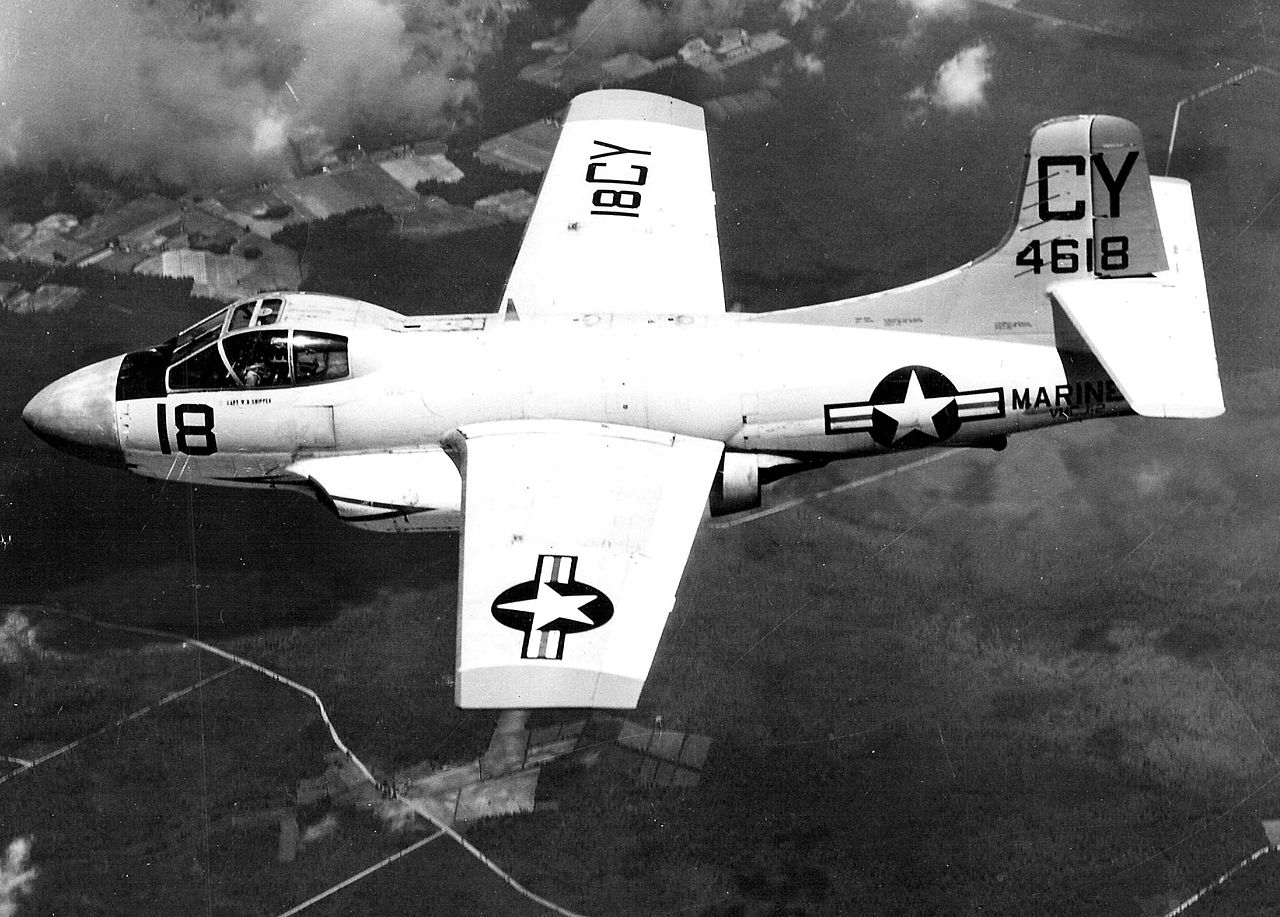
USMC EF-10B Skyknight over Cuba
Beginning in April 1962, Soviet Premier Nikita Khrushchev increased Cuba’s military defenses by secretly approving the installation of medium- and intermediate-range ballistic missile (MRBM and IRBM) bases on the island. Before these missile sites could operate, the Soviets needed to shield them from American U-2 spy planes. To create this protective air defense, they chose the SA-2 surface-to-air missile—a weapon already proven effective against U-2s—to guard the MRBM and IRBM facilities. The SA-2 system depended on early-warning radars, target acquisition equipment, and fire-control radars to function.
According to Joe Copalman in his book F3D/EF-10 Skyknight Units of the Korean and Vietnam Wars, while the US Marine Corps was flying around Cuba to keep the quickly evolving Electronic Order of Battle (EOB) updated, the CIA was conducting U-2 reconnaissance flights to track the island’s growing military presence. On August 29, photos from a CIA flight verified at least eight SA-2 missile sites in western Cuba. Soon after, VMCJ-2 confirmed these sites were operational when two EF-10B Skyknights, crewed by ECMOs CWO Marty Lachow and SSgt William Wood, detected emissions from the ‘Fan Song’ fire control and tracking radar. Although Khrushchev’s plan to install IRBM and MRBM launch sites in Cuba was still secret at the time, the deployment of several SA-2 sites strongly suggested that the Soviets were preparing to defend something of great value.
The ‘13 days’ of the Cuban Missile Crisis
On Oct. 14, 1962, imagery from a U-2 overflight revealed what the Soviets had erected the SA-2 sites to defend—nuclear-capable SS-4 MRBMs. Another flight two days later discovered more SS-4s, as well as longer-range SS-5 IRBMs. Placement of these missiles in Cuba meant the Soviets could strike nearly anywhere in the continental USA with far less warning than with intercontinental ballistic missiles launched from within the USSR. So began the ‘13 days’ of the Cuban Missile Crisis.
USMC ‘Whales’
As the situation grew more intense, US Marine Corps ‘Whales’—the nickname for EF-10B Skyknights—were prepared to jam Cuban ‘Fire Can’ and ‘Whiff’ anti-aircraft artillery radars. However, crews remained concerned about the ‘Fan Song’ radar, which guided the SA-2 missiles, since there was little information available about how this system worked. Under mounting pressure from Castro to protect Cuba from air raids, local Soviet SAM officers escalated matters on October 27 by firing at a USAF U-2 without approval from Moscow, resulting in the aircraft being shot down and its pilot, Major Rudolph Anderson, losing his life. The following day, Khrushchev agreed to withdraw the IRBMs and MRBMs from Cuba, ending the immediate crisis.
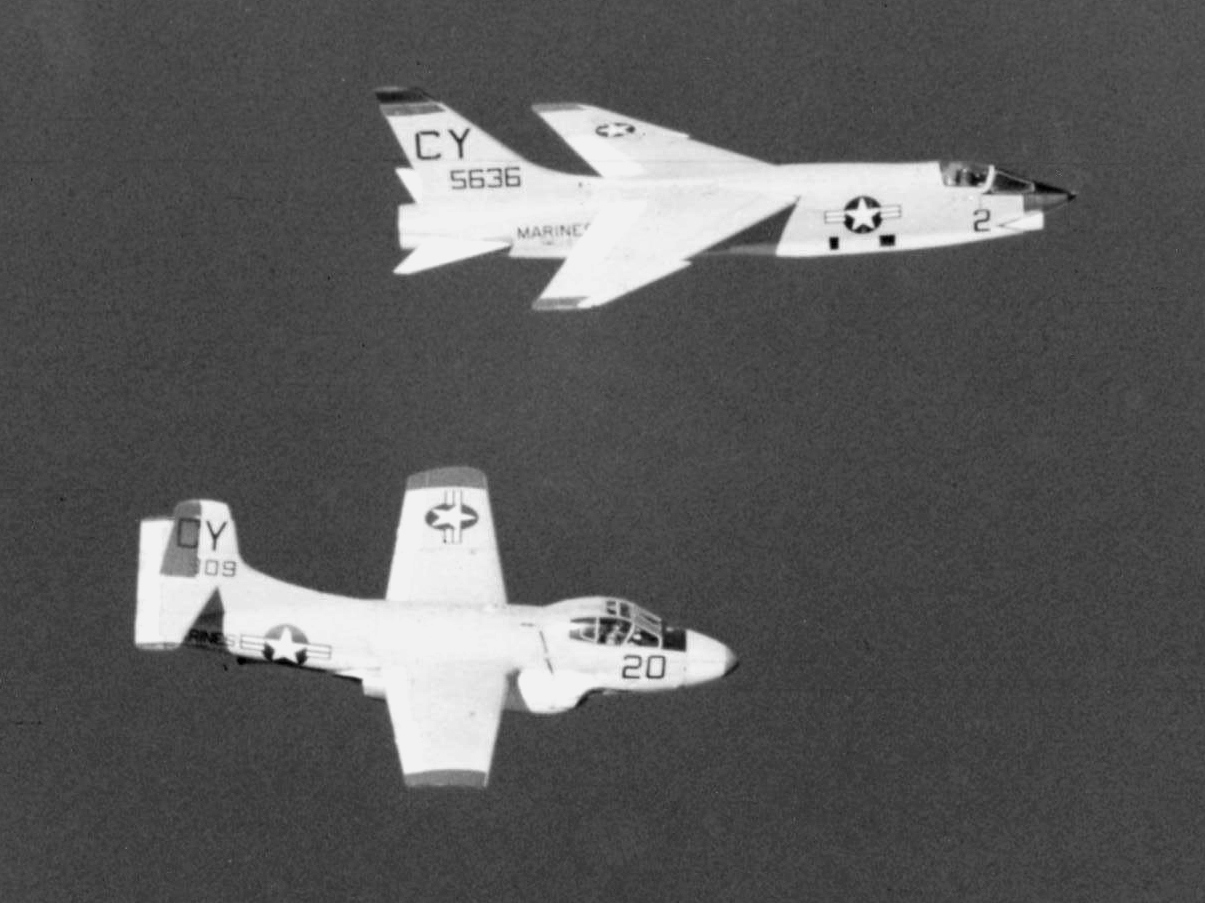
Throughout the rest of the decade, the US Marine Corps continued flying ELINT missions around Cuba until VMCJ-2 retired its EF-10Bs. These flights served both to monitor Castro’s air defenses and to give new ECMOs firsthand experience with Soviet radar signals before they deployed to Vietnam. Missions carried the risk of potential interception by Cuban MiG fighters. Because these flights often covered long distances, communication between ‘Whale’ crews and their controllers sometimes became unreliable, which occasionally led to inadvertent entries into Cuban airspace—fortunately, these never resulted in a hostile conflict. To improve communication, VMCJ-2 equipped several EF-10Bs with a high-frequency (HF) radio, enabling controllers to issue warnings over longer ranges. Aircraft with this modification had a wire antenna stretching from behind the cockpit to the top of the tail, along with another wire attached to the left side of the fuselage.
Pissing Castro off
Despite this fix, unintentional crossings into Cuban airspace continued to occur. These were usually caused by high winds at altitude and clouds concealing the Cuban coastline, leaving pilots without any visual way to navigate. This scenario played out in 1967, when 1st Lt. Terry Whalen, serving as an ECMO, experienced such an incursion during a mission.
‘Some guys you liked flying with, some you didn’t, but there was one guy, his name was Ariel Cross. I got to know him pretty well. He was a quiet guy, and I’m a smart aleck, and I was always trying to get him to lighten up a little bit. We used to fly down to NAS Key West and fly around Cuba to piss Castro off. It was good training.
‘I was flying down there with Ariel one day, and he kind of drifted into Cuban airspace. Supposedly, they scrambled a couple of jets to see what was going on, and the Navy scrambled a couple of jets to see what we were doing. Nothing happened, but it could have been a bad incident, I suppose. We got back, and I thought it was funny, but Ariel, being such a serious guy, he was really angry at himself. I kept joking about getting to go to Cuba and drink their booze, and all that stuff, but he wasn’t having any of it.’
F3D/EF-10 Skyknight Units of the Korean and Vietnam Wars is published by Osprey Publishing and is available to order here.
Photo by U.S. Navy and U.S. Marine Corps