

The essence of the V-FA’s plan for fighting NATO was a 1,000-aircraft strike down every three major axes over West Germany (north, center, and south)—three times a day.
As explained by Tom Cooper, an Austrian aerial warfare analyst and historian, “Time and again, I’m asked how the Soviets would deploy their air power in the case of a ‘WWIII’ – i.e. a major (conventional) war with NATO in Central Europe… or to compare the Soviet air power and Soviet tactical air defenses with those of Iraq in 1990-1991….or, well, I see wargamers trying to depict theoretical scenarios for Central Europe of the 1970s and/or 1980s, and then involving 2-4 ‘MiGs’ or ‘Sukhois’…
Hand on heart, this is a complex set of topics, and trying to address it properly is next to certainly going to fail. But let me try to address at least the ‘cornerstones’.
The Soviet way of fighting air wars was one of _smashing_ the enemy, not of needling it (BTW, essentially, the Russian way nowadays is quite the same). Means: forget that with ‘2-4 MiGs/Sukhois’ for any scenario in central Europe of the 1970s. They wouldn’t operate that way, but come with literally, ‘1000 Tupolevs, Sukhois, and MiGs’.
Many people nowadays have a massive problem just comprehending the numbers involved. It’s been so long I lost count of ‘kids’ who can’t understand alone the fact that the Soviet Group of Forces in Germany (SGFG) had some 40 divisions_ (no ‘battalion task groups’ or whatever, but DIVISIONS), or that the Soviet Frontal Aviation had about 3,500-4,000 tactical combat aircraft deployed in East Germany, Poland, and Czechoslovakia: add the bombers of the V-DA deployed in what is nowadays Ukraine to get the complete picture…. And no: it was not like ‘mass of these was non-operational’. Quite on the contrary. In this regard, all I can say is: if you want to seriously study—or play—the 1970s/1980s, forget the ‘metrics’ of the 2020s.
Anyway… how would the Soviet air come?
The essence of the V-FA’s plan for fighting NATO was a 1,000-aircraft strike down every three major axes over West Germany (north, center, and south)—three times a day. To fly such a strike, they had to breach the ‘chain’ of MIM-23 HAWK SAM sites constructed down the full ‘width’ of West Germany. Correspondingly, each air strike would receive heavy EW support (say: 15-20 stand-off jammers), and start with 100-150 Tu-16s and Tu-22s using AS-4/6s. They would be followed by 2-3 regiments of Su-24s armed with AS-10s and AS-11s; these by 2-3 regiments of Su-17s armed with AS-9s and AS-10s… and only then would they come in with ‘other’ tactical aircraft (MiG-27s, Su-25s). Use of ‘other’ (but ARM) PGMs would be minimal: perhaps 4 aircraft per squadron were armed with PGMs, others with free-fall bombs or unguided rockets…and every wave would be completed by top cover in the form of 2-3 regiments of MiG-23MLs and/or MiG-29s.
Bottom line: one wave would include 1,000 aircraft in the north, 1,000 in the center, and 1,000 in the south—and three such 3,000-aircraft waves were planned for every single day. The first of such waves would seek to demolish air defenses and air bases; the following would be targeting major NATO bases and/or ground forces—as necessary (i.e., depending on the situation).
(Hope, I need not explain how busy the NATO air force would be just trying to protect its air bases from all of this….)
Should there (still) be any doubts… well, perhaps those having doubts might want to—finally—read Milos Sipos’ and my book Iraqi Mirages: which would help understand that ‘even’ the IrAF was operating that way. Sure, it had no ‘1,000 aircraft’, BUT: from around early 1984, every single one of its air strikes—whether BAI or CAS—was organized as follows:
– Syrel-equipped Mirages to monitor the activity of enemy air defenses in real-time (so to enable commanders in the Kari HQ to direct the air battle in real-time)
– Caiman-equipped Mirages providing standoff EW support
– MiG-23ML and/or Mirages flying BARCAP
– Tu-16s and Tu-22 deploying chaff-corridors
– Kh-28-armed Su-22s and/or Baz-AR-armed Mirages flying SEAD
– and, ‘only then’, the ‘bombers’ – usually in the form of squadron-sized formations of SPS-141-equipped MiG-23BNs and Su-22s, and Remora-equipped Mirages.
By 1986, up to 4-6 squadrons of fighter-bombers were involved in every single such operation, and every single such operation was canceled if any of EW-support aircraft had to abort.
I.e. ‘even Iraqis’ didn’t operate any other way. Just the scale was different (indeed, every single foray by their SuEs and/or Mirages over the Persian Gulf was receiving a similar amount of EW- and top cover….)
(If you’re surprised now, or ‘still can’t believe this’: don’t worry, you’re not alone. I have seen quite a few real-life _Generals_ dropping their jaws at seeing this; it was easy because they usually sit in the front row during my related presentations….)

In turn, NATO would actually operate in a very similar fashion to the way it did in 1991 (this is where experiences from Iraq in 1991 are relevant): i.e., in big formations, with plentiful EW-support, ‘too’.
…and that would be badly necessary, because, say, a corps-sized SGFG formation was protected by at least one brigade of SA-10s, plus a regiment of SA-11s for every single division, plus four regiments of 2S6s per division… all complemented by another regiment of SA-13s per division, and then dozens of teams/platoons of SA-14s/16s… and that in addition to V-FA’s interceptors that would be present ‘in numbers’.
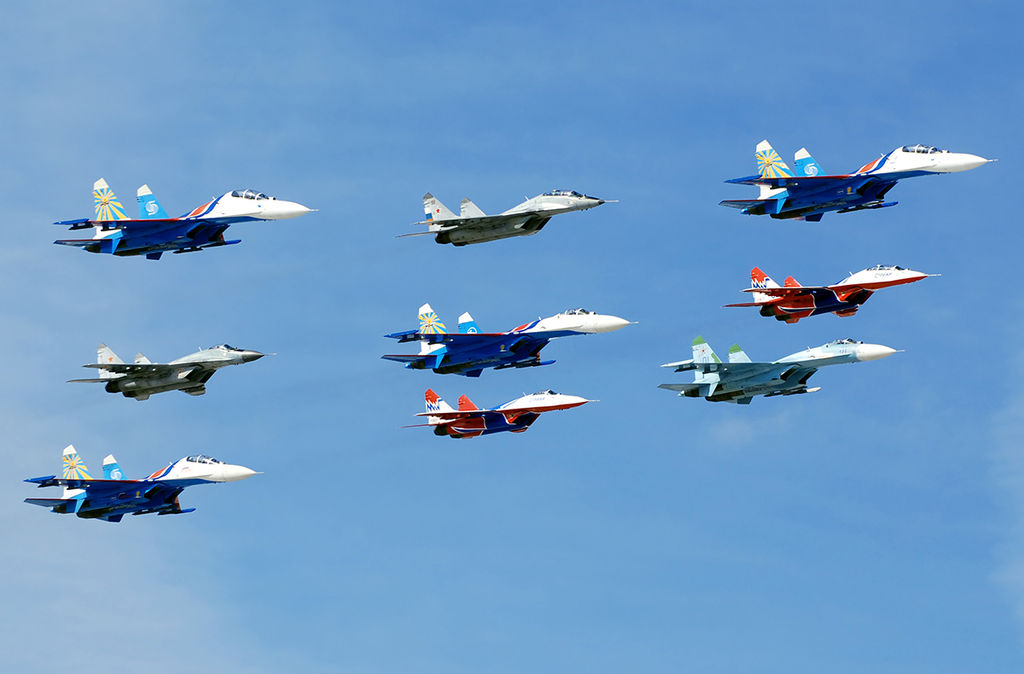
In other words: sorry, but with ‘2 MiGs/F-16s here and 2 A-10s there’… well, perhaps—and then after a week of the war, and resulting massive attrition, and that on either side. Otherwise, early on, the sky would really look like what some of the photos in this post show… at least in those three major directions of Soviet air strikes.
That’s it—at least in ‘quick and dirty’ fashion.
EDIT: Ah yes… How would the modern-day VKS (i.e. Russian Air-Space Force) operate nowadays?
In quite a similar fashion.
How do I know? From doing two things: from reading their tactical manuals and from monitoring VKS ops over Syria—for example, in the period March-June 2017, when they were launching up to three to five major waves of 70 aircraft a day (click here for an example)—and that ‘on a sortie-to-sortie basis’.”
Check out Helion & Company’s website for books featuring interesting stories written by Tom Cooper.
Photo by Aleksandr Markin, and By English: Aleksandr Markin; Русский: Александр Маркин (Su-27 and MiG-29) via Wikipedia and Ministry of Defence of the Russian Federation


