

The Untold Challenges Submariners Face
The Reality of Submarine Service
Serving on a US Navy submarine required courage, stamina, and deep expertise. America’s state-of-the-art vessels were capable of supporting hundreds of sailors working and living together beneath the sea for months at a time. According to Navy Petty Officer 2nd Class Khamani Conklin, Torpedoman’s Mate aboard USS Maine (SSBN-741), an Ohio-class ballistic missile submarine, submariners formed a different kind of camaraderie than sailors on other vessels.
“I don’t think being on a submarine is for everybody. I think you have to be somebody that can be comfortable with no sun and no outside communication. Submariners are different from everyone else in the Navy.”
Yet few outsiders understood the peculiar challenges submariners faced in their sealed metal vessels.

The Ammonia Problem: How Submarines Managed Air Quality
When nuclear submarines remained submerged with a sealed atmosphere, crews faced a critical challenge: carbon dioxide buildup could become fatal. To solve this, submarines relied on a chemical compound called amine to remove CO₂ through a process managed by the CO2 Scrubber system.
As Ron Charest, a former US Navy submarine sailor who retired as Senior Chief Electronics Technician, explained, the amine system operated by absorbing carbon dioxide when cool and releasing it when hot. However, amine carried a distinctive fishy, ammonia smell that permeated every corner of the submarine’s interior, including the clothing and skin of crew members.
“This is a very effective system, with the downside being the amine imparts a rather ‘unique’ smell into the atmosphere,” Charest noted.
Beyond amine, submariners were exposed to cooking odors, hydraulic oil vapors, diesel exhaust not fully captured by the exhaust system, inboard venting of sanitary tanks, and the smell of a large number of closely confined people. Crew members became accustomed to the odor after a while, but the smell proved unmistakable to outsiders. Charest recounted flying home on vacation in civilian clothes, only to have a passenger ask if he’d served on submarines after catching a whiff—her husband had served underwater, and she’d never forgotten the distinctive scent.
The Sanitary Problem: Why Submariners Couldn’t Flush
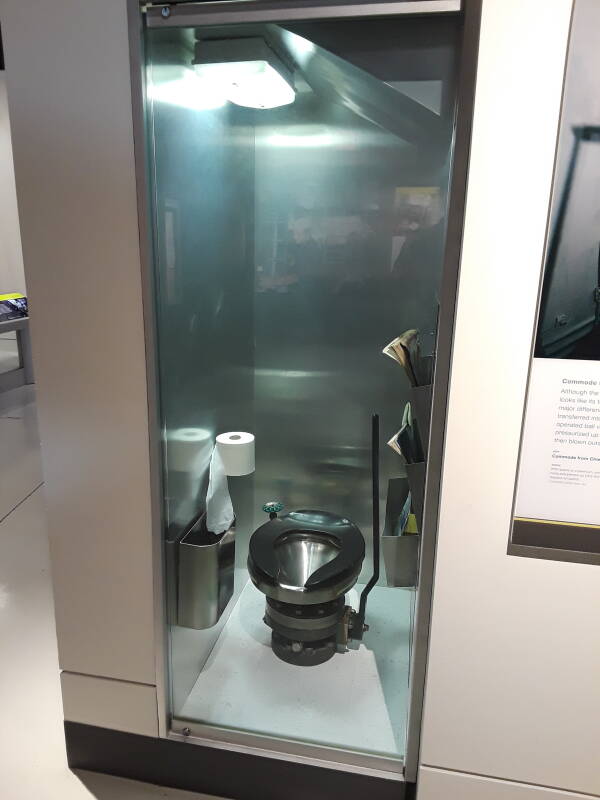
Just as on surface ships, the toilet aboard a submarine was referred to as “the head” in traditional maritime custom. However, submarines faced far greater challenges with this mundane operation than their surface cousins.
Submarines carried sanitary tanks designed to hold human waste generated in the heads. Under normal operating conditions near the surface, these tanks were routinely flushed to the open sea. The process, called “Blowing Sanitaries,” involved using compressed air from the air banks to pressurize the tanks to a pressure exceeding the sea pressure at the boat’s depth. This routine procedure was performed by the Machinist gang.
However, when submarines operated in hostile waters, trailed enemy combatants, or descended to extreme depths, the sanitaries could not be emptied. As Dale Rich, a former US Navy submariner, explained, the evolution had the potential to create significant noise and consumed vital resources, particularly compressed air.
At extreme depths—below 500 feet—the air pressure required to remove waste increased dramatically. At 500 feet, air pressure would need to exceed 215 psi to push waste from the tank, compared to just 44 psi at 100 feet. Because compressed air was a vital resource that might be needed to surface the submarine in an emergency, it was reserved rather than used for sanitary operations.
It was not unusual for submarines to remain in positions where they could not expose themselves for many days. During these extended periods, the sanitaries filled up, and the heads were restricted. Crews experienced no showers, no laundry, limited use of the head, and restricted water usage. “Usually this is when the crew begins to beg for a ‘Mercy Blow,'” Rich explained. The officer of the deck would inform the Captain of the situation, and measures were taken to alleviate the problem if operationally possible.

Medical Care Without Doctors: The Role of Hospital Corpsmen
What happened when submariners fell ill? Unlike surface ships with dedicated medical officers, submarines typically carried no doctor aboard.
According to Ralph Cahill, a US Navy Reserve Submarine Officer, submarines relied instead on a Hospital Corpsman—a senior medic with years of experience who received specialized training as an “Independent Duty Corpsman” (IDC). This designation allowed them to perform emergency medical procedures that typical corpsmen were not equipped to handle.
“However, they are not doctors, and so there are limits to what they can do on board,” Cahill explained. “In cases of dire medical situations, the IDC will do their best to stabilize the patient, and then the submarine will attempt to Medically Evacuate (MEDEVAC) them as quickly as possible.”
The Vietnam War Exception
This arrangement represented a significant change from earlier practice. During the Vietnam War era, Boomers (SSBNs)—ballistic missile submarines—carried physicians as members of the wardroom. LCDR Lealis Hale MC (SS) USNR served two patrols aboard USS Tecumseh (SSBN-628) out of Guam in 1969 and recalled a two-person medical department consisting of the doctor and the Independent Duty Corpsman.
“Submarine Medical Officers had their own path to obtaining their dolphins, and many qualified,” Hale noted. “Some medical officers even qualified as Officer of the Deck and stood watch in rotation in that position.” These medical officers often entered service as relatively senior reserve officers.
As the Vietnam era concluded and the Doctor Draft ended, fewer physicians volunteered for submarine service. “Physicians still join the Submarine Service, and the Submarine Medical School has officers in training at its New London Sub Base, Connecticut,” Hale observed. “But the poster is correct, physicians no longer ride the boats on patrols.”
He reflected on his experience: “I can say that my shipmates on the boat and later as my tour as Squadron (One) Medical Officer were the most dedicated, well-trained group of officers and men I have had the honor of serving with.”
A Different Kind of Sacrifice
These challenges—the pervasive ammonia smell, the restricted use of basic facilities, the reliance on medics rather than doctors—represented just a few of the unique hardships submariners endured. Yet as Rich concluded, submariners were all volunteers who chose this demanding life. They performed their duties not because they were ordered to, but because they loved what they did.
Photos courtesy of the U.S. Navy, Mass Communication Specialist 2nd Class Jonathan W. Hutto, Sr., SmarterEveryDay YouTube channel, and National Museum of the US Navy

