

The Delta 2 would surprise everyone—including Fairey itself—by breaking the absolute World Speed Record by a huge margin in March 1956
The West was shaken when the Soviet Union tested its first atomic bomb in August 1949, and the Korean War a year later underscored Russia’s advancing technology in the form of the MiG-15, a fighter that could outclass anything the RAF had at the time. In the years after the Second World War, funding for RAF Fighter Command had been cut back sharply, but the growing threat of Soviet bombers created an urgent need for new jet fighters.
That urgency produced Operational Requirement (OR.) 329/F.155T and some of the most audacious designs ever put on paper.
Britain’s leading aircraft makers—including Hawker, English Electric, Fairey, Vickers Supermarine, de Havilland, Saunders-Roe, and Armstrong Whitworth—began designing powerful supersonic aircraft with entirely new guided-missile systems, intended to intercept a Soviet attack and bring down high-flying enemy aircraft before they could unleash a devastating nuclear strike on Britain.
As Dan Sharp explains in Cold War Interceptor, the slender experimental Fairey Delta 2 had already flown a full year before the F.155T tender deadline, so Fairey naturally proposed a straightforward development of this promising aircraft for the competition—though it also had ambitions to push the design further.
The first Fairey Delta 2 to fly, serial WG774, took to the air on Oct. 6, 1954, from 4:57 p.m. to 5:23 p.m. On Nov. 17, during the aircraft’s 14th test flight and before it had yet gone supersonic, it suffered engine failure at 30,000 feet at 1:06 p.m. and made a forced landing at 1:12 p.m. According to the crash report issued on Nov. 22, pilot Peter Twiss “succeeded in landing the aircraft on the runway on the nose wheel and tail skid only. He ran along the level for about 1000 ft and only then slewed off the runway. The aircraft is now on its main undercarriage and will be brought back to Fairey works by road on Monday.”
“There is some damage to the nose wheel, the underside of the rear fuselage, and to the wing tips and ailerons. It is intended to remove the wing and check for distortion in the jigs. Until this is done, it will be uncertain how much damage has been sustained.”

As inquiries into the cause of WG774’s engine failure—with fuel starvation the main focus—continued on Mar. 18, 1955, Fairey’s chief engineer, Robert Lickley, wrote to Ronald Andrew Shaw, Assistant Director of the Ministry of Supply’s Aircraft Research Department, under the heading “ER.103 [Experimental Requirement ER. 103 issued on Sep. 26, 1950, which generated the Delta 2] Development.”
He wrote, “As you know, we have been looking into developments of the ER.103, and the enclosed brochure is an attempt to summarize our thoughts and ideas.”
“We have based it mainly on the fact that by making use of the lead-in time already available in the ER.103 prototype, a very high-performance fighter can be available in squadron service, well in advance of any new type. The interim version would give much useful data and would represent a research type of considerable value.”
“The whole project would seem to fall into the shorter development stages now envisaged but gains greatly by making use of aircraft research programs already underway. Should you wish to discuss further any aspect of this, I would be very pleased to do so with you.” Scribbled at the bottom of Lickley’s original letter is a note from Shaw: ‘Spoke on telephone 22.3.55’.”
The brochure laid out a two-stage plan. Delta 2 was designated ER.103A, while the next phase, ER.103B, was the interim experimental version mentioned in Lickley’s letter. It would be slightly enlarged over the base model, with wingspan increased from 26 ft 10 in to 28 ft, length from 52 ft 3 in to 54 ft 4 in, and height from 10 ft 2 in to 12 ft 4 in. Its engine would be replaced by either a de Havilland Gyron or a Rolls-Royce RB.122, raising top speed at 45,000 ft from Mach 1.49 to Mach 2.72.
If that proved successful, the final development would be a fighter powered by a Gyron and two de Havilland Spectre rocket engines. It would be much larger, with a wingspan of 37 ft 7 in, a length of 58 ft 4 in, and a height of 14 ft 2 in. The ‘A’ weighed 13,600 lb and the ‘B’ 20,650 lb, while the ‘C’ would weigh 27,000 lb. Speed at 45,000 ft would dip slightly to Mach 2.54, and the armament would consist of two Blue Jay missiles. By then, Lickley’s thinking was clearly focused on the F.155T.
By June 8, 1955, the Delta 2 mock-up was still occupying valuable space at Fairey. At that point, the Ministry of Supply—which had previously wanted it scrapped—wrote to the company to say that arrangements had been made for the Air Ministry to take over the mock-up of the aircraft. It added that Service transport would collect the mock-up from RAF Station Henlow on June 9 or 10, and that the letter authorized the transfer of the aircraft and engine mock-ups to the officer in charge of transport.
The Air Ministry’s decision to take over the Delta 2 mock-up instead of having it scrapped suggests that the Air Staff already had a strong interest in the aircraft as a possible basis for future fighters, even at that early stage.
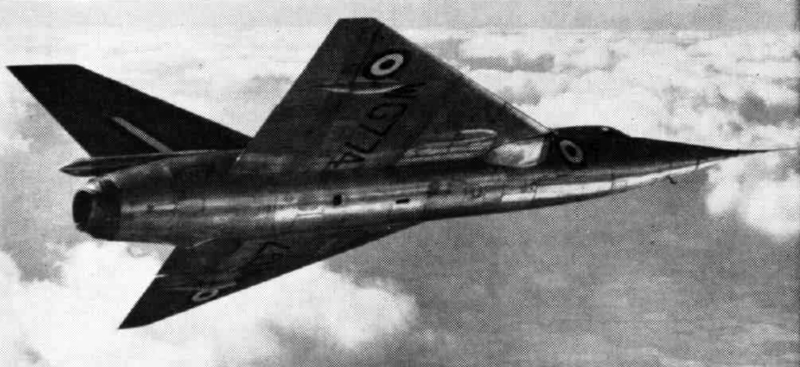
Flight testing of WG774 resumed on June 26, but fuel system problems appeared almost immediately, and on July 13 the aircraft suffered an engine failure early in its takeoff run. The engine was removed and returned to Rolls-Royce for detailed inspection. In the meantime, a de-rated engine was installed, and subsonic flying resumed, with 26 flights carried out between August 23 and September 26. The Delta 2 still had not broken the sound barrier.
By the October 6 deadline for the F.155T submissions, Fairey was alone among the competitors in offering two designs. The first was a direct outgrowth of the Delta 2 and amounted to a two-seat version of the ER.103C described in Lickley’s brochure seven months earlier. The second was a new proposal that, while still based on Delta 2 technology, took a much bolder and riskier step forward.
During the evaluation process, the ER.103 design was often called either “Fairey Small” or “Fairey Little.” The brochure itself was titled simply The Fairey Fighter Aircraft (ER.103 Development), while the three-view drawing was labeled The Fairey Two-Seat Fighter (ER.103 Development). The larger, more powerful alternative was known as “Fairey Large” or “Fairey Big.”
The ER.103 design had its own brochure, but it contained no narrative text—only drawings and technical data. This “Fairey Small” version used the ER.103C’s single Gyron engine and two Spectre rocket motors, though its dimensions were slightly different, measuring 56 ft 3 in in length and 14 ft 3 in in height, with the same 37 ft 7 in wingspan.
As the “Fairey Large” brochure put it, a single-engine version was barely feasible: it could be designed around the de Havilland weapon alone, but both altitude performance and range would be limited.
Yet the Delta 2 would later astonish everyone—including Fairey—by smashing the absolute world speed record by a wide margin in March 1956. In October 1955, however, its prospects were seen in far less optimistic terms.
The Delta 2 was also tested in France for a period, partly because Fairey had good relations with Dassault Aviation and the French Air Force. In October and November 1956, it carried out 47 low-level supersonic test flights from Cazaux Air Base near Bordeaux, with Dassault engineers closely observing and learning a great deal about delta-wing aircraft from the trials. Dassault later developed the MD.550 Mystère-Delta, which aviation author Derek Wood said “bore a striking resemblance” to the Delta 2; that design was ultimately built as the successful Dassault Mirage III fighter. Wood credits the Delta 2 with helping confirm Dassault’s theories and supporting the Mirage III’s design and development.

Photo by Crown Copyright, US Navy

