

The F-104’s extremely short wingspan, which made it a very fast but highly unstable craft at low altitudes, didn’t scare the Germans one little bit
The F-104 Starfighter, with its futuristic appearance, had a long, tubular fuselage, a sharply tapered nose, and very small, thin wings.
The wings were so short that neither the landing gear nor fuel tanks could be housed in them, so both had to fit inside the fuselage. The small wing design was important for giving the Starfighter its impressive acceleration, climb rate, and maximum speed. On the other hand, the tiny wings hurt its sustained turning ability, and because they could not store fuel, the aircraft’s operational range was quite limited.
The aircraft lacked an effective radar and carried only a cannon and heat-seeking missiles, which meant it could be used only as a daytime, clear-weather fighter.
Despite this, the Starfighter was taken into service by 15 NATO and other nations, which modified it for use as a fighter-bomber. The version supplied to the Luftwaffe and Marineflieger, designated F-104G (G for Germany), was not a simple daytime interceptor but an all-weather ground-attack model. It weighed about 2,000 pounds more than the original F-104 while using the same engine. For most operations, it also had to carry four external fuel tanks, further increasing its weight.
However, German Starfighters also flew ground-attack training missions without external fuel tanks, as recalled by Gregory Rush, a former U.S. Air Force veteran, on Quora. He describes walking with a colleague along a snowy, icy road to an American air base in West Germany during a large military exercise when they heard a faint sound overhead. They both froze in astonishment as a German Air Force F-104 roared toward them at very low altitude, flying along the road so low that it was actually beneath the power lines.
“In a couple of seconds before he passed overhead, I saw the power lines bowing upwards on either side of the road from the pressure wave he was pushing in front of him. We snapped our heads towards each other, thinking, ‘You Gotta be Shittin’ Me!’. Then I was airborne as we both dived into a dirty & icy ditch.”
“German pilots are very good and very crazy.”
“Apparently, the F-104’s very short flight range without external tanks wasn’t a problem for German home defense forces. The Starfighter’s extremely short wingspan, which made it a very fast but highly unstable (non-computer-aided) craft at low altitudes, didn’t scare the Germans one little bit.”
Rush concludes;
“People will still tell me that this plane would never, ever, ever be flown in the way I’ve described. Well, I just say, ‘That’s what happens in your life; this is what happened in mine!'”
“One thing about their raiding tactic is that I bet they wouldn’t need a whole lot of ammunition to bring an entire flight line to a complete stop for some time. The plane that buzzed us made three similar flights over the base before the warning siren even began wailing…”
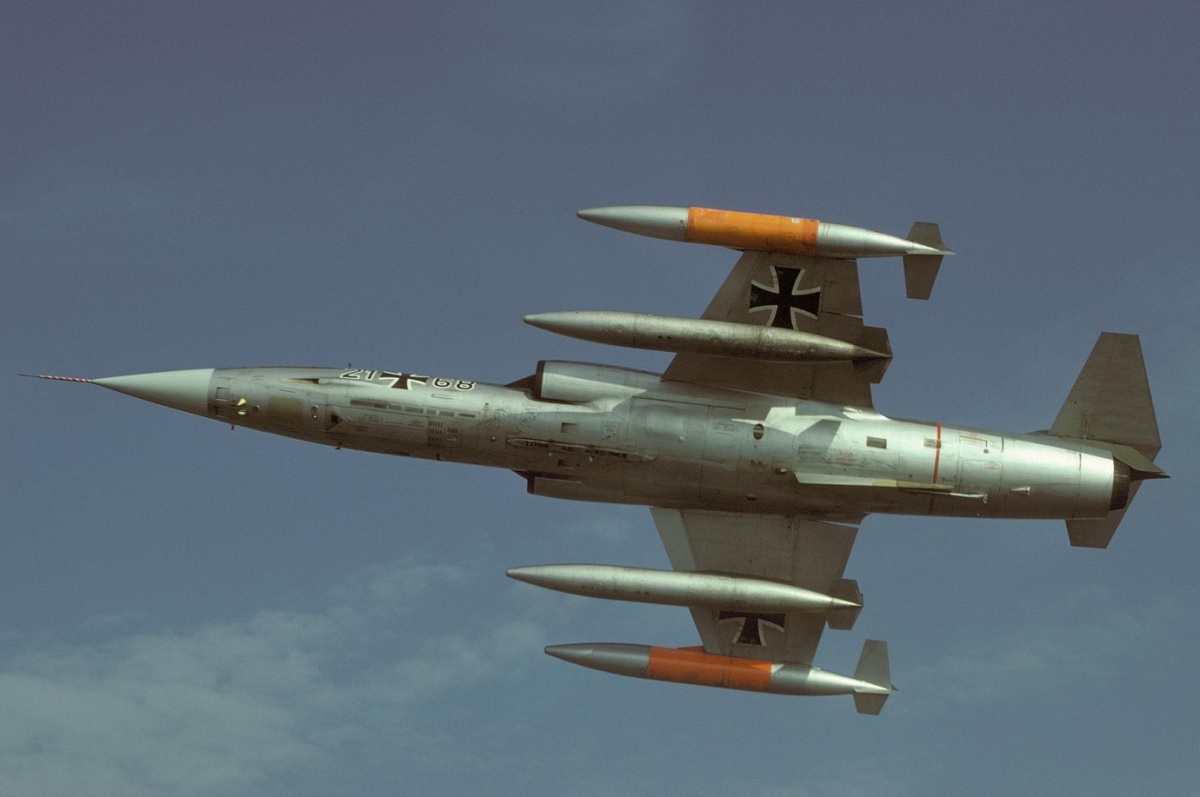
Photo by U.S. Air Force and Rob Schleiffert from Holland via Wikipedia

