

The Final Countdown, the movie that introduced the Tomcat to Hollywood
Cold War advances in Soviet long-range patrol and bomber aircraft created a need for a fleet-defense fighter capable of intercepting high-altitude bombers well beyond visual range. Grumman answered with the iconic F-14 Tomcat. Armed with long-range AIM-54 Phoenix air-to-air missiles, the Tomcat could engage multiple targets at distances exceeding 90 miles. To combine the speed required of an interceptor with the ability to carry such heavy weapons, Grumman developed the F-14’s highly effective variable-sweep wings, allowing the aircraft to operate across a broad range of airspeeds.
The Tomcat was not only the most formidable fighter in carrier air wings but also an enduring symbol of its era, gaining prominence through encounters with Libyan aircraft in the 1980s and its appearances on the silver screen, most notably in the blockbuster film “Top Gun.”
Six years before “Top Gun” placed the F-14 Tomcat at the center of popular culture, “The Final Countdown” demonstrated that Grumman’s twin-tailed fighter possessed genuine star appeal. As a lieutenant and F-14 pilot, Al “Shoes” Mullen flew in the film and generously allowed the author to review his notes about the experience.
Shoes joined Fighter Squadron 84 (VF-84, the Jolly Rogers) as a nugget in September 1977. He quickly distinguished himself as a pilot and, in September 1978, was selected to attend the Topgun class alongside his RIO, Jim “Tex” Huston.
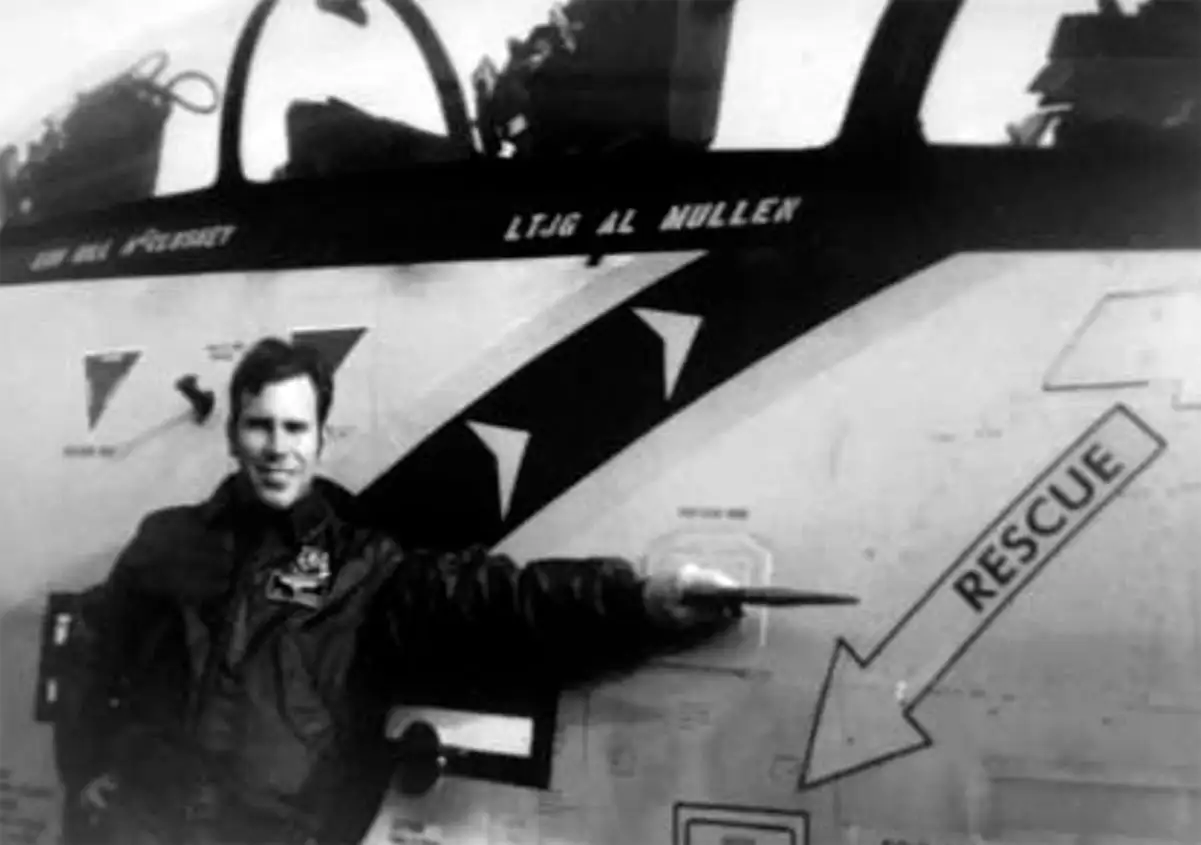
Tomcat pilots filming The Final Countdown
Only a few months after completing Topgun, Shoes and Tex joined a group of pilots and RIOs who spent several weeks at NAS Key West filming the science-fiction adventure movie. The story follows the USS Nimitz after it is transported back in time, where it encounters elements of the Japanese strike force shortly before the attack on Pearl Harbor. Despite the time-travel premise, it remains an enjoyable film.
The movie originated with Peter Douglas, the son of actor Kirk Douglas, but the project remained stalled for several years. Shortly before taking command of VF-84, Commander Emory Brown learned about the film and offered the squadron’s support. As a result, the Jolly Rogers—and their distinctly painted F-14s—became internationally recognized movie stars.
According to Shoes, filming in Key West “started with a helicopter as a camera platform, two T-6s (and a spare) playing Zeros, and about five F-14s: two painted as ‘202,’ two painted as ‘203,’ and one spare ready to be anything.”
“The strategy was doomed from the start. The movie guys wanted the Tomcats flying with their wings swept back to look cool (so we had to be fast), the T-6s flying with their canopies open to look cool, (which slowed them down) and the helicopter hovering as a stable camera platform, theoretically in a known location.” That plan lasted only until the tropical winds began pushing the helicopter off position.
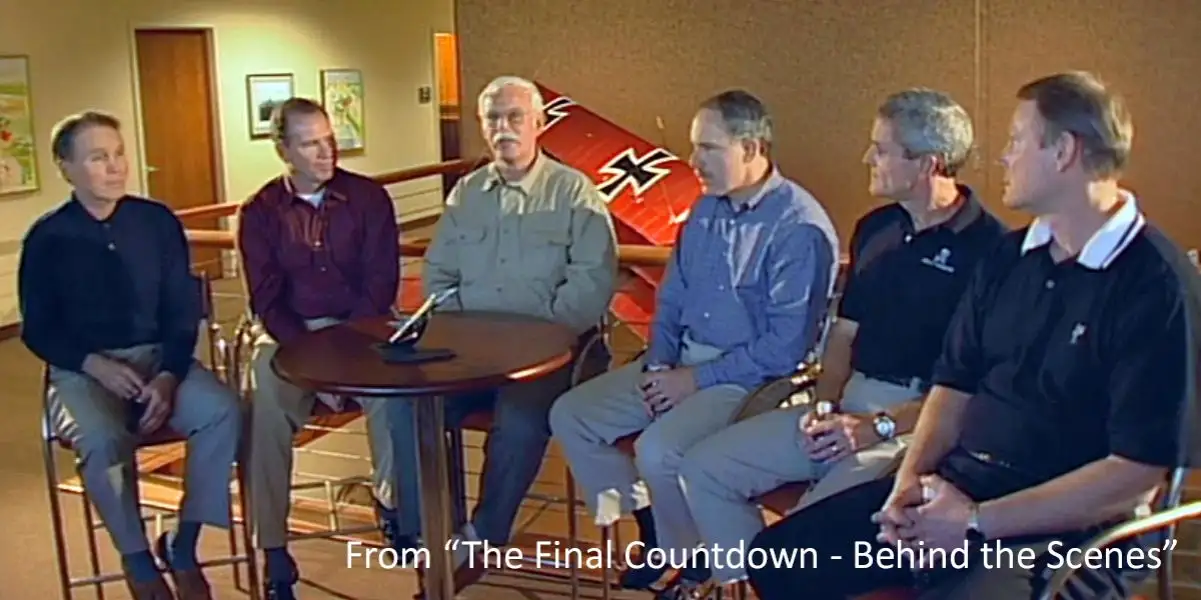
Helicopter camera platform
Before filming began, the aviators and production crew carefully planned and briefed each shot, much as they would prepare for an actual flight.
Using a helicopter as the camera platform, however, made the process far more complicated. Shoes compared every scene to “an attempt to get three pool balls to collide on a pool table at exactly the same time. Try it sometime!”
The difficulties were compounded by the fact that the production was filmed on motion-picture stock, with no video playback available for immediate review. After shooting for an entire day, the exposed film had to be sent away for processing. Filming continued for another day or two before the footage returned, often revealing that little of what had been captured was usable.
“Either the Tomcats and Zeros were awesome, but no helicopter was there to film it. Or the helo was trying to hang on to a formation of Zeros and the Tomcats fell out of the sky trying to slow down to below 200 knots with the wings swept back.” The result was an expensive and frustrating loss of time.
Eventually, the production company secured a modified B-25 from Tallmantz Aviation, equipped with a camera mounted in the tail-gunner position.
“This was a game changer because the bomber was speed compatible with the Zeros and they could comfortably fly in formation with the bomber as one element. We (Tomcats) could fly at 300 knots or more to sweep the wings and finally we only had to get two pool balls to hit on the table at the same time. Infinitely easier!”
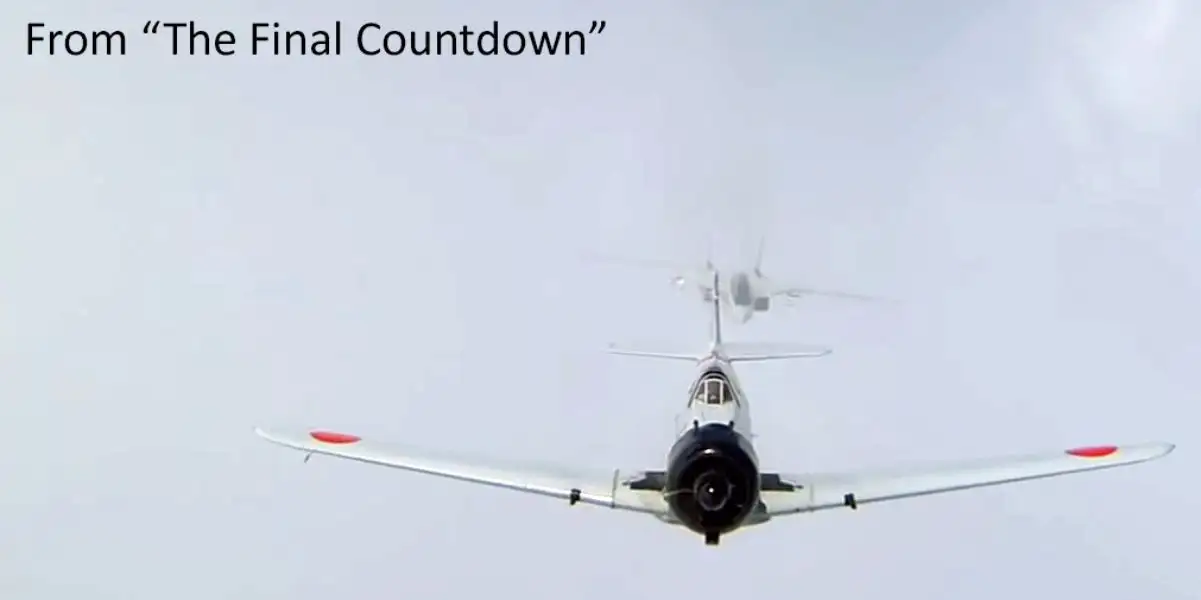
Memorable scenes of the air wing and carrier ops
The finished film featured several memorable sequences showcasing not only the F-14 Tomcat but also carrier operations and the broader air wing. One standout moment shows two alert Tomcats receiving clearance to arm before accelerating down the deck with their wings sweeping aft. Later, after striking the Zeros and forcing them to scatter, the film cuts to a Zero racing just above the cloud tops as a Tomcat emerges ominously behind it.
The Final Countdown premiered on August 1, 1980. Designed as a summer blockbuster, the film received what could best be described as a lukewarm response. According to The Numbers, it earned nearly $57 million worldwide—not a poor result, although much of that revenue came from international screenings.
Today, several movie websites describe The Final Countdown with words such as interesting, entertaining, thought-provoking, and fun. The film is undoubtedly most cherished by Tomcat enthusiasts, who never seem to tire of watching the powerful fighter in action.
Author Dave “Bio” Baranek was a student for RIO when The Final Countdown came out in August 1980. He went through the Top Gun class in 1982, and LT “Shoes” Mullen was one of his instructors. For more on the F-14 Tomcat and Top Gun, check out Bio’s website, www.topgunbio.com, and his books TOPGUN DAYS, BEFORE TOPGUN DAYS, and Tomcat RIO.


