

Former US Navy submariners recall the thrill of an emergency surface, a periscope that came up inside a cardboard box, and the strict procedures that kept crews alive
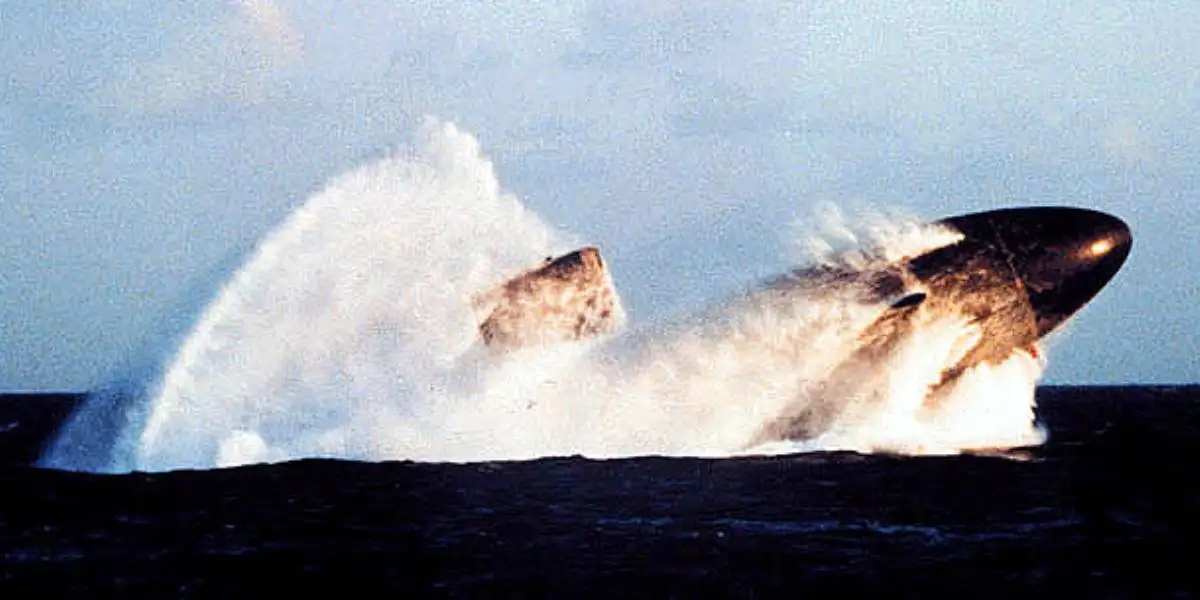
Mention the word “submarine” to anyone, and a host of images spring to mind: the sleek, low black silhouette pier-side, the drama of an emergency blow as the boat broaches the surface in a volcanic eruption of water, and the sinister image of a periscope feathering the surface, hinting at what lurked below.
Serving on a US Navy submarine takes courage, stamina, and deep expertise, quite literally. Here, veterans describe two of the most memorable moments of the job: the explosive ride of an emergency blow and the tense, sometimes comic encounters that happened when a boat came up to periscope depth.
What Is an Emergency Main Ballast Tank Blow?
An emergency main ballast tank blow is a procedure used aboard a submarine that forces high-pressure air into its main ballast tanks. The air pushes ballast water out of the tanks, quickly lightening the ship so it can rise rapidly to the surface.
But what was it like to be inside a submarine during one? Timothy Mauch, a former US Navy submarine sonar Chief Petty Officer, explained on Quora:
“An Emergency Blow is FUN!!! It beats any ride at any amusement park!
“I was a member of the Pre-Commissioning Unit (PCU) of USS Henry M. Jackson (SSBN-730) in 1984. The PCU is the people who will be the first crew when a boat is commissioned. Before commissioning, every ship or boat in the Navy goes through several ‘sea trials’ where EVERYTHING is tested. Of course, that includes the Emergency Blow system.
“This system is designed to allow a damaged submarine to surface when everything else is broken (a submarine surfaces by blowing all of the water out of the Main Ballast Tanks (MBT), giving it a lot of positive buoyancy).”
Totally Pneumatic
“The system is totally pneumatic. You don’t need hydraulic power. You don’t need electricity. It doesn’t use any other system on the boat. It’s totally independent. The high-pressure air (several thousand psi) is stored in air banks (rows of air flasks) inside the MBTs. The air goes through huge pipes (several inches in diameter) through pneumatic valves to dump into the tanks. Those valves are pneumatically operated, remotely, by mechanical valves in the Control Room, above the Ballast Control Panel. We call them ‘chicken switches.’ (Submariners have a strange sense of humor).”
He continued:
“When the order to Emergency Surface is given, the Chief Of the Watch (who is responsible for moving ballast around the ship) sounds the emergency surface alarm (ahh-OO-gah! ahh-OO-gah! ahh-OO-gah! just like in the movies) and throws (opens) both valves. Other control stations take the appropriate actions to maintain control during the ascent, the boat takes a large up-angle, and it feels like an express elevator (a 560 FOOT LONG ELEVATOR. Imagine THAT!) When the bow breaks the surface, momentum keeps it going up until there’s enough weight out of the water to bring it crashing back down.”
Being Aboard
“If you watched the movie Hunt For Red October, that was a real 688-class boat (not a model or prop) doing an actual Emergency Blow, just for the movie. Yes, the studio paid the Navy for that. The handles the Chief pulled were the actual ones (not a set).
“Now imagine being aboard. The pipes are at the furthest point in the bow and stern of the pressure hull. In the bow, that’s the Sonar Equipment Space (my working area). That is the place where you feel the most motion and acceleration (like a roller coaster). Also, as the high-pressure air expands while going through the pipes, the pipes get very cold, very quickly (a physical property of expanding gases), and frost forms on the surface of the pipes. (Yes, they’re very cold to the touch. I touched them).”
Mauch concluded:
“Finally, the passage of air through the pipes is EXTREMELY LOUD! If you don’t wear hearing protection, it could damage your ears. Rock concerts are QUIET!
“14 years in the Navy, and I only did it once.
“WHAT A RIDE!!!”
The Eye of the Submarine
If the emergency blow was the submarine’s most dramatic moment, the periscope was its most watchful. It became the eye of the submarine, invented and developed solely to provide a means of viewing the surface without fear of detection by surface craft.
When Submarines Came Up Under the Unexpected
Over the decades, submarines coming to periscope depth occasionally hit objects on the surface, though such incidents were rare and typically harmless, at least for the submarine.
The Fishing Boat Incident, Philippines (Mid-1980s)
James Mowrey, a former US Navy nuclear submarine officer, recalled a remarkable encounter in the Philippines in the mid-1980s. He was serving in the Control Room when his friend, the Officer of the Deck (OOD), brought the submarine to periscope depth on a beautiful day. As the scope broke the surface, there was a muffled “bong,” followed by the OOD calling out in alarm and immediately ordering a rudder swing.
The scope had struck a small one-man fishing boat. From his low-power periscope view, the OOD watched the fisherman tumble overboard. The man swam back to his vessel, climbed aboard looking scared and very confused, and sailed off, never knowing what had hit his boat. As Mowrey noted, the fisherman “is still telling the story of ‘something’ hitting his boat, knocking him overboard, but then never appearing.”
The Cardboard Box Incident, Mediterranean (Early 1990s)
John Hartzog, another former US Navy nuclear submarine officer, had an even more unusual encounter on patrol in the central Mediterranean in the early 1990s. His submarine was coming to periscope depth on a calm, sunny summer day to obtain a satellite fix and receive radio traffic.
After the routine preparations and the raising of the periscope, the OOD began scanning the underside of the surface for “shapes and shadows,” a critical safety procedure. Just as the scope was breaking the surface, he yelled “emergency deep,” immediately putting the crew on high alert, since the command implies the submarine is about to collide with something. Sonar had detected nothing, but passive sonar had its limitations, particularly against sailboats running silently without engines or generators.
After reaching a safe depth beneath even the deepest-drafted ships, the crew circled back and tried again. This time they found the culprit: a cardboard box floating upside down. The periscope had come up inside it. As Hartzog reflected, “Not so much a needle in a haystack, more like threading a needle in a haystack.”
Why Raise the Periscope When Diving?
The procedures governing submarine operations grew out of hard-won lessons. David Kirk, a former US Navy submarine officer and Strike Warfare Officer, explained the several reasons the periscope was raised during a dive:
Visual Surveillance. The OOD had to keep scanning the horizon to make sure no enemy aircraft or surface ships detected the boat until it was fully submerged.
Ballast Tank Verification. The OOD had to confirm visually that the main ballast tank (MBT) vents had opened and were venting. If one failed, the tank would not fill properly with water, affecting reserve ballast and damage control capabilities. The OOD announced “Venting Forward,” then reported “Venting Aft” after confirming the aft vents were working.
Deck Status Monitoring. By procedure, the OOD reported when “the decks were awash,” allowing the chief of the boat to close the MBT vents at the right moment.
Scope Under Notification. When the scope went under, the entire control party had to know, so the Chief of the Watch could lower any remaining masts or antennae. It also let the Diving Officer of the Watch use a larger down angle to reach depth without fear of the propeller breaking the surface.
Why Procedures Matter
Submariners lived and died by written procedures. Officers reviewed them before every operation, and crews treated them as checklists during every evolution. When a casualty occurred, sailors performed immediate actions and then consulted the procedures to audit their response.
This obsession grew from tragedy. Between 1905 and 1935, approximately 20 submarines were sunk and subsequently raised pier-side. Early submarine crews, treating their boats like surface ships, relied on tribal knowledge and the “all-knowing” senior NCOs. Many submarines sank alongside their piers because simple steps were forgotten or overlooked. This history led to the submarine warfare patch, later the submarine warfare pin, developed to identify sailors who faced the added risks of submarine service. The formal program eventually influenced the aviator, special warfare, and even surface warfare communities.
According to Kirk, “If in the middle of doing an evolution you determine the procedure is flawed, you place the ship or the reactor into a safe condition, stop the procedure, go back to the appropriate officers and chiefs to rewrite it, then train on it, and then attempt it again.”
Procedures did not replace common sense or intuition; they enhanced both by ensuring no critical step was overlooked. The duty officers, including the Officer of the Deck and the Engineering Officer of the Watch, served as the final safeguards, making sure procedures were followed, and contradictions did not result in damage or loss of life.
In the underwater realm, where margins for error were nonexistent, procedures were not merely suggestions. They were survival itself.
Photos by Photographer’s Mate 1st Class Kevin H. Tierney / U.S. Navy

