

The Blackbird
The SR-71 was the most advanced aircraft in the Blackbird family, which also included the A-12 and YF-12. A Lockheed team led by Clarence “Kelly” Johnson, then vice president of the company’s Advanced Development Projects division—better known as the “Skunk Works,” now part of Lockheed Martin—designed the spy plane. The Blackbird made its first flight on December 22, 1964.
Its extraordinary speed allowed it to collect intelligence within seconds as it raced over hostile territory. At an altitude of 80,000 feet, it could survey 100,000 square miles of Earth’s surface in an hour.
The SR-71’s advanced engineering was so demanding that even the tools needed to build it had to be designed from scratch.
SR-71 low on gas
Colonel Richard “Butch” Sheffield, an SR-71 Blackbird Reconnaissance Systems Officer (RSO), describes in his forthcoming book, Ohio to Supersonic: Flying the SR-71 Blackbird to the Secret World of the Skunk Works, how crew members’ pressure suits began to warm as the aircraft ran low on fuel. Taking on fresh fuel had the opposite effect, cooling them down. Aboard the SR-71, fuel also served as a heat sink.
The SR-71’s systems were highly complex but ingeniously engineered, requiring designers to find a way to manage the extreme heat produced during high-speed flight.
Aviation and turbine-engine expert Iain McClatchie explains on Quora that flying above Mach 3 presents a major thermal challenge: everything becomes too hot, even the air slowed down as it interacts with the aircraft. The plane and its pilots must withstand hours in conditions comparable to a pizza oven, with two 500-million-BTU-per-hour “flamethrowers” nearby.
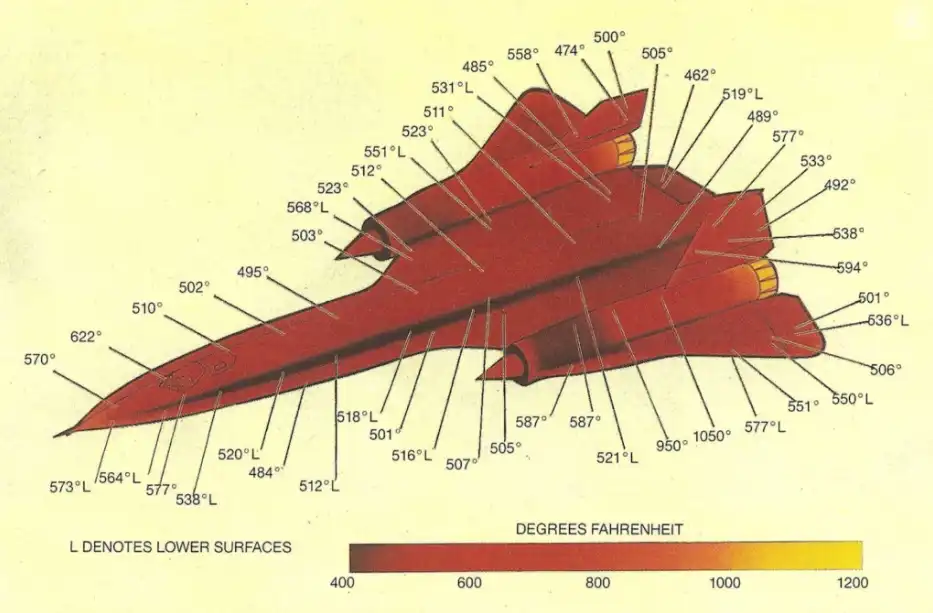
At first glance, the graph might suggest that the aircraft, glowing with heat, is cutting through the frigid air at −52°C and 80,000 feet, with the surrounding air cooling it. McClatchie explains that this is not the case: air must accelerate to the aircraft’s speed before it can contact the vehicle, and that process generates heat. At Mach 3.2, the air’s stagnation temperature reaches 740°F—hotter than every labeled point on the graph. The nacelles surrounding the afterburners, though not shown, are even hotter than the surrounding air.
Fuel used as a heat sink
McClatchie acknowledged that the idea might seem unbelievable but encouraged readers to consult the graph and judge for themselves.

McClatchie explains that the shock waves produced by the aircraft heat the surrounding air, while the aircraft itself cools the air touching its surface. After the SR-71 passes, the disturbed air slows and settles, leaving a trail of heated air high in the atmosphere.
He says the aircraft managed the extreme heat by allowing most of its structure to run hot and building it from materials such as titanium and stainless steel, which remain strong at high temperatures. It also carried a large supply of cold fuel, which absorbed heat from critical areas before being burned. When the SR-71 separated from a tanker, fuel made up half its weight.
A special kerosene, JP-7, was developed to serve as a heat sink. Its boiling point was 285°C at atmospheric pressure, near the upper end of the kerosene range. After refueling at 30,000 feet, the fuel could be below 0°C. As it flowed through the aircraft, it cooled the avionics and cockpit, reaching about 177°C by the time it arrived at the engine.
The heated JP-7 then powered hydraulic systems for engine actuators, particularly the variable-geometry nozzle. By the time it reached the fuel injectors, it had warmed to 316°C, yet remained liquid because it was under several atmospheres of pressure. During cruise, the burner cans operated at 330 kPa—about 3.3 times sea-level pressure—so the fuel did not boil as it left the nozzles, though its droplets evaporated very quickly.
A mix of hydrocarbons centered around C₁₂H₂₆
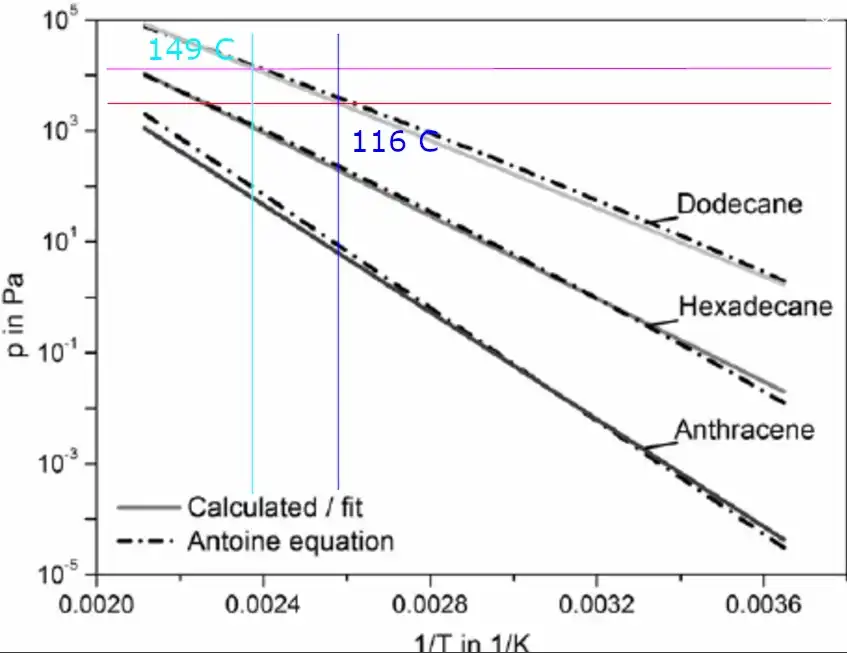
McClatchie continues by explaining that JP-7 consists mainly of hydrocarbons, particularly dodecane (C₁₂H₂₆). The graph plots dodecane’s vapor pressure against reciprocal absolute temperature, which can make it difficult to interpret. For example, a value of 0.0024 corresponds to 417 K, or 143°C. A liquid boils when its vapor pressure exceeds the surrounding pressure. McClatchie marks dodecane’s boiling points at 2,900 Pa—the absolute pressure at 80,000 feet—and 13,000 Pa, the minimum absolute pressure inside the SR-71’s fuel tanks. He notes that the dodecane in JP-7 begins boiling at 162°C at sea level, well below the often-cited 285°C, which is the temperature at which the fuel evaporates completely.
He also points out that JP-7 has a flash point of 60°C and was stored in tanks formed by the aircraft’s outer skin. During cruise, fuel vapor near the upper skin could become much hotter than that. If air entered the tanks, an ignition source could trigger a deflagration and destroy the aircraft. To prevent this, nitrogen from a 260-liter liquid-nitrogen dewar pressurized the tanks. This was particularly important during descent, when rising ambient pressure meant additional gas was needed to fill the empty space in the tanks.
Tolerable tank temperature
McClatchie explains that nitrogen pressurization alone could not prevent the fuel from heating inside the tanks. The aircraft’s lower surface warmed the fuel much like a stove heats water in a pot, although the fuel—more than a meter deep—took longer to reach a simmer. At cruise altitude, the fuel would begin simmering at 116°C under ambient pressure. Raising the tank pressure by 10 kPa above ambient increased the allowable temperature by 33°C. This temperature limit restricted how long the SR-71 could remain at cruise before fuel began boiling away.
Once the fuel entered the system, pumps raised its pressure enough to prevent boiling. The amount of heat the fuel could absorb was instead limited by its coking temperature—the point at which it starts leaving varnish-like deposits inside the fuel lines and other plumbing. McClatchie does not give a specific figure for JP-7, but notes that it must exceed 316°C. He also describes an experimental hydrocarbon blend, JP-900, designed to resist coking up to 482°C. It was developed for a faster aircraft that was never built.
SR-71 looking for a tanker, not because it was low on gas
McClatchie notes that engineers could not reproduce the aircraft’s actual behavior in wind-tunnel tests. Kelly Johnson suggested that, during cruise, fuel flowing against the fuselage’s lower skin and the inner wing kept those areas cooler than the upper surfaces. The uneven heating caused the airframe to bend as it expanded at different rates. This may have given the wings a slight anhedral angle and made the aircraft unstable in roll.
McClatchie adds that fuel heating inside the tanks created another challenge. Because the engines could accept fuel at a maximum temperature of 177°C, warmer tank fuel had less capacity to absorb heat before reaching the engines. Flight crews have reported descending to seek a tanker not because they were short on fuel, but because the fuel had become too hot.
He concludes that using fuel as a heat sink is common in high-speed aircraft. The Concorde and the F-15, F-16, F-18, F-22, and F-35 all use the technique, as likely do other supersonic aircraft.
Check out Born into the Wild Blue Yonder Facebook page for further Blackbird photos and stories.
Photos by Unknown, NASA, U.S. Air Force, and Lockheed Martin


