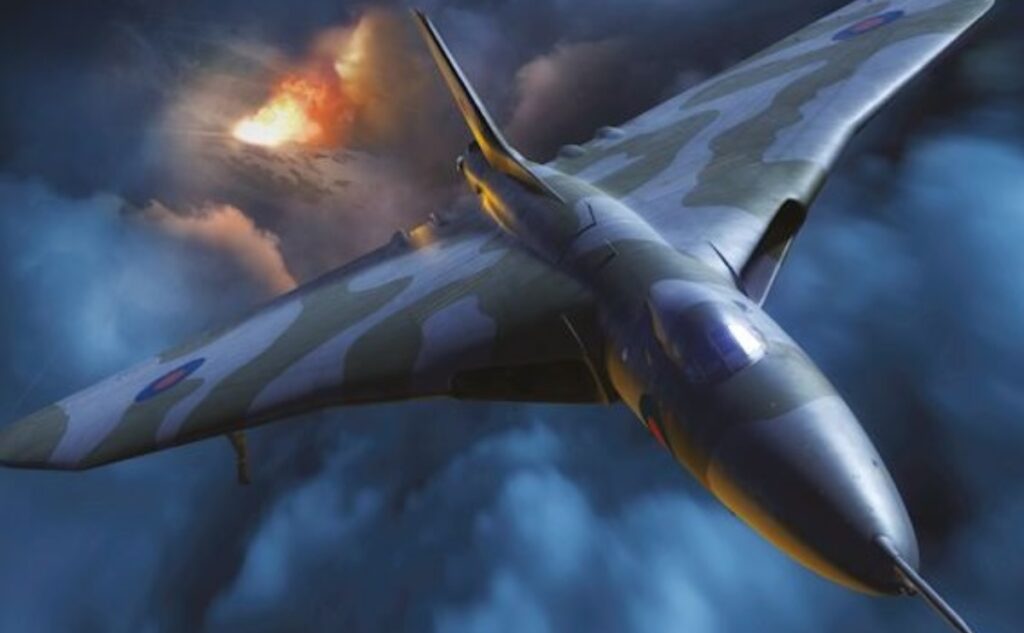
The idea was simple: to destroy the runway at Port Stanley and prevent Argentine fast jets from using it against the Royal Navy task force
The RAF’s first strikes of the Falklands War rank among the most extraordinary air operations in military history. The objective was straightforward: destroy the runway at Port Stanley and deny Argentine fast jets the opportunity to use it against the Royal Navy task force.
According to Andrew D. Bird’s book Operation Black Buck 1982: The Vulcans’ Extraordinary Falklands War Raids, Flight Lieutenant Martin Withers took the lead on the outbound leg of Black Buck 1 during the night of Apr. 30/May 1, 1982, becoming the first pilot to take an Avro Vulcan B.2 bomber into combat. Squadron Leader Bob Tuxford, flying Victor (White 2), was assigned to refuel the Vulcan (Blue 2). After completing the transfer, he changed roles and continued south. Both Withers and Tuxford pushed on to the final fuel bracket, but refueling the Vulcan depleted Tuxford’s own reserves. Withers then continued alone toward the Falklands, making his approach at a low level. He descended to 300 ft before climbing to 1,000 ft for the bombing run, some 40 miles from his primary target, Port Stanley airport.
The approach was tracked by GADA 601 3a Batería Skyguard radar operators positioned on Sapper Hill. The coordinates were entered into the computer system, allowing four Oerlikon 35mm cannons to track the aircraft. However, the command center refused permission to open fire.
To confirm their position, the Vulcan XM607’s H2S Mk 9 radar eventually locked onto Mount Usborne, located 33 miles west of Stanley. With the aircraft correctly aligned, the automated bombing control system was activated. Withers made the final approach at 10,000 ft and an airspeed of 330 knots (610 km/h), while GADA 601 3a Batería Skyguard radar operators continued tracking XM607.
The operators alerted the command center for a second time, but permission to engage was again denied because the aircraft might have been a friendly Hercules C-130 or P-2 Neptune. As the Argentine commanders hesitated, the Vulcan’s DASH-10 electronic countermeasures pod was activated. Four miles from the target, the aircraft’s ECM was masking the Argentine air defense systems.
At a range of two miles and an angle of 35°, the automated bombing system released 21 bombs in quick succession. Withers then banked the Vulcan 60 degrees to the left, subjecting the crew to 2 g (20 m/s²)—twice the normal force of gravity—as they turned away from the target.
Flying at 440 mph, XM607 was three miles from the airfield when the first bomb detonated. The blasts tore into the concrete runway, while the remaining 20 bombs struck near troops sheltering beneath canvas. Their wooden barricades offered no protection against the shock waves, and several people were killed.
Outside Stanley harbour, the Río Carcarañá was waiting to enter when the explosions reached the vessel. Carrying the equipment and transport vehicles of GADA 101’s Batería B, the ship swung violently like a pendulum before its crew managed to bring it under control. It was then quickly relocated to San Carlos for unloading.
Withers turned almost due north toward a prearranged rendezvous with a Victor tanker off the Brazilian coast, near Rio de Janeiro. Under the Rules of Engagement, live fire was prohibited within a designated radius of the British task force as RAF Vulcan XM607 passed nearby. At 0746Z, the crew transmitted the code word “superfuse,” confirming that the attack had succeeded. The signal was received by HMS Hermes.
The illustration accompanying this post depicts a Vulcan B.2 flying through clouds after leaving the target, with an explosion visible in the background.
Operation Black Buck 1982: The Vulcans’ extraordinary Falklands War raids is published by Osprey Publishing and is available to order here.
Photo by Adam Tooby via Osprey