

Blackbird
The SR-71, unofficially called the “Blackbird,” was a long-range strategic reconnaissance aircraft capable of speeds exceeding Mach 3. It was developed from the Lockheed A-12 and YF-12A.
The first SR-71 flight took place on Dec. 22, 1964. The first operational aircraft was delivered in January 1966 to the 4200th Strategic Reconnaissance Wing—later redesignated the 9th Strategic Reconnaissance Wing—at Beale Air Force Base, California.
The Blackbird represented a class of aircraft unlike anything that had preceded it. As legendary Skunk Works designer Kelly Johnson recalled in an article published on the Lockheed Martin website, “Everything had to be invented. Everything.”
Emergency Landing
For example, the SR-71 was designed without a boarding ladder. So how did its crews leave the aircraft after making an emergency landing?
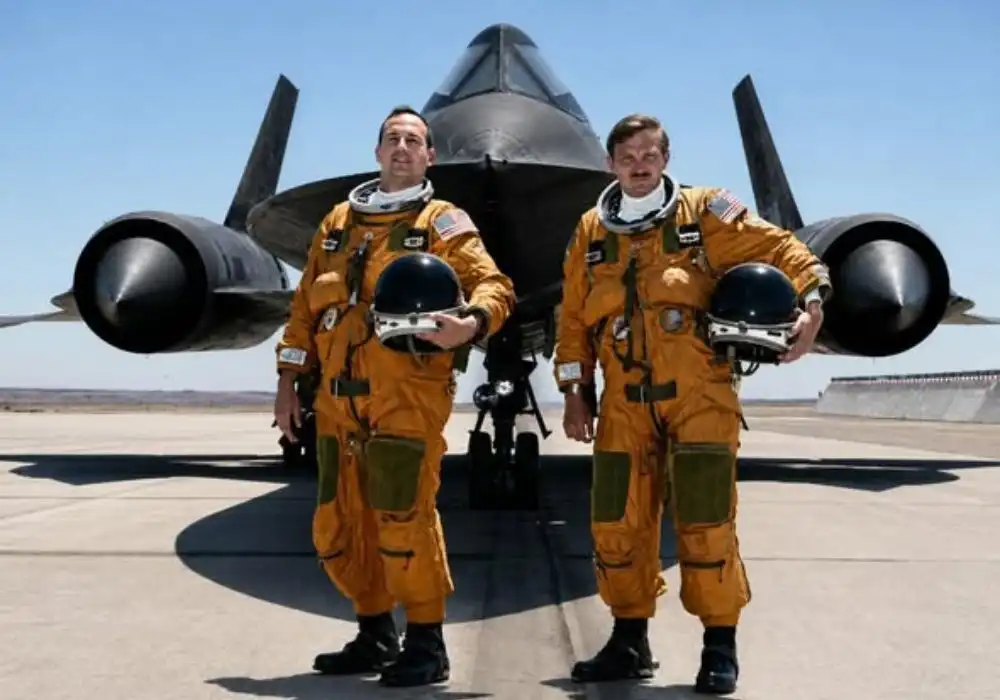
SR-71 pilot Stormy Boudreaux explained that although the Blackbird was designed without a boarding ladder, the crew could still leave the aircraft with a little “gymnastics.”
First, they manually opened the canopy by unlocking it and pushing it upward until it latched in the open position. After unstrapping and removing their spurs, they climbed over the side, slid down the chine, hung briefly from its edge, and dropped the short distance to the ground.
In an extreme emergency, such as an aircraft fire, the crew could even eject while the SR-71 was stationary on the ground. However, they had to do so before unstrapping, using either the standard D-ring or the alternate ejection T-handle to initiate the sequence.
SR-71 hanging and jumping down from the chine to get out of the plane
Under normal circumstances, the RSO followed a specific procedure. He opened his canopy, unstrapped, climbed down onto the chine, turned around while seated on its edge, and then lowered himself by his hands before dropping to the ground.
He carried a spare set of landing-gear pins, which he installed before signaling the pilot that it was safe to shut down the engines. Until the pins and wheel chocks were in place, the pilot held the brakes and kept the engines running to prevent the aircraft from moving.
Boudreaux added that personnel responding to an SR-71 landing at an unfamiliar base often had a six- or eight-foot step ladder in their truck. When available, it could be used instead of climbing down and jumping from the chine.
It has always been surprising how difficult it is to exit the aircraft without assistance. The crew would open their canopies and slide down the chines to the edge, then hang briefly before dropping to the ground. Re-entering the cockpit, however, required ladders or movable platforms—such as a B-4 stand—provided by the local base.
The book Ohio to Supersonic: Flying the SR-71 Blackbird to the Secret World of the Skunk Works by Colonel Richard “E.” Butch Sheffield and Linda Marie Sheffield is available to order here.
Check out Born into the Wild Blue Yonder Facebook page for further Blackbird photos and stories.
Photos by Crew photo colorized by Robert D. Hall lll


