

Kill ratio of about 8:1
The XF-86 completed its maiden test flight on October 1, 1947. The first production variant, the F-86A, took to the air in May 1948, and the U.S. Air Force received its first Sabre on August 16 that year. In September 1948, an F-86A established a world speed record by reaching 670.9 miles per hour.
The F-86A, followed by the F-86E and F-86F, served in Korea as the principal adversary of the Soviet-built MiG-15. By the end of the conflict, Sabre pilots had claimed 792 MiG kills, achieving an approximate kill ratio of 8:1.
More than 5,500 F-86 day fighters were produced in the United States and Canada. The Sabre was also operated by the air forces of 20 other countries, including West Germany, Japan, Spain, Great Britain and Australia.
Soviets steal an F-86 Sabre
As John Fredrickson recounts in North American Aviation In the Jet Age, The California Years 1945-1997, Ralph Wetterhahn published a fascinating account in the Spring 2007 issue of the North American Aviation Association Review bulletin (NAAR Bulletin, pp. 10-12). It was widely understood that many MiG-15s flown during the Korean War were piloted by Soviet personnel, but the full extent of that involvement remained concealed until the collapse of the Soviet Union.
Following his wartime face-to-face meetings with Soviet leader Joseph Stalin, Gen. “Hap” Arnold believed Stalin was better informed about American airpower, and more perceptive, than some of Arnold’s own generals.
Stalin was deeply impressed by the F-86 Sabre’s performance and ordered that one be captured. After months of failed attempts, an opportunity finally emerged on October 6, 1951.
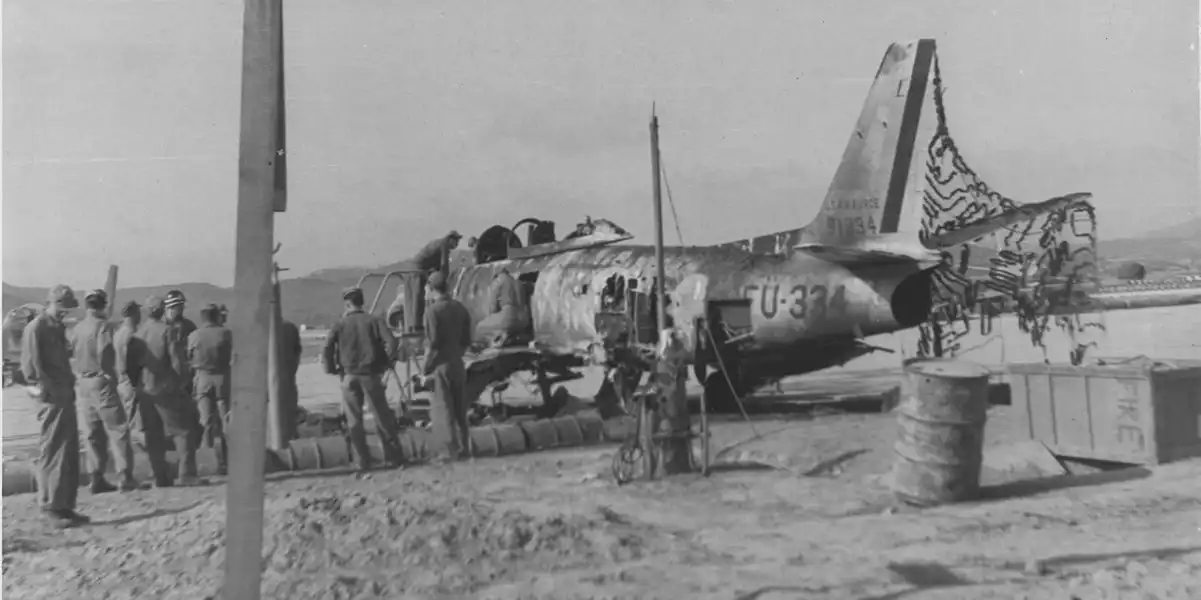
The F-86A flown by 2Lt. Bill N. Garret was struck by MiG-15 fire in the engine and around the ejection seat. Garret turned toward the Yellow Sea in an attempt to ditch the aircraft, but a second MiG-15, flown by Capt. Konstantin Sheberstov of the Soviet Air Force, attacked him. Forced down on a mudflat, Garret was rescued by an SA-16 amphibious aircraft, while enemy troops took possession of the Sabre.
American aircraft then attacked the disabled fighter from above in an effort to destroy it, but the rising tide soon concealed the aircraft. The Soviets recruited 500 Chinese workers to recover the stranded Sabre. Working the following day beneath cloud cover, the salvage team removed the wings and loaded the aircraft’s sections onto trucks. The convoy moved at night and concealed itself in tunnels during daylight hours.
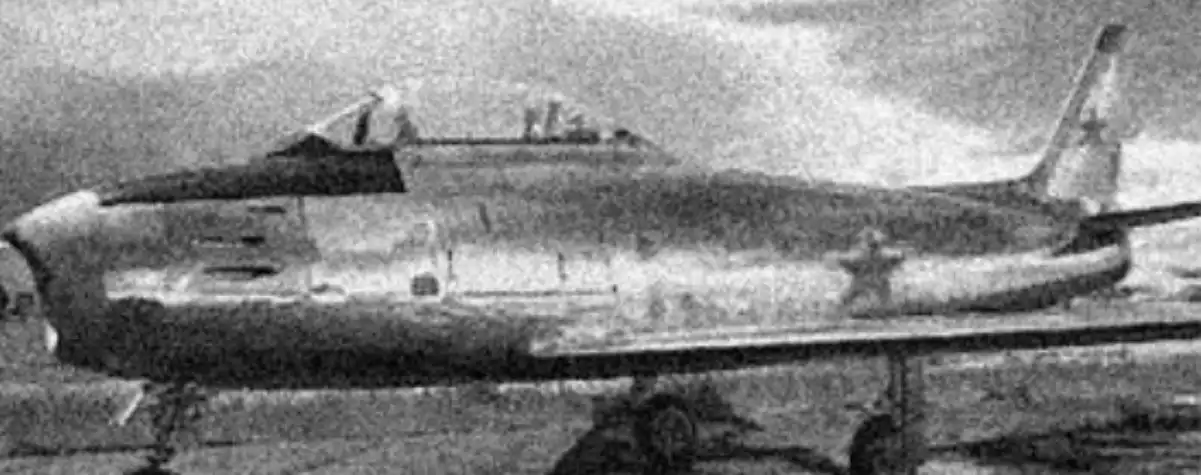
The captured Sabre, serial number 49-1319, reached the Air Force Research Flight Test Institute at Zhukovsky, approximately 22 miles southeast of Moscow, in October 1951.
Warning system to counter the Sabre gunsight
The MiG-15 was equipped with a manual gunsight system developed in 1939, but Soviet engineers were particularly interested in the F-86’s more advanced technology. The Sperry APG-30 radar gunsight had an effective range of approximately 3,000 feet and could determine the distance to a target while calculating the necessary lead, even when the enemy aircraft was maneuvering.
To counter the American system, the Soviets developed a warning device. A sensor resembling a police radar detector was installed in the tail of each MiG-15 and connected to the pilot’s headset. When it detected the F-86’s radar, it emitted an alert tone, warning the communist pilot of the threat. The system was inexpensive, uncomplicated and generally effective.
Stalin reportedly considered producing a copy of the F-86, but his approaching death, along with the Soviet Air Force’s belief that the forthcoming MiG-17 would surpass both the MiG-15 and the Sabre, brought the idea to an end. At the same time, a steady stream of components recovered from other Allied aircraft crash sites in Korea continued to reach the Moscow suburbs for technical analysis.
North American Aviation In the Jet Age, The California Years 1945-1997 is published by Schiffer Publishing and is available to order here.
Photos by U.S. Air Force, Joec03 via Wikipedia and unknown

