

At first, this kind of mission was performed by US Navy A-1s, but by mid-August 1965, the 1st ACS sent a flight of A-1Es to Udorn RTAFB, Thailand, to cover F-105 air strikes into high-threat areas
The A-1 Skyraider was originally developed as a carrier-based torpedo and dive bomber. Designated the XBT2D-1, it made its first flight on March 18, 1945, while deliveries of the AD-1 to the U.S. Navy began in November 1946. In 1962, the aircraft was redesignated as the A-1.
The Skyraider was the Navy’s first single-seat torpedo and dive bomber. Its outstanding performance in both Korea and Vietnam led officials to consider reviving production in 1966, nearly a decade after manufacturing had ended in 1957.
The aircraft’s most notable contribution during the Vietnam War was its role in search-and-rescue operations. Early in the conflict, it became clear that helicopters operating alone were too vulnerable to carry out combat search-and-rescue missions. Consequently, an SAR task force decided in 1965 that rescue helicopters should operate in pairs, supported by Skyraiders providing armed escort.
These missions were initially flown by U.S. Navy A-1s. However, by mid-August 1965, the 1st Air Commando Squadron (ACS) had deployed a flight of A-1Es to Udorn Royal Thai Air Force Base in Thailand to cover F-105 strikes against heavily defended targets. This deployment marked the beginning of the U.S. Air Force’s advanced combat search-and-rescue program.
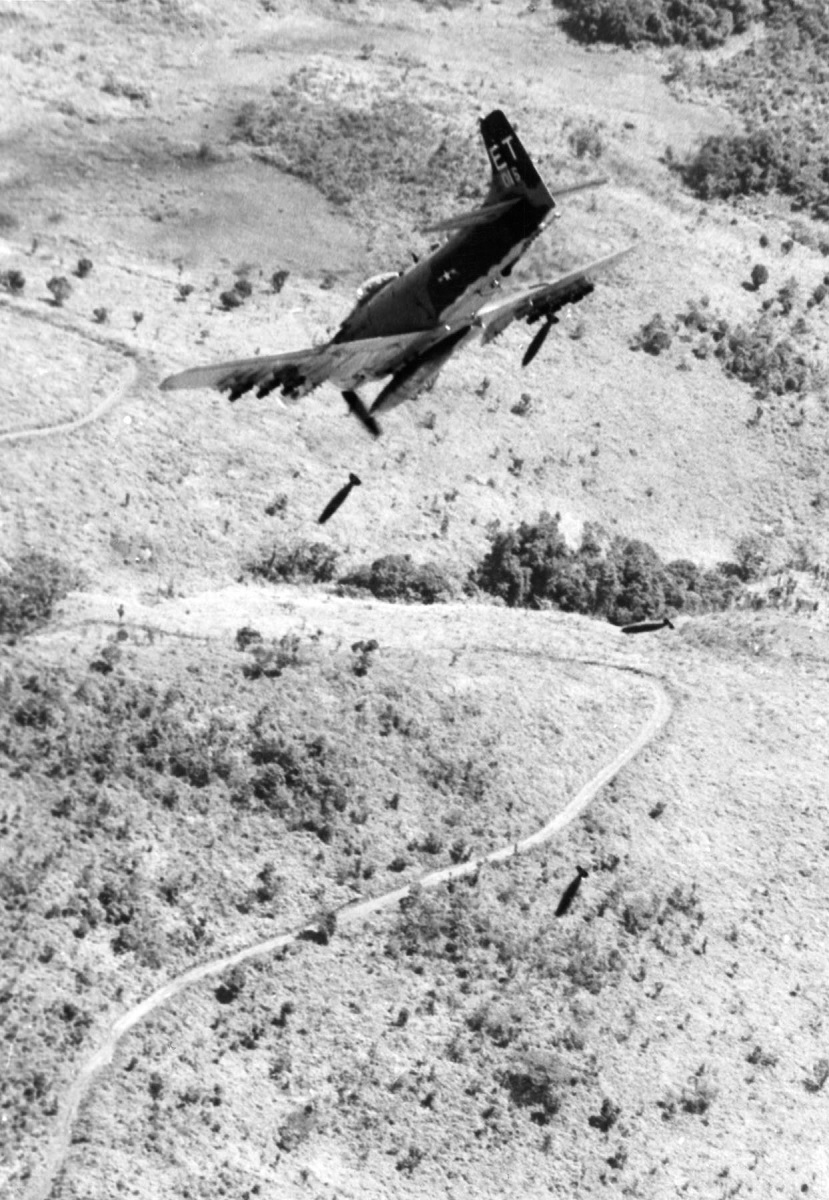
According to Wayne Mutza’s book The A-1 Skyraider in Vietnam, the well-known “Sandy” callsign originated in late 1965 with Capt. J.W. “Doc” George. While flying an A-1 replacement aircraft to one of the Skyraider units rotating through Udorn, George used “Sandy”—his departure callsign from Bien Hoa. After landing at Udorn, he was asked which callsign he wanted to use there, and he chose “Sandy.” The name was later adopted by George’s replacement and eventually became the standard callsign for Skyraiders assigned to search-and-rescue duties.
Glen Mackey, then an A-1 pilot with the 1st Air Commando Squadron, described the early days of the Sandy operation to Mutza. On September 20, 1965, Mackey flew a SAR mission with Maj. Lou Gang, who commanded a flight of Skyraiders from the 602nd Fighter Squadron (Commando). Their mission was to rescue the pilot of a downed F-105. Mackey recalled that they reached the area during the afternoon in favorable weather, guided by three F-105s circling at approximately 12,000 feet. At the time, the Air Force’s rescue capability consisted primarily of HH-43 “Huskies” based at Nakhon Phanom Royal Thai Air Force Base. The crew was told that two helicopters were en route. They quickly detected the survivor’s radio beacon and began circling above the wooded, hilly terrain. The HH-43s arrived soon afterward.
Mackey and Gang continued circling while homing in on the survivor’s radio signal. As Mackey recalled, the survivors spotted the helicopter and released red smoke, prompting the HH-43 to hover and lower its rescue sling. Just as the operation appeared to be proceeding smoothly, the helicopter was hit and crashed almost on top of the survivor. Until that moment, the crews had seen no ground fire, and the incident unfolded so quickly that Mackey did not actually witness the crash. The second Husky was then called in, but it came under fire as soon as it arrived. Shortly afterward, its crew aborted the mission after reporting that one member had been wounded and that fuel was leaking inside the cabin.

Mackey and Gang summoned all available fighter aircraft and began directing strikes around the crash site, hoping to give the downed aircrews an opportunity to escape. They remained overhead for roughly two hours, until darkness, attempting to maximize the survivors’ chances of evading capture. One of the helicopter crew members nearly reached the Thai border before being captured. When the A-1s returned to Udorn, the crews counted approximately a dozen bullet holes in their aircraft. The day’s outcome was grim: one F-105 and one HH-43 were destroyed, another HH-43 and two A-1Es were damaged, and no rescues were completed. Mackey later reflected, “This is going to be a very interesting month.”
Later that month, Mackey’s flight successfully supported the rescue of an F-105 pilot who had been shot down near Dien Bien Phu. However, two other missions—to locate an F-105 crew and an F-4C—ended unsuccessfully. During the F-105 search, Capt. Doyle Ruff’s aircraft was heavily damaged by a large-caliber gun near Route 6, west of Hanoi, while the crews operated in poor weather. The A-1 sustained more than 150 holes, including one in the right wing large enough for someone to climb through, yet Ruff managed to return safely to Udorn. Despite the damage, the entire crew survived.
The footage below—which includes one of the striking aerial sequences from the film Flight of the Intruder—offers a glimpse of what a Sandy sortie was like.
The A-1 Skyraider in Vietnam is published by Schiffer Publishing and is available to order here.
Photo by U.S. Air Force

