

Sabreliner
The T-39 Sabreliner was an American business jet developed by North American Aviation and operated by the U.S. Air Force, Navy, and Marine Corps. Its name reflected the aircraft’s design similarities to the F-86 Sabre. Produced between 1959 and 1982, the Sabreliner served widely as an executive transport, training aircraft, and cargo carrier. Approximately 800 were built, with more than 200 delivered to the U.S. military and the remainder sold for civilian use. The aircraft required a two-person flight crew and could accommodate up to seven passengers.
89th Airlift Wing
The 89th Airlift Wing (89th AW) operated T-39 Sabreliner jets as one of 17 active-duty Air Force wings assigned to Air Mobility Command (AMC). Based at Joint Base Andrews, Maryland, the wing provides global Special Air Mission airlift, logistics, aerial-port support, and communications for the president, vice president, cabinet members, combatant commanders, and other senior military and elected officials at the direction of the White House, the Air Force chief of staff, and AMC.
The U.S. Air Force describes the wing’s mission as “Advancing national interests by delivering diplomacy…safe, comfortable, reliable, connected, and protected. ‘Perfection is our standard!’”
This description might lead some to assume that the 89th AW carries out its mission using luxurious business jets…
Ron Wagner, a former T-39A Sabreliner pilot with the 89th Airlift Wing, recalled on Quora: “The Air Force does not have luxury business jets!”
Dignitaries
Ron Wagner recalled that, as a pilot with the 89th Military Airlift Wing at Andrews Air Force Base, he flew the unit’s jets and quickly learned that they were far from luxurious.
Most of the passengers were U.S. government officials. The best-known aircraft associated with these missions was Air Force One, but the wing also operated Air Force Two and Executive One Foxtrot for members of the first family. Under the “SAM” call sign, short for Special Air Missions, the crews also frequently flew in direct support of the White House.
The wing was additionally tasked with transporting foreign dignitaries within the United States. These officials typically arrived at Andrews in their own aircraft but were not permitted to travel domestically in those jets with their regular crews. Their aircraft were therefore parked on the North Ramp while the dignitaries traveled aboard Air Force aircraft. When security was required, the State Department provided protection through a branch that closely mirrored the Secret Service, carrying out the same mission with personnel dedicated to protecting non-U.S. VIPs.
The Saudi prince with a roll of $1,000 bills to buy F-15s
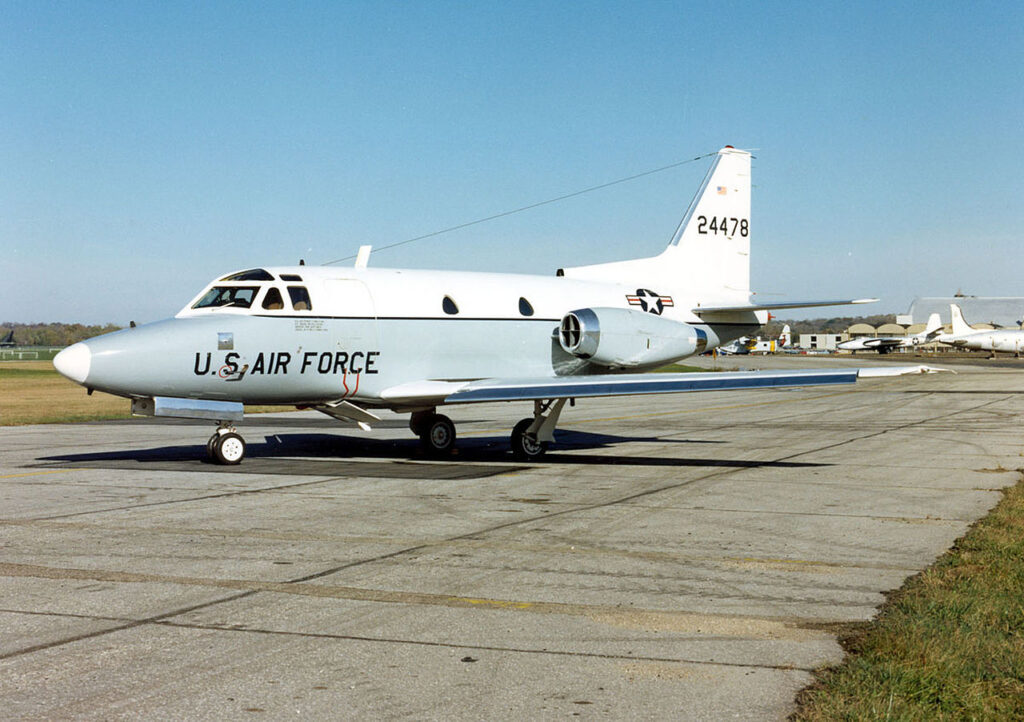
Ron Wagner first realized how little luxury the T-39A Sabreliners offered when he transported a Saudi prince and his entourage from Andrews Air Force Base to Nellis Air Force Base near Las Vegas. Saudi Arabia was considering the purchase of F-15s, and the delegation was scheduled to attend a special demonstration of the aircraft.
As the prince boarded, Wagner observed from the cockpit as he reached the top of the stairs and reacted with shocked dismay to the aircraft’s interior.
The prince initially refused to board, but a State Department escort explained that his only alternatives were to travel aboard a U.S. Air Force aircraft or fly commercially, since his own aircraft and crew were not permitted to operate domestic flights within the United States. The prince was visibly insulted by the complete lack of luxury aboard the jet.
His expectations became even clearer during a refueling stop halfway to Nevada. Before leaving the aircraft, the prince reached into his robe, pulled out a large roll of $1,000 bills, and began peeling them off while asking how many were needed to pay for the fuel.
Wagner explained that Saudi Arabia would be billed directly for the entire cost, so there was no need for the prince to pay at that time. The roll of money then disappeared back into the folds of the prince’s robe as he went inside to wait.
Still astonished, Wagner asked the State Department representative how much money the prince was carrying. The representative replied that he had 235 one-thousand-dollar bills on him.
The Saudi prince with $1,000 bills
Ron Wagner recalled being nearly overwhelmed by the amount of cash involved. Since the encounter took place around 1977, he noted that the $235,000 carried by the Saudi prince would have been enough to retire on. However, the State Department representative explained that this was merely the prince’s spending money for an initial visit to the casinos and that the larger sum was in the representative’s briefcase.
When Wagner asked how much it contained, the representative replied that it held $10 million. Wagner then asked whether the money was in cash, to which the representative responded that it was.
Wagner later addressed comments questioning whether $1,000 bills were available in 1977. He explained that he had since confirmed that such notes were in circulation and could be obtained by the right individuals. In his view, a Saudi prince visiting the United States to purchase 60 of the world’s most advanced fighter aircraft certainly qualified.
Photos by U.S. Air Force and Rob Schleiffert from Holland via Wikipedia

