

Admiral Stockdale’s performance of duty during eight years as a prisoner of war in North Vietnam earned him the Medal of Honor, and he has the distinction of being one of the most highly decorated officers of the naval service
James Bond Stockdale, U.S. Naval Academy Class of 1947, stands as a model of leadership, inspiration, and naval aviation excellence. His performance during eight years as a prisoner of war in North Vietnam earned him the Medal of Honor, and he is recognized as one of the most highly decorated officers in the history of the U.S. Navy.
He was shot down on Sept. 9, 1965, while flying a VA-163 A-4E Skyhawk, and subsequently became the senior Navy prisoner of war held in Hanoi’s notorious Hỏa Lò prison. During his captivity, Stockdale endured torture on 15 occasions, spending two years in leg irons and four years in solitary confinement. This treatment was a direct consequence of his decision to assume command of the prisoners of war and to organize covert resistance in defiance of his captors’ orders. He received the Medal of Honor for deliberately inflicting a near-fatal injury on himself to demonstrate to the North Vietnamese that he was prepared to die rather than yield to their demands.
Promoted to captain while still in captivity, he was freed on Feb. 12, 1973, and then underwent extensive medical care to address the injuries he had sustained during ejection and subsequent torture. Although these injuries left him permanently disabled with his left knee joint, then–Rear Admiral Stockdale continued his naval service, taking command of Antisubmarine Warfare Wing, Pacific, in January 1974. He later became president of the Naval War College, and concluded his 37-year Navy career as a vice admiral in 1979.
Stockdale recounts his final mission in Carrier Air Group Commanders, written by Robert L. Lawson.

On Sept. 9, 1965, Stockdale climbed into his A-4E to lead an attack on the troublesome and nearly legendary Thanh Hoa railway bridge. However, poor weather conditions made the original plan impossible to execute, so he redirected the different elements of the strike group to search for alternate targets.
“I had neglected to mention to Wynn Foster, XO of VA-163, who found himself on my wing, what exactly our alternate target would be. I remember we loitered offshore listening to VA-163 CO Harry Jenkins’ division comparing notes on their detections of SAM radars, on their just-acquired gear, flying in the soup, down near Vinh. That SAM was the southernmost one yet detected, I believe.
“I knew of a place where we could normally get rid of a bomb load into a worthwhile target without prior arrangements and with surprisingly little flak: a railroad siding four or five miles west of Highway 1, about 15 miles south of Thanh Hoa. The ceiling was low up there, and since Wynn’s and my planes had 500-pound bombs with an option switch for snakeye or steep dive delivery, we went in under the clouds. We proceeded up the coast past our target, then swung west to a nice ‘180’ turning point, and swept in to line up on those beautiful boxcars.
“I didn’t even have my oxygen mask snapped across my face. We were coming in flat, in the trail, right on the deck at about 500+ indicated, I, and undoubtedly Wynn were both totally relaxed. I had pulled this foul-weather snake-eye maneuver in this same train parking area a couple of days before and got no flak.
“Then I heard it!! ‘Boom! Boom! Boom! Boom!’ I knew right where to look—the noise came from two o’clock. And there it was, firing at me point-blank, 200 yards at three o’clock. It was, I think, a 57 mm mobile cannon. I watched it belching fireballs directly at me and, by the time I recognized all this, every red light in my cockpit was on and pulsating: fire! Hydraulics gone! Everything unwinding!
“I had to get that oxygen mask up to give Wynn a Mayday. That took an instant, and by that time the plane was out of control, with me just along for the ride. The stick didn’t work, and I was heading for the deck. The confusion of `g’ forces interrupted my grabs for the curtain, so I went for the alternate handle between my legs. I remember craning my head back to see the chute blossom, and a strange feeling came over me as I watched the chute unravel that `something about that ejection was just not right.’
“I later figured I had ‘sensed’ something awry with my bones; I had forgotten to grab my right wrist with my left hand, and it was hours later before I realized I couldn’t raise my left arm. An instantaneous wind blast flail, of which I was never conscious, had broken bones in my left shoulder and back. But I had a lot more going through my mind than checking bone structure. Even when, seconds later, I touched down right on the main street of a little country town named Tin Gia (just after I floated over highway one), longing for that open ocean I could see less than a mile ahead, I could hear feet pounding down the street. Then I caught them out of the corner of my right eye at three o’clock—the town’s rough necks, sprinting forward, just about to gang tackle this ‘American Air Pirate.’ It was maybe two minutes before the police whistle started to blow. The pummeling and gouging and twisting suddenly stopped, and I was sat up in the street and motioned to disrobe by the pith-helmeted official.
“Eventually, I saw my left leg—broken at the knee and sticking out at a right angle toward nine o’clock. Crippled for life! I knew it in an instant. What a letdown.
“You see, between the time I pulled the ejection handle and came to rest in that main street, I had become a man with a mission. I can’t explain this without unloading a little emotional baggage that was part of my military generation’s legacy in 1965.
“In the aftermath of the Korean War, just over 10 years before, we all had memories of reading about and seeing early television news accounts of U.S. government investigations into the behavior of some American prisoners of war in North Korea and Mainland China. There was a famous series of articles in the ‘New Yorker’ magazine that later became a book entitled In Every War But One!’ The gist of it was that in the prison camps for Americans, it was every man for himself. Since those days, I’ve come to know officers who were prisoners of war there, and I now see much of that reporting as selective and a bum rap. However, there were cases of young soldiers who were confused by the times, scared to death, in cold weather, treating each other like dogs fighting over scraps, throwing each other out in the snow to die, and nobody did anything about it.
“This situation could not go on, and President Eisenhower commissioned the writing of the American Fighting Man’s Code of Conduct to guide future POWs.
“It is written in the form of a personal pledge. Article Four: ‘If I become a prisoner of war, I will keep faith with my fellow prisoners. I will give no information or take part in any action that might be harmful to my comrades. If I am a senior, I will take command. If not, I will obey the lawful orders of those appointed over me and will back them up every way.’ In other words, as of the moment Eisenhower signed the document, American prisoners of war were never to escape the chain of command; the war goes on behind bars.
“As an insider, as CAG aboard Oriskany, I knew the whole setup—that the North Vietnamese already held about 25 prisoners, probably in Hanoi, and that as the only wing commander to survive an ejection, I would be their senior—their commanding officer—and would remain so, very likely, throughout this war that I felt sure would last at least another five years. And here I was starting off crippled and flat on my back.
“All told, the disaster of this business of my being impeded in my duty by being permanently crippled was only a temporary setback from things that were important to me. Being cast in the role of sovereign head of an American expatriate colony that was destined to remain autonomous, out of communication with Washington, for years on end, was very important to me. Months later, I was 42 years old, still on crutches, dragging a leg, at considerably less than my normal weight, with hair down near my shoulders, my body unbathed since before I was catapulted from Oriskany, and with a beard that had not seen a razor since I arrived, when I took command (clandestinely, of course—the North Vietnamese would never acknowledge our rank) of about 50 Americans. That expatriate colony would grow to more than 450—all officers, all pilots or NFOs. I was determined to play well the given part. And all Americans continued to refer to me as ‘CAG’ until after I got home. “I was ‘CAG’ from February 1965, when, on the eve of our departure for WestPac, I took the job at a ceremony on the flight deck of Oriskany alongside at North Island, until February 1973, when I arrived back at North Island after an eight-year absence. CAG—the boss of American flight crews—for eight full years. Can anybody top that?”
Carrier Air Group Commanders is published by Schiffer Publishing and is available to order here.
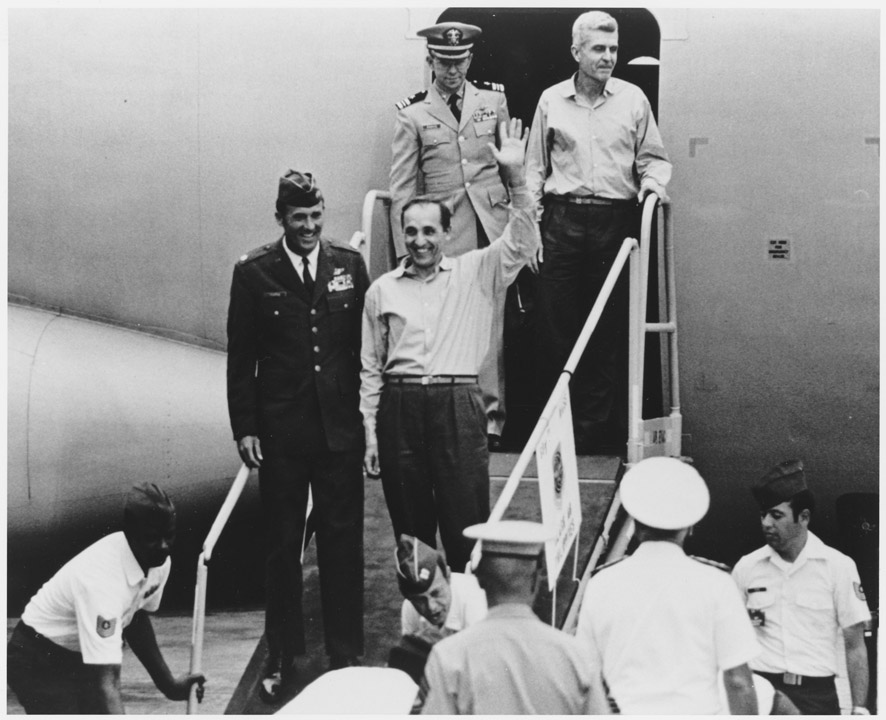
Photo by U.S. Navy

