

The F-102 Delta Dagger
The United States Air Force’s first operational supersonic, all-weather interceptor with Mach 1 capability was the F-102 Delta Dagger. Its signature wasp-waisted delta-wing design, manufactured by General Dynamics’ Convair division in San Diego, California, was inspired by technologies developed by German scientists during World War II.
The F-102, known as “Deuce” by her aircrew, had an internal weapons bay that could hold up to six AIM-4 rockets and infrared or radar-guided missiles.
Over 1,000 F-102s were accepted into the US inventory, and they flew for 20 years before the Mach 2 capable F-106 Delta Dart gradually replaced them.
The F-102’s slowness was by far its greatest flaw. By a narrow margin, the aircraft was indeed supersonic. That was just Mach .95 with external tanks connected.
Deuce limited to less than Mach 1.0
Roger Daisley, former F-102 pilot, recalls on Quora;
‘I was an F-102 pilot for several years. Virtually all of our aircraft were fitted with under-wing aux. fuel tanks. They were limited to less than Mach 1.0.
‘I was also selected to be a “Functional Test Pilot.” What this means is that after an aircraft undergoes certain repairs, it must be test flown to verify airworthiness. One of the test points is supersonic flight. To accomplish this, the aux. fuel tanks are removed.
‘These were always “fun” flights because we could really wring the aircraft out: High roll rates, high G turns, at both high and slow speeds, minimum control speed limits, stability checks at both high and slow speeds… and going supersonic.
‘When “going super” the only indication was the rapid altimeter and vertical speed fluctuation. The “ride” did seem to smooth out. The flight controls were also a little stiffer.’
Daisley concludes;
‘The cockpit noise level never changed because the only real “noise” in the cockpit was that of the air conditioning system … and it didn’t care what speed we were flying.’
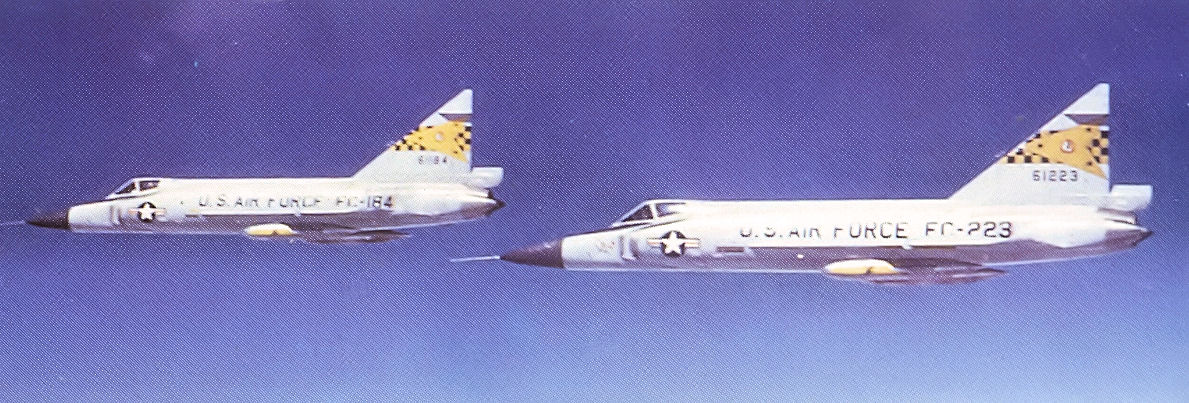
Photo by U.S. Air Force
