
The F-86D Sabre Dog
To counter the growing Soviet threat, the US government and USAF started a massive effort in the late 1940s to establish an effective defense of US airspace. The USAF selected the Northrop F-89 Scorpion as an interim aircraft and the Convair “1954 Interceptor” project as their primary aircraft to support this aim. The Air Force considered two aircraft as alternatives to the Scorpion, according to McChord Air Museum: a modified Lockheed TF-80C, which became the F-94 Starfire, and a heavily modified F-95A (F-86D), an all-weather interceptor version of the F-86A Sabre. This decision was made after numerous delays in the F-89 development program.
On December 22, 1949, the Sabre Dog, designated YF-95, completed its first flight. On July 24, 1950, the designation was modified to YF-86D. The F-86A and the Sabre Dog had only 25% in common externally, but otherwise, the two aircraft were very different from one another. Along with being the first USAF aircraft with an all-missile armament, the F-86D was also the first all-weather interceptor piloted by a single person, handling both the radar and flight controls.
Additionally, the Sabre Dog had an afterburning engine (a General Electric J47-GE-17 turbojet with an electronically controlled fuel scheduling system that relieved the pilot of the tedious task of continuously monitoring engine behavior).
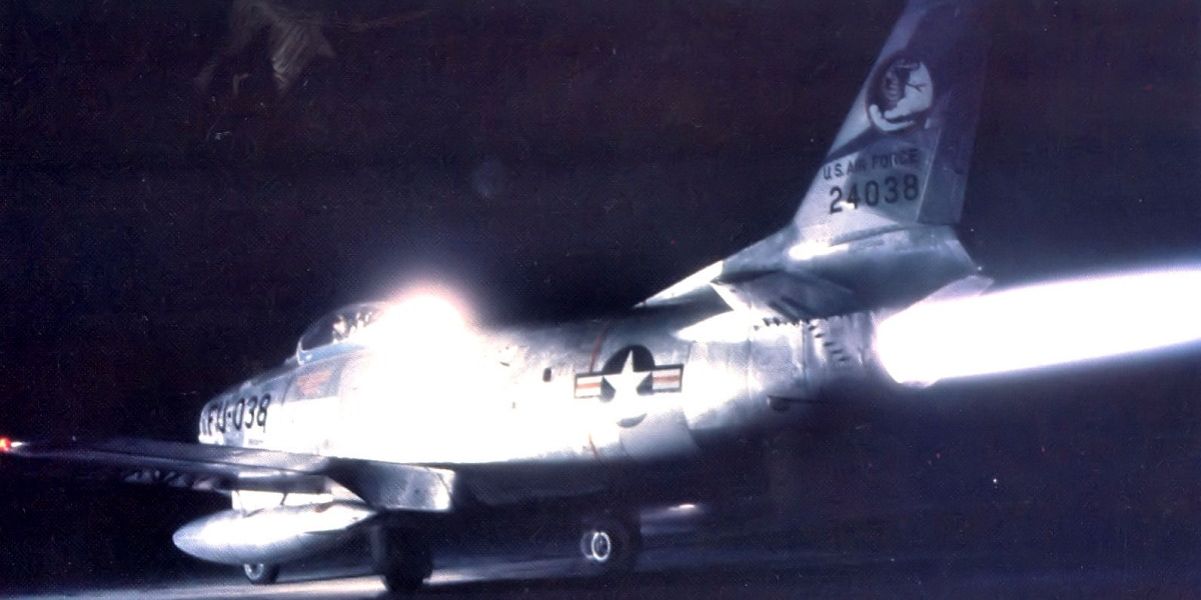
The F-86D that the Afterburner in the Hangar to Take Off during a Scramble
David Ross, former F-86D Sabre Dog fighter pilot in the US Air Force, recalls on Quora.
“In the late fifties, while flying an F-86D, on cross-countries I would land at an intermediate base for fuel. As soon as the fuel truck left I would preflight the plane, start the engine and leave. As for letting the engine ‘warm-up’ there is no need for that.
“To illustrate this our alert hangars had doors front and back and on the floor was an iron ring to tie the aux-power cable to. This design was to enable a faster scramble time.
“One day I told my crew chief to tie the start cable to this ring and get the loose stuff cleared out of the hanger, because if we got a scramble I was going straight to afterburner on start.
“We did get a scramble and I started the engine and went to full throttle and afterburner right in the hangar.
“I was airborne just about the time I got to the runway, everything worked as it was designed to do. There was one problem though, the crew chief said I blew stuff out the back of the hangar, with the afterburner, that people didn’t even know was in the hangar.”
Ross concludes;
“We never tried that kind of scramble again.”
Photo by U.S. Air Force