

Sea Shadow
Drawing on his experience developing the F-117 stealth aircraft, Ben Rich, who then headed Lockheed’s Skunk Works, suggested adapting the technology his team had developed for aircraft to submarines. The goal was to make these vessels effectively invisible to sonar. Early tests with a small-scale model indicated that the approach could reduce detectability by roughly a thousandfold, although the design would limit the vessel’s speed.
The Department of Defense initially showed little interest in the concept. That changed after Rich, working with a colleague, modified the idea for use on surface ships. DARPA subsequently awarded a contract to investigate the application of stealth principles and materials to surface vessels, including how seawater affected radar-absorbing coatings.
At the time, the Soviet RORS satellite, which operated with X-band radar, represented one of the most serious threats to US surface ships. Recognizing that the vessel’s shape would be crucial to evading detection, Rich’s team designed a ship built around sharply angled, 45-degree flat surfaces that closely resembled the F-117 Nighthawk. Led by engineer Ugo Coty, the team tested the design at an ancient lake bed deep in California’s Death Valley. They filled a 100-by-80-foot plastic swimming pool and installed a radar system designed to replicate the Soviet satellite’s equipment. The successful trials secured additional Navy funding for construction of the Sea Shadow prototype.
Four-man crew
Lockheed’s Ocean Division eventually learned about the project and persuaded Rich to transfer it to them, as the division urgently needed new work at the time. Under the arrangement, chief engineer Ugo Coty remained involved to ensure that the shipbuilders did not sacrifice stealth characteristics in pursuit of improved performance.
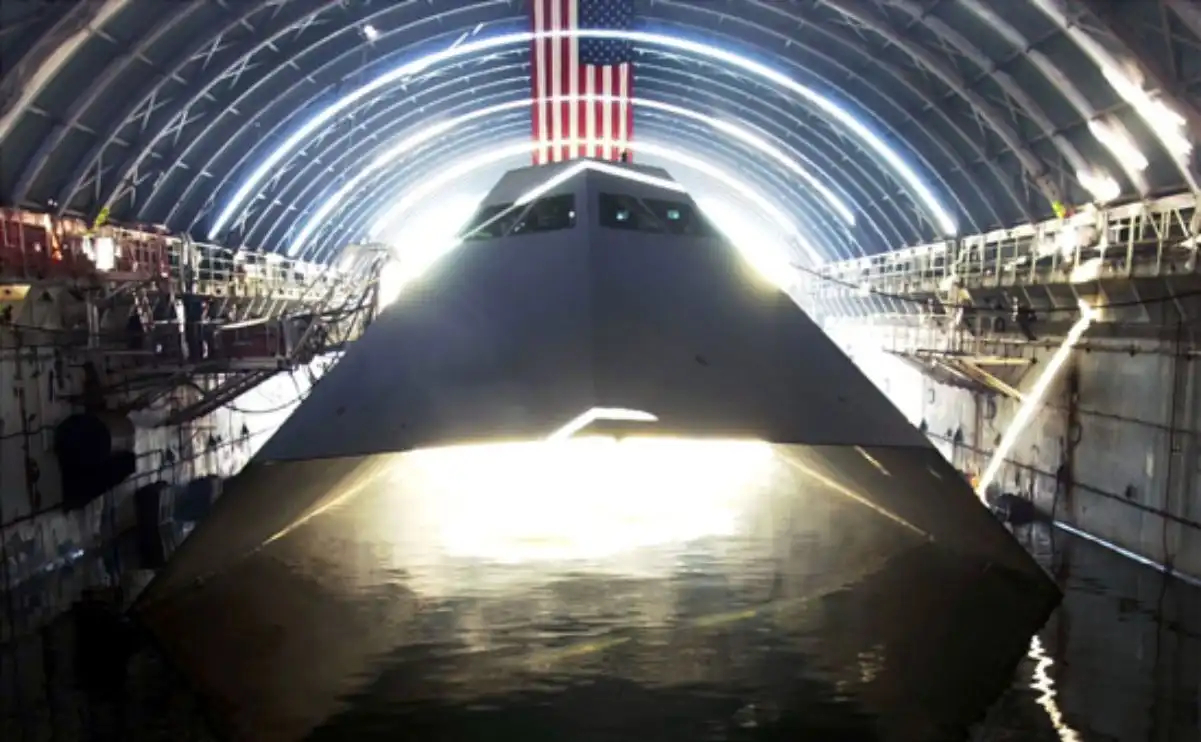
Built under strict secrecy, the Sea Shadow prototype—also known as IX-529—was assembled inside the Hughes Mining Barge 1, a submersible barge concealed in Redwood City, California.
In his book Skunk Works, Ben Rich described the vessel as follows:
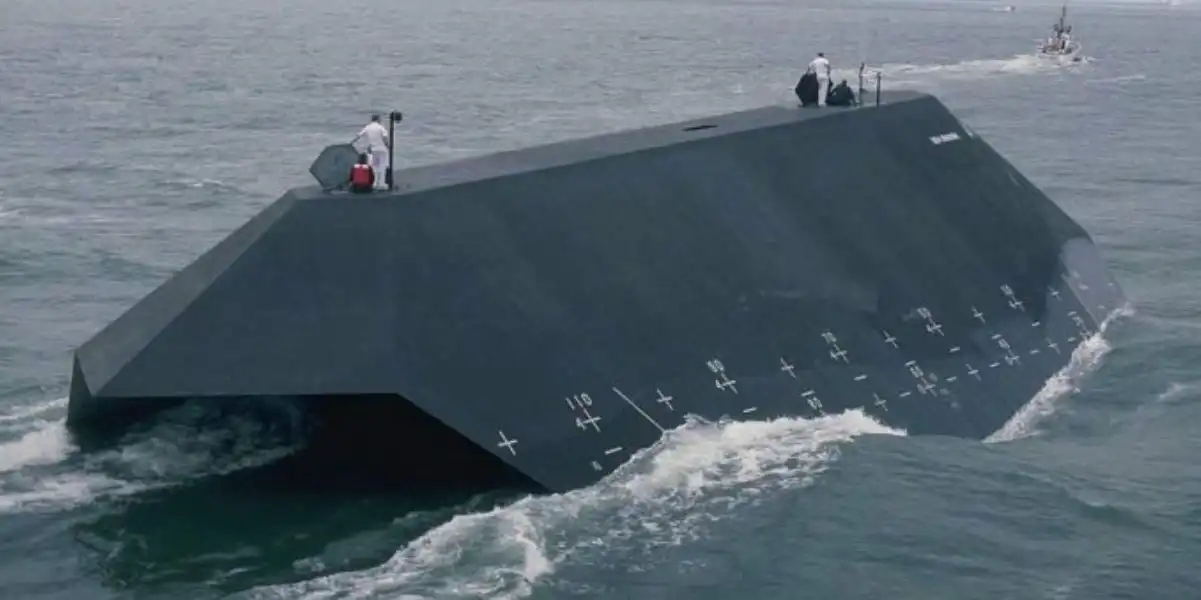
‘The Sea Shadow was made of very strong welded steel, displaced 560 tons, and was 70 feet wide. Our ship had a four-man crew—commander, helmsman, navigator, and engineer.
“By contrast, a frigate doing a similar job had more than three hundred crewmen.”
“Viewed from head-on, the ship looked like Darth Vader’s helmet. Some Navy brass who saw her clenched their teeth in disgust at the sight of the most futuristic ship ever to ply the seas. A future commander resented having only a four-man crew to boss around on a ship that was so secret.”
“Our stealth ship might be able to blast out of the sky a sizable Soviet attack force, but in terms of an officer’s future status and promotion prospects, it was about as glamorous as commanding a tugboat.”
18 Sea Shadow stealth ships protecting the US Navy carrier fleet
“We could arm it with 64 Patriot-type missiles and send it out 300 miles ahead of the carrier task force as an invisible, amphibious SAM missile site. We’d shoot down the Soviet attack aircraft before they got within missile range of the fleet. And because they couldn’t see the stealth ship electronically, they’d literally never know what hit them. We did an analysis and determined that the entire US Navy carrier fleet could be protected by only eighteen of our stealth defenders armed with SAMs. Since our ship would knock out most of the incoming air armada trying to attack our carriers, we would make the Aegis more effective by dramatically decreasing the number of incoming missiles it would be called upon to try to destroy at one time.”
“And we had compelling test data to prove our contentions. To accurately measure the low radar cross-section of a model ship under realistic ocean conditions, Ugo Coty went to one of the most remote areas of the western desert. There, within hailing distance of Death Valley, he built himself a miniature ocean. The place was about two days from Edwards Air Force Base by mule pack or by jeep crawling through deeply rutted roads. It was an ancient lake bed sitting at the foot of an 8,500-foot mountain, on top of which Ugo Coty planned to mount a radar system.”
The miniature ocean
Coty took SR-71 Blackbird RSO Col. Richard “Butch” Sheffield to see the miniature ocean.
In his book Ohio to Supersonic, Sheffield recalled:
“Ugo Coty was a real ‘Skunk.’ This is a compliment to anyone who works in the Skunk Works. Ugo was an engineer who was considered brilliant by many. He worked on about 12 programs at the Skunk Works, and he kept them undercover from almost everybody there.”
“For some reason, he liked me and cleared me into all of his programs.”
“Ugo took me out to someplace north of Edwards Air Force Base and drove us high in the mountains on a narrow one-lane road. I was sitting in the front passenger seat, and when I looked out of the window, all I could see was space. The road was just as wide as the vehicle. The road circled the mountain several times. When we reached the top, a large radar antenna was sitting on top of the mountain. He walked me over to the edge and pointed down at the desert floor; thousands of feet below was an artificial lake with boats floating in it. The boats were about 10 to 20 feet long. Were in all shapes.”
Trials
The Sea Shadow’s initial trials in 1981 were deeply disappointing. Its wake proved far larger than expected, making the vessel detectable by sonar and from the air. Engineers eventually traced the problem to the ship’s propellers, which had been installed backward, allowing the project to continue. The vessel was completed in 1984 and conducted nighttime trials in 1985 and 1986.
Despite these tests, the Sea Shadow never progressed beyond the experimental stage. However, engineers used the lessons learned from the program in later technologies, including submarine periscopes and several newer Navy destroyers, such as the DDG 1000 Zumwalt-class ships.
The Navy showed little enthusiasm for the futuristic vessel, and Ben Rich found working with the service particularly challenging. Kelly Johnson, the legendary founder of Lockheed’s Skunk Works, had 14 written management principles, but his unofficial 15th rule was more direct: “Starve before doing business with the damned Navy.”
The public first saw the stealth ship in 1993. Thirteen years later, in 2006, the Sea Shadow was ultimately dismantled.
Photos by U.S. Navy


