

A new engine support structure was built onto the Spitfire’s fuselage, and the DB 605 engine and cowling panels were added
The Spitfire is widely regarded as Britain’s most famous fighter aircraft. During the summer of 1940, it became an enduring symbol of freedom by helping defeat the German air offensive in the Battle of Britain. At the time, it was the highest-performing aircraft operated by the Allies.
The public first saw the Spitfire prototype at the 1936 RAF Display at Hendon, where it appeared in the New Types Park. However, production aircraft did not begin entering service until August 1938. By the outbreak of war a year later, nine RAF squadrons were equipped with the type. Despite urgent requests from France, the Commander-in-Chief of Fighter Command declined to send Spitfires across the Channel during the German Blitzkrieg of 1940. The value of that decision soon became apparent: by July 1940, Fighter Command had nineteen squadrons operating Spitfire Mk Is.
Supermarine Aviation Works (Vickers) Ltd originally developed the Spitfire as a private venture, driven by the ambition to achieve performance beyond that of the earlier F.7/30 design. This objective, together with efforts to unlock the greater potential of the Rolls-Royce Merlin and Griffon engines, shaped the parallel development of both the aircraft and its powerplants, becoming a central part of the Spitfire’s story.
Did German engineers ever install one of their own engines in a captured Spitfire during World War II?
According to aviation historian Charles McDevitt, they did. Writing on Quora, McDevitt states that the aircraft was tested at Rechlin, where its performance was judged superior to that of the Merlin-powered version.
In November 1942, Spitfire VB EN830, coded NX-X and operated by No. 131 Squadron, was forced to land in a turnip field on German-occupied Jersey. German personnel subsequently repaired the aircraft, fitted it with a DB 605A engine, and carried out several other modifications.
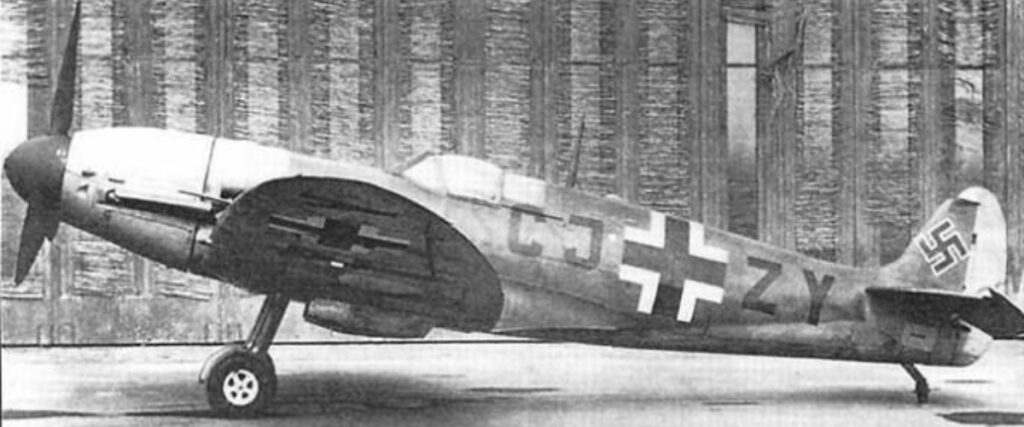
After the Merlin engine was removed, engineers found that the Spitfire’s fuselage cross-section was almost identical to the engine nacelle of a Messerschmitt Bf 110G. This made it possible to construct a new engine mount on the Spitfire’s fuselage and install the DB 605 along with its cowling panels. A propeller assembly and supercharger air intake taken from a Bf 109G completed the conversion.
The aircraft also received German instruments, while its original 12-volt electrical system was replaced with a German 24-volt system. In this configuration, the Daimler-Benz-powered Spitfire began flight testing in early 1944.
The relative ease of adapting the aircraft to an inverted V12 engine was not entirely surprising, given that the first Bf 109 had been powered by a Rolls-Royce Kestrel engine.
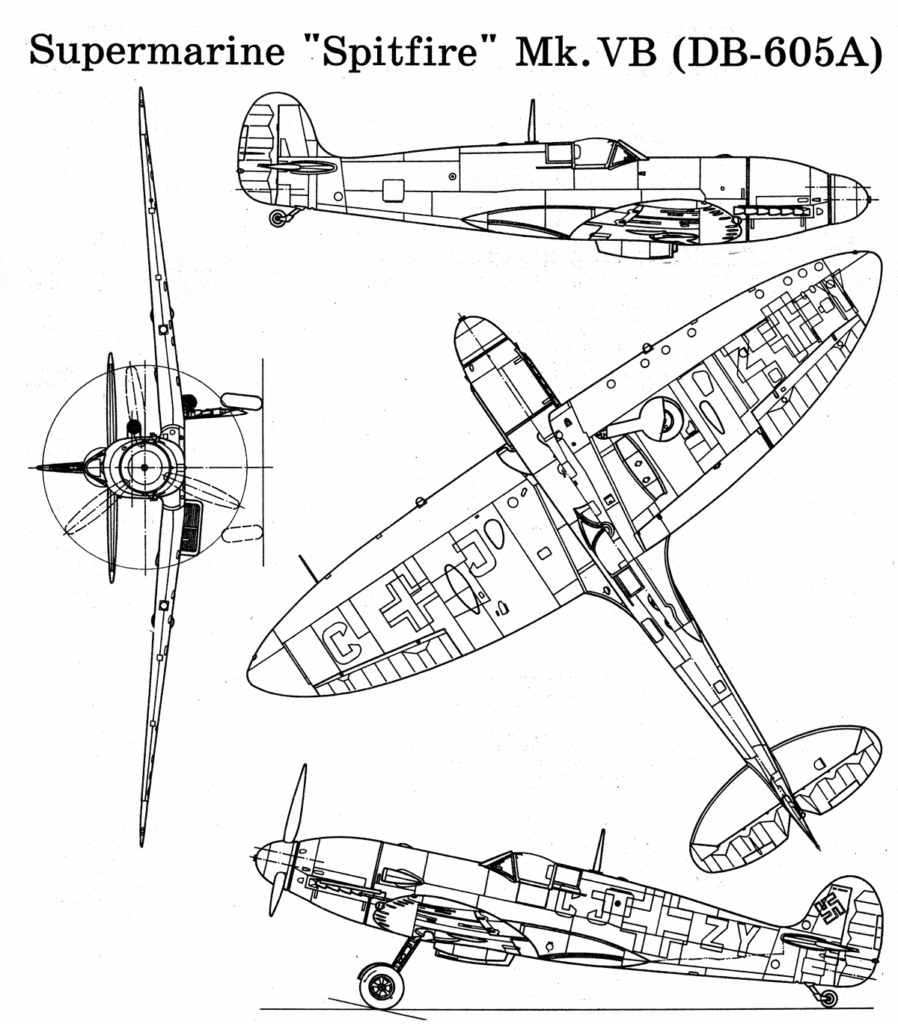
McDevitt concludes that the converted aircraft retained the Spitfire’s refined handling characteristics, making it popular with German pilots accustomed to the more demanding landing behavior of the Bf 109.
Powered by the DB 605, the aircraft delivered outstanding performance and was significantly faster than the Merlin-powered version. However, the comparison was influenced by the removal of all armament, which substantially reduced its weight.
The aircraft continued to fly regularly until it was destroyed during a USAAF bombing raid on 14 August 1944.
Photo by WW2aircraft.net and Philip Basson via Captured Aircraft Facebook Group

