

The final USAF Vietnam MiG kill was ‘a comedy of errors’
The intense air battles fought during the 1972–73 Linebacker offensive over North Vietnam became a defining chapter for the USAF’s F-4 Phantom II crews, who were credited with destroying 48 MiG-19s and MiG-21s.
In the four years since the end of Rolling Thunder, the USAF had done little to modernize the Phantom II’s missiles or refine its tactics. However, the introduction of the gun-armed F-4E gave the aircraft a 20mm cannon, which accounted for seven kills. Additional electronic upgrades, particularly the APX-80 Combat Tree IFF interrogator, also enabled more effective employment of the AIM-7 Sparrow missile.
Early morning MiGCAP in RP III
Nevertheless, when air combat over North Vietnam resumed in early 1972, unreliable missiles and rigid tactics resulted in relatively few MiG victories. In cases where larger numbers of kills were recorded, chiefly by the 432nd TRW, which accounted for 33 of the 48 destroyed MiGs, they often involved multiple missiles being launched at a single aircraft. This reduced the number of aircrews credited with shooting down more than one MiG.
According to Peter E. Davies’ book USAF F-4 Phantom II MiG Killers 1972–73, the final USAF MiG kill of the Vietnam War was achieved by an F-4D crew. The engagement occurred after the Linebacker II onslaught ended on Dec. 29, although F-4 crews remained authorized to engage MiGs threatening US air operations over North Vietnam.
On Jan. 8, 1973, Capt. Paul Howman and 1Lt. Lawrence Kullman were leading the ‘Crafty’ flight on an early-morning MiGCAP mission in Route Package III, approximately 80 miles southwest of Hanoi. Howman had remained in theater after initially arriving on temporary duty with the 8th TFS/49th TFW.
A comedy of errors
Paul Howman described the ensuing MiG engagement as “a comedy of errors”.
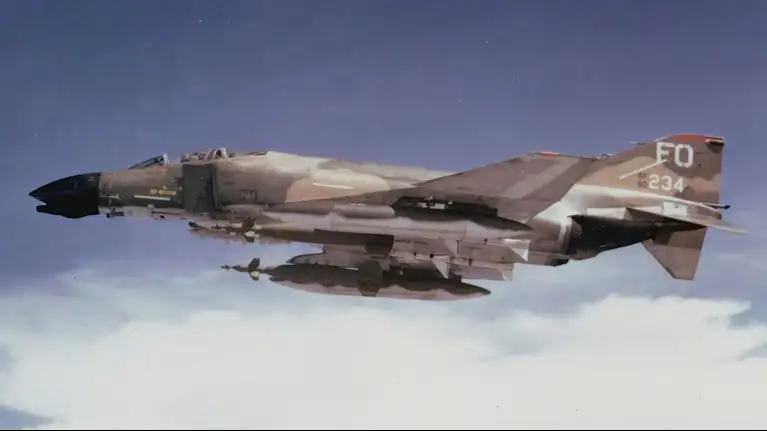
Paul Howman explained that the Stan-Eval personnel had required him to complete a check flight before he could lead missions during the following two weeks. His flight commander had been assigned as his wingman in the two-ship formation but had been forced to abort while taxiing because of an aircraft malfunction. An airborne spare F-4E had also been launched, although its radar was inoperative. Howman therefore joined up with that aircraft after reaching the pre-strike tanker.
That night, three two-ship formations were assigned MiGCAP duties for B-52s attacking SAM sites near Vinh. The wing commander, Col. Scott Smith, led one formation, while the commander of the 555th TFS led another to protect the tankers. Howman’s flight occupied the middle position.
The first MiGCAP
Red Crown detected a MiG-21 approximately 65 miles northeast of the F-4s and directed them toward a point 26 nautical miles from the target.
Paul Howman recalled that, as this was his first MiGCAP mission, he had tried to conserve fuel and extend the flight for as long as possible by “flying the bug” at 26,000 feet. As the situation became more serious, he raised the aircraft’s nose and attempted to jettison the centerline fuel tank. However, the forward bay fairing circuit breaker had been pulled to indicate that no centerline tank was installed, allowing the crew to monitor the forward Sparrow missiles instead. As a result, the tank did not jettison, although Howman was unaware of this at the time.
The F-4 carried three fuel tanks, four AIM-7 Sparrows, and four AIM-9 Sidewinders. Howman then decided to descend to obtain a better upward-looking radar view of the MiG. With an undercast layer at 8,000 feet, he intended to level off at approximately 10,000 feet but nearly descended through the cloud deck.
Red Crown instructed the formation to turn to a heading of 300 degrees. Howman turned only to 330 degrees so they could continue watching the area where the MiG had been detected. Red Crown then corrected their heading to 300 degrees, taking the MiG off their radar scope. At the same time, the wing commander’s flight was vectored east toward the 19th parallel, where it was to execute a double-pincer maneuver with Howman’s formation.
The final USAF Vietnam MiG Kill
When the F-4s turned back toward the MiG, they received indications that it was still in the area, but Lawrence Kullman was unable to locate it. Howman then spotted the MiG’s afterburner, placed it in the center of his windscreen, selected the caged radar-guided lead, and achieved a lock-on. After firing an AIM-7E-2, he remembered that two missiles were normally launched to maximize the probability of a kill, so he fired a second Sparrow.
The launches produced such intense noise and flashes that Kullman initially thought the F-4 had been hit. In fact, both forward missiles struck the centerline fuel tank as they departed, leaving two scratches approximately eight inches long and half an inch deep. Had the tank been punctured and the fuel ignited, the damage could have brought down the aircraft.
The first missile flew straight toward the target, leading Howman to wonder whether it was defective. The second performed the characteristic barrel roll associated with the AIM-7. As the first missile detonated, Howman could make out the delta-wing silhouette of the MiG-21 against its afterburner. The second Sparrow appeared to strike the MiG underneath. After a brief delay, during which Howman again suspected a malfunction, the fighter exploded. Its fuselage broke in two and the right wing separated.
The wing commander then called “Tally ho” over the burning wreckage, which plunged through the 8,000-foot undercast directly in front of an F-111 returning from a strike mission.
Unpredictable mission
Howman then considered the possibility that another MiG might be in the area and turned north toward the direction from which the first aircraft had approached. His radarless wingman made a wider turn while attempting to position himself for a Sidewinder shot. Unsure at first whether the aircraft might actually be a MiG, Howman and his wingman performed several scissors maneuvers.
After returning to the tanker, his wingman told him that the centerline tank was still attached. Howman refueled it because they had another mission to fly, escorting a B-52 leaflet drop. His wingman subsequently returned to base because of aircraft problems, while Howman rendezvoused with an airborne spare at the tanker.
Capt. Howman’s unpredictable mission ended with him approaching the wrong runway. The designated runway had been changed without his knowledge, preventing him from carrying out his original plan to perform an aileron roll before landing.
USAF F-4 Phantom II MiG Killers 1972-73 is published by Osprey Publishing and is available to order here.
Photos by U.S. Air Force

