

U-2 vs. SR-71
Work on a groundbreaking intelligence aircraft was already underway at Lockheed’s advanced development division—the renowned Skunk Works in Burbank—before Gary Powers’ U-2 was shot down. The new aircraft was designed to fly faster and higher than any aircraft before it, while maintaining a small radar cross-section (RCS).
Based on the Lockheed A-12 and YF-12A, the SR-71—unofficially nicknamed the “Blackbird”—made its first flight on December 22, 1964. The first operational SR-71 was delivered in January 1966 to the 4200th Strategic Reconnaissance Wing, later renamed the 9th Strategic Reconnaissance Wing, at Beale Air Force Base in California.
Capable of speeds exceeding Mach 3, the SR-71 remained the world’s fastest and highest-flying operational aircraft throughout its nearly 24 years of service. From an altitude of 80,000 feet, it could survey 100,000 square miles of the Earth’s surface in an hour.
The U-2 Dragon Lady, by comparison, has a top speed of 410 mph and can operate above 70,000 feet.
Yet the U-2 remains in service, while the U.S. Air Force retired its SR-71 fleet on January 26, 1990.
So which aircraft would have been easier to detect using radar and infrared: the faster, higher-flying SR-71 with its afterburners engaged, or the slower U-2, which flies at high altitude without afterburners and produces a weaker infrared signature?
Both are easy to track with radar
Damien Leimbach, a former U.S. Air Force U-2 avionics technician, explained on Quora that both aircraft were relatively easy to track by radar. Although the SR-71’s shape may have made it less observable than similarly sized aircraft of its era, Leimbach said it remained clearly visible on radar. He noted that the aircraft was targeted hundreds of times, possibly as many as 800, over places such as Vietnam and Libya. While it was never shot down, he added, that did not mean it was never hit.
Leimbach also said that a special compound was added to the SR-71’s JP-7 fuel in an effort to ionize the exhaust and scatter radar waves. The measure was discontinued after a few years when it became clear that the rest of the aircraft remained visible on radar. He argued that the seven U-2s downed by radar-guided surface-to-air missiles (SAMs) likewise demonstrated the aircraft’s vulnerability to radar tracking.
According to Leimbach, efforts to reduce the U-2’s vulnerability included using paint mixed with iron particles and employing active jamming signals, though neither approach was particularly effective at the time. He said that advances in compact, powerful computers have since made it easier to deceive a missile than to make an aircraft invisible to radar. The U-2 continues to fly over areas defended by advanced missiles, he observed, and none has been shot down since 1969.
IRST
Leimbach explained that infrared tracking was not as straightforward as the question suggested. He noted that there were no high-altitude, infrared-guided surface-to-air missiles (SAMs). Although some long-range, infrared-guided air-to-air missiles existed, he said they reached their maximum range only when launched from an aircraft traveling at Mach 1 and flying at 50,000 feet. A ground-launched missile, operating against denser air and gravity, would have substantially reduced capabilities, he added, and those missiles were all modern designs.
Leimbach said the SR-71 had been retired in the 1990s, when infrared search and track (IRST) technology was still in its early stages and had a maximum detection range of about ten miles. Because both the U-2 and SR-71 flew above that range, he said, infrared tracking would not have been a concern. Whether or not the SR-71’s afterburners were engaged, neither aircraft could have been tracked by infrared in the 1990s or earlier.
SR-71 is easier to spot on IRST than the U-2
Damien Leimbach concluded that if the SR-71 were still flying today, it would be much easier to detect using infrared. He said modern infrared search-and-track systems could detect aircraft at ranges of up to 100 nautical miles, particularly from behind. The SR-71 became extremely hot during flight, he explained: temperatures in its wheel wells exceeded 400°F during high-speed dashes, which is why aluminum had to be added to the latex in its tires to prevent them from melting.
By contrast, Leimbach said, the U-2 remained extremely cold.
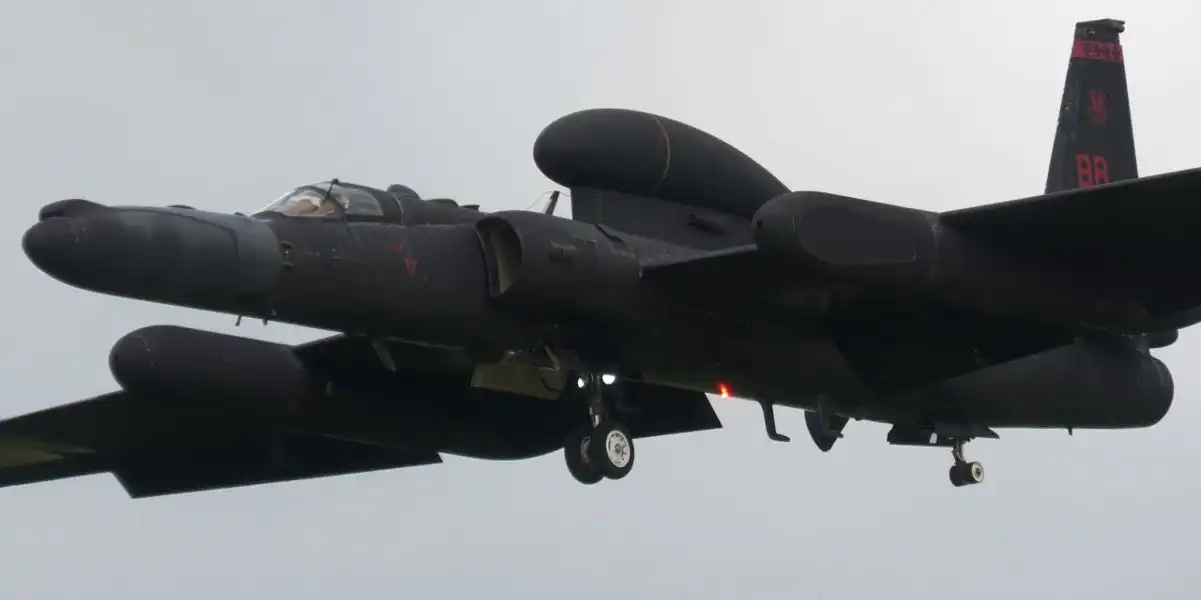
Damien Leimbach concluded that, on close inspection, the outlines of the inboard and outboard fuel tanks could be seen traced in frost. The fuel in the wings cooled below 32°F, he said, and when the aircraft descended into warm, moist air, moisture condensed on the wings and froze.
He added that this aircraft would be much harder to detect using infrared search and track (IRST), though not impossible.
Check out the Born into the Wild Blue Yonder Facebook page for further Blackbird photos and stories.
Photos by Unknown and screenshot from a YouTube video


