

By the eleventh day of Operation Linebacker II, the North Vietnamese were at the mercy of the B-52. The North Vietnamese returned to the negotiating table. The US achieved its objective of letting go of the war. The BUFF had succeeded where all other tactics had failed.
Operation Linebacker II was a complex, joint-service campaign conducted over North Vietnam in December 1972. The B-52 sorties flown during the operation became the most famous B-52 missions of the Southeast Asia War. Earlier that year, the first Operation Linebacker had been an air interdiction campaign aimed at stopping the flow of supplies during North Vietnam’s Easter Offensive. After the communists delayed peace talks, the U.S. Air Force assembled a massive B-52 force—99 B-52Gs and 53 B-52Ds at Guam, plus another 54 B-52Ds at U-Tapao. To pressure the communists into serious negotiations, the United States launched Operation Linebacker II. From the night of December 18 through December 29, waves of B-52s carried out precision strikes against military targets in Hanoi, Haiphong, and other locations in North Vietnam.
According to Walter J. Boyne’s Boeing B-52: A Documentary History, the first pilot to launch on the initial “Linebacker II” mission on December 18, 1972, was Major Bill Stocker in Rose I. The aircraft operated in three-ship cells identified by color codes, ranging from plain Red and Blue to names like Cherry, Slate, and Ebony. Stocker knew he was leading a large strike force that would be supported by many other U.S. combat aircraft. Douglas EB-66s, Douglas EA-3s, the older “Skynights,” and Grumman EA-6s would jam enemy communications. McDonnell Douglas F-4s, General Dynamics F-111s, and Vought A-7s would hit airfields and help keep MiGs grounded. Republic F-105 “Thuds,” flying as advanced Wild Weasel aircraft, would use Shrike radar-homing missiles to suppress SAM sites. F-4s would also provide MiG combat air patrols, maintain air superiority, and escort any damaged B-52s back home.
Farther out, the aging EC-121 Connies, still prone to leaking oil from their engines, would track radio frequencies and identify surface-to-air missile launches. Lockheed C-130s and the Sikorsky HH-53 “Jolly Green Giants” would stand by for rescue missions. As always, Boeing KC-135A tankers from Kadena’s 376th Aerial Refueling Wing would supply fuel before the strike to the thirsty B-52Ds and, if needed, provide emergency refueling afterward.
Ships from the Seventh Fleet also contributed to the surveillance and rescue effort. One vessel, known only to the crews by the call sign “Red Crown,” offered such remarkable air and surface monitoring that SAC crews were still speaking of it with admiration years later in ready rooms.
One of the most frustrating aspects of the operation for veteran crews was SAC Headquarters’ order that aircraft not take evasive action against SAMs or MiGs during the long approach from the Initial Point to the bomb release point. The reason was twofold: SAC wanted to ensure that only military targets were struck, and it was also feared that evasive maneuvers could compromise the effectiveness of the electronic countermeasures within the three-ship cell.

Opinions on these instructions remain deeply divided. One view holds that SAC’s basic tactical doctrine already called for specific evasive maneuvers that would have maximized the cell’s ECM effectiveness, while another argues that the maneuvers eventually adopted were improvised as experience accumulated. Either way, the losses would prove heavy.
As the bombers entered the target area, SAMs turned the skies around Hanoi into a blaze of activity. A launch could be seen as a white flash on the ground, roughly the size of a city block, followed by a trail arcing upward into the clouds and ending in a huge mushroom-shaped burst of light. The missiles were also tracked on electronic equipment, with both the ground-to-missile signal (uplink) and the missile-to-ground signal (downlink) detectable. Crews listened to radio calls announcing launches and, looking through the windscreen, saw what one pilot called “wall to wall SAMs.” The Electronic Warfare Officer could identify signals showing a missile was closing in. At times, thirty or forty SAMs were in the air at once, apparently all aimed at a single cell. One crew calmly said, “this one is going to get us,” then stayed steady, released its bombs on target, and was hit afterward. It took extraordinary nerve and discipline.
For some Electronic Warfare Officers, or EWOs, the signals provided the first genuine view of an electronic threat they had spent years rehearsing for in simulation. They were captivated by how clearly the signals appeared, thrilled to see a system they had trained for throughout their careers suddenly become real, even as they overlooked the danger it represented.
The first attack was unprecedented for both sides. More than 200 SAMs were launched, and the U.S. lost two B-52Gs from Andersen and one B-52D from U-Tapao.
Crew debriefs were reviewed as quickly as possible, but the first wave on the second day went up according to the original strike plan. It ran into intense SAM fire, though no aircraft were lost. By then it was clear that the rule forbidding evasive action from the Initial Point to bomb release was too expensive. The second and third waves were told that coordinated evasive maneuvers could be used, as long as ECM effectiveness was preserved and the bomber remained straight and level just before bomb release.
Analysis of the data led to improved SAM jamming methods and better use of evasive tactics. New black boxes were developed and installed. The hope was that the third attack would benefit from all this information, but instead it suffered the highest losses of the war. Out of 93 aircraft launched, four B-52Gs and two B-52Ds were shot down. After the usual breakaway over the target, the aircraft turned into a jet stream of more than 100 knots that seemed to bring them nearly to a standstill. The breakaway also banked the planes to a critical angle, reducing some of their ECM capability.
MiG-21s had been seen flying alongside the bomber formations, much like the Germans in World War II, while relaying speeds, altitudes, and headings to the SAM sites. At least 220 SAMs were launched, including salvos at the turn point, when the bombers were most exposed.
The losses alarmed leaders at every level of headquarters and drew major attention in the national press. General Meyer, CINCSAC, reviewed every detail of the previous three days’ operations, examining both U.S. and North Vietnamese actions. Losing six B-52s from a force of 93 amounted to nearly a 7 percent loss rate. A loss of three, or about 5 percent, was considered acceptable; anything higher was not, since the B-52 was no longer in production and the United States could not afford to lose either its nuclear deterrent or its heavy strike force to Hanoi’s SAMs.
Meyer concluded that the enemy had also been damaged and decided that the 8th Air Force should continue. Rather than limiting the campaign to the original three days, the bombing intensity would be maintained indefinitely. Ground crews would get no break as they repeated the endless cycle of refueling, rearming, and servicing the bombers, while aircrews would fly every two or three days. Meyer’s decision to continue was the right one. The new tactics, which emphasized destroying SAM sites, along with the dwindling SAM inventory, had decisively shifted the balance in the B-52’s favor. The next two missions would, as planned, be limited to U-Tapao’s B-52Ds, while Andersen prepared for another full-scale effort.
During this period, the decision was made to hunt down and destroy SAM storage depots in an effort to cut off supplies at the source. The enemy defenses appeared to be struggling to cope with the far more varied tactics the BUFFs were using. Three straight days passed without any B-52 losses or SAM damage. The MiG-21s, which had caused serious concern before “Linebacker II” began, showed little willingness to attack the bombers, and at least two were shot down—one by T/Sgt Sam Turner and another by A1C Albert More. Three additional kills were claimed, but not confirmed.
Christmas Day brought a pause, giving crews at both U-Tapao and Andersen a day of relief, and even the ground crews got a few hours off. In hindsight, many saw it as a costly mistake, because the North Vietnamese used the day to move SAMs into firing positions and prepare for the inevitable restart of operations.
On December 26, entirely new tactics were put into use. All Andersen aircraft—33 B-52Ds and 45 B-52Gs—were launched within a compressed window of 2 hours and 29 minutes. Four waves, approaching from four different directions, were to converge over Hanoi at the same time, while three additional waves were scheduled to strike Haiphong simultaneously. The raid involved 120 targets with the same bomb-release time, supported by 110 aircraft in the air.
Colonel James R. McCarthy, commander of the 43rd Strategic Wing, served as airborne commander for the mission despite suffering from severe pneumonia. The attack faced intense SAM resistance, and the weather made the operation even harder, with 100-knot winds complicating the synchronized bomb release from aircraft coming in from opposite directions. Ground speeds varied by as much as 200 knots, leaving the navigators with a difficult task to get their aircraft into position on time.
The raid was carried out with precision, with bombs hitting their targets exactly when expected; despite a sharp rise in SAM fire, only two B-52s were lost. SAC’s dominance over Hanoi had been established.
Over the next two days, the B-52s, alongside the fighters, focused on destroying individual SAM sites, and after that the accuracy of the missile launches declined noticeably. The last two B-52s were shot down on the ninth day of the raids.
The tenth and eleventh raids passed without incident; the bombs struck their intended targets, chiefly SAM storage depots, and Headquarters announced that “Linebacker II” was over. The North Vietnamese had returned to the negotiating table, and the United States was now able to achieve its goal of ending the war. The B-52s had succeeded where every other tactic had failed.
Over those 11 days—the only period in which SAC fought the war the way it wanted to, using aging aircraft some more than 17 years old—SAC flew 729 sorties over the most heavily defended territory in history, dropped 15,000 tons of bombs, and suffered 15 losses, or less than 2 percent of the sorties. Roughly 1,240 SAMs were fired at them.
By the eleventh day, the North Vietnamese were at the mercy of the B-52.
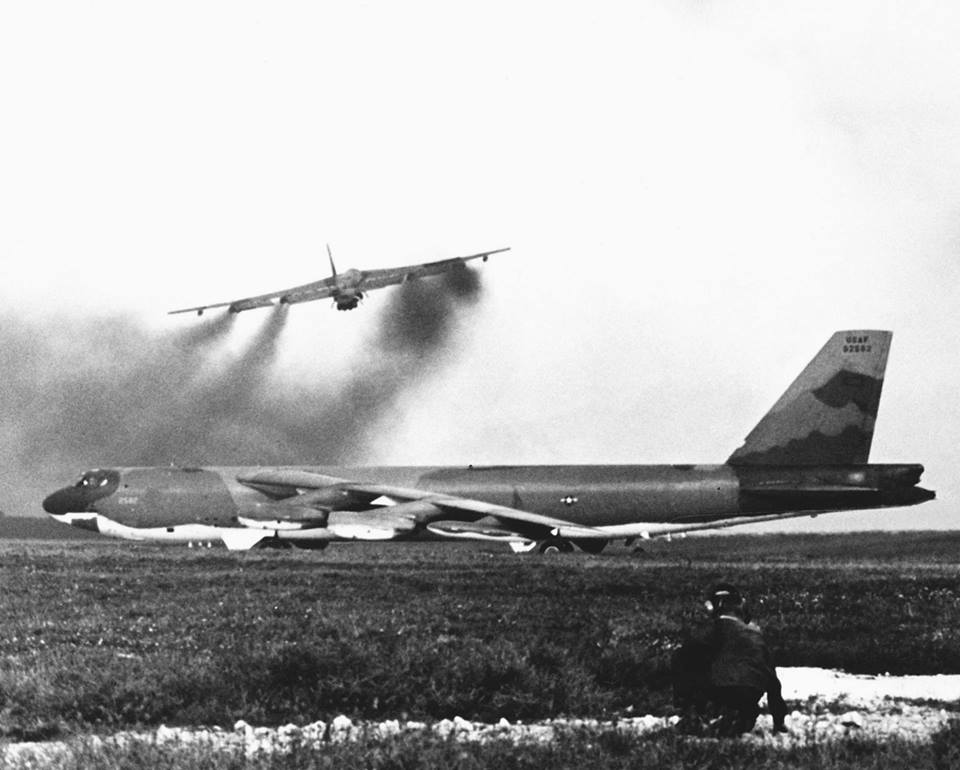
Top Image: Jack Fellows, ASAA; Photo by U.S. Air Force


