

F-80 pilot 1st Lt. Russell J. Brown identified the plumes of burning kerosene from the falling tanks as the MiG catching fire, an illusion in the haze that reinforced his belief he had mortally wounded his adversary
On November 8, 1950, during a B-29 raid on Sinuiju, 1st Lt. Russell J. Brown flew an F-80C with the 16th Fighter Interceptor Squadron, part of the 51st Fighter Interceptor Wing. He was one of four F-80 Shooting Star pilots in a four-flight operation targeting the North Korean airfield in support of the bombers. As described by Thomas McKelvey Cleaver in Holding the Line: The Naval Air Campaign in Korea, Brown served as wingman to his element leader, 16th FIS commander Maj. Evans G. Stephens. While the other three flights strafed the airfield, Brown and Stephens initially provided top cover; afterward, Stephens planned to take his own flight down for a final “clean-up” strafing run.
Smith later recalled that when they finally carried out their strafing run, the antiaircraft fire was intense, with most of it coming from the Manchurian side of the river. “We could have got out and walked on it,” he remarked. Once Brown and Maj. Stephens finished their pass, they climbed to provide cover for 1st Lts. Ralph N. Giel and Richard D. Escola during their attack. Soon afterward, Maj. Stephens spotted between eight and twelve MiG-15s closing in from the south and at a higher altitude on the Korean side of the river, and he ordered Giel and Escola to break off and rejoin the formation.
The four F-80s regrouped at 20,000 feet, where Major Stephens spotted two MiG-15s coming out of a dive and heading toward the Antung complex at the same altitude. As Stephens rolled sharply left to chase them, Brown still hadn’t seen the enemy fighters. “I was looking around like mad and flying formations at the same time.” When they finished the turn, Brown finally saw the two MiGs; the leader crossed directly in front of Stephens, while the wingman turned in front of Brown.
The wingman climbed left, but Brown held a tight turn inside his maneuver. Although three of Brown’s six .50-caliber guns had jammed during the strafing run, he still managed to fire four short bursts that all missed. The MiG pilot then rolled into a dive, and Brown followed. As the two jets plunged almost straight down, Brown closed to within 1,000 feet of the MiG and fired one long burst followed by three shorter ones. Brown saw what he believed was the MiG catching fire near the engine. “It Was now or never, I squeezed the trigger and held it down.” He later reported that the MiG appeared to ignite only 2,000 ft above the hills below. As the jet seemed to explode, Brown — his Shooting Star shaking at more than 600 mph — pulled the throttle back and hauled hard on the stick. G-force streamers trailed from the wingtips as the F-80C finally pulled out of the near-vertical dive just a hundred feet above the terrain and climbed back toward higher altitude.
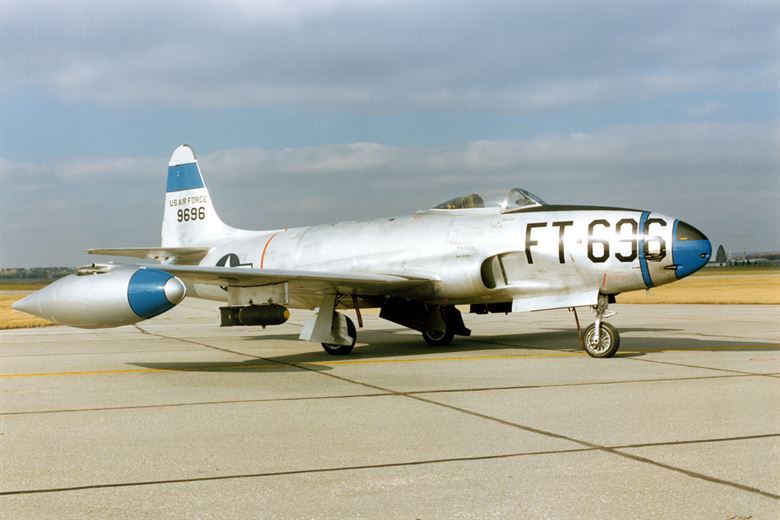
Brown’s claim was officially recognized as the first jet‑versus‑jet kill. In reality, the MiGs that engaged his formation belonged to a contingent from the 28th, 72nd, and 139th Guards Fighter Aviation Regiments, which had been assigned to intercept the B-29s. Scrambled too late to strike the bombers before they released their payloads, the Soviet pilots instead targeted the fighter‑bombers attacking the flak positions. Brown’s adversary was Lt. Kharitonov, who was very much alive and not scattered across the Korean landscape. During his dive, he jettisoned his two underwing fuel tanks. In the thin haze at low altitude, Brown misinterpreted the falling tanks as fragments breaking off the MiG. He then mistook the streams of burning kerosene from the dropped tanks for the MiG itself catching fire—an illusion created by the haze that convinced him he had fatally damaged his foe.
In fact, the MiG-15’s rugged design meant that the fire from a single .50‑caliber machine gun would only be lethal with a rare “golden BB” hit on a critical component. As Brown pulled out of his dive, Kharitonov recovered as well, leveling off so low that his jet exhaust disturbed the treetops below. Remaining at minimum altitude, he dashed back across the Yalu River and was already descending onto Antung’s main runway while Brown was climbing to rejoin his formation and reporting a victory. Brown’s “kill” still stands in official USAF history as the first jet‑versus‑jet shootdown. He stayed in theater until the summer of 1951, but this was his only credited success. That he had gotten close enough to fire at all was largely a matter of luck; had Kharitonov seen him in time and advanced the throttle, the MiG-15 could easily have outrun Brown’s F-80 Shooting Star.
The following day, it was the U.S. Navy’s opportunity to see how the Panther would fare against the MiG. VF-111’s commanding officer, Lt. Cdr. William T. “Tom” Amen, led a formation of 12 F9F-2 Panthers from squadrons VF-111 and VF-112 to escort an attack on the Yalu River bridge at Sinuiju. He later recounted:
“We could clearly see the big runway at Antung across the river in Manchuria but were too far away to ascertain what type of aircraft were parked along the runway. As the bomb-laden ADs started their dives on the bridge, I radioed the leader to find out if any of them had sighted MiGs. Ten seconds later, a voice came on the radio to say there was a fast-moving jet coming up behind our formation. I looked over my shoulder, and there it was, a shiny swept-wing aircraft banking toward me from my seven o’clock position. I immediately turned to meet him head-on. The MiG pilot raised his nose and started a steep, almost vertical climb to about 15,000 feet, where he leveled off. Just as he started his climb, my wingman and I got off a burst of 20mm. It was ineffective. We stayed on his tail. If we’d hesitated, the MiG pilot would have gained the advantage since he already had a 100-knot speed advantage. If he’d chosen to remain straight and level, he could easily have outdistanced us, but every time he turned, we closed the gap.
“We were firing short bursts as we closed in, and the other two Panthers of our division were firing long bursts as they tried to close in. Evidently, that scared the MiG pilot into a dive, and I got on his tail.
“We were heading almost straight down, and my airspeed hit 500 knots as I was firing all the way. Suddenly, my Panther started to buffet as the nose was trying to tuck under, and I hit my dive brakes and stopped firing. The MiG’s dive angle had increased to about 40 degrees. As we passed through 3,000 feet the MiG flipped over on its back. I thought the pilot was either crazy or had one of the best fighters ever built! A second later I could see mountains coming up fast. Then I saw trees and rocks. Pulling hard, I bottomed out with no more than 200 feet to spare. As I turned the nose up, my wingman called to report I had gotten the MiG, which had gone straight in and exploded, starting a forest fire.”
After the Cold War ended, Amen’s adversary was identified as Captain Mikhail Grachev of the 29th IAP. Because Russian records confirmed his loss, Amen is in fact the first American pilot to have shot down a MiG-15.
Holding the Line, The Naval Air Campaign in Korea is published by Osprey Publishing and is available to order here.
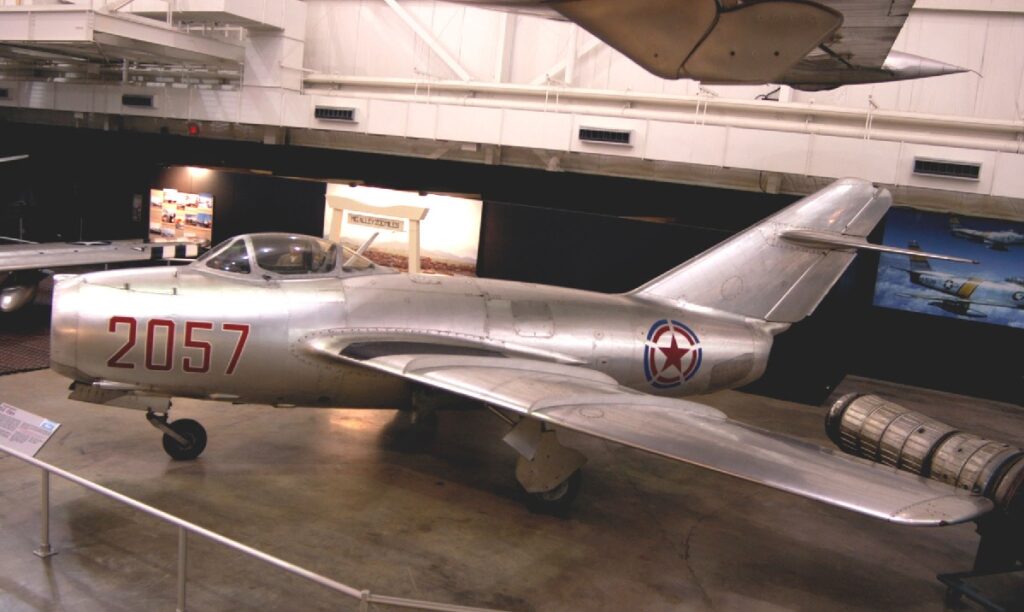
Photo by U.S. Air Force and U.S. Navy

