

A third-generation tiltrotor built to reshape vertical flight reached a key milestone when a U.S. Army Special Operations pilot took the controls for the first time
Born under the Joint Multi-Role Technology Demonstration (JMR TD) program, the Bell V-280 Valor was a U.S. Army science and technology effort designed to develop, expand, and demonstrate new capabilities in vertical lift technology. A clean-sheet, next-generation tiltrotor applying lessons learned from nearly six decades of tiltrotor expertise, the V-280 served as a precursor to the Department of Defense Future Vertical Lift (FVL) program — an initiative aimed at delivering the next generation of vertical lift aircraft to the Joint Warfighter, with the speed, range, payload, and mission systems required for future operations.
The program was awarded in September 2013, with a Preliminary Design Review in 2014, a Critical Design Review and the start of aircraft assembly in mid-2015, and assembly completed in early 2017. Four agreements were awarded under the JMR TD to AVX Aircraft, Bell Helicopter, Karem Aircraft, and a Sikorsky-Boeing team for initial designs, with the Bell and Sikorsky-Boeing efforts funded to build and fly technology demonstrator aircraft. The U.S. Army Aviation and Missile Research, Development, and Engineering Center (AMRDEC) led the JMR TD effort.
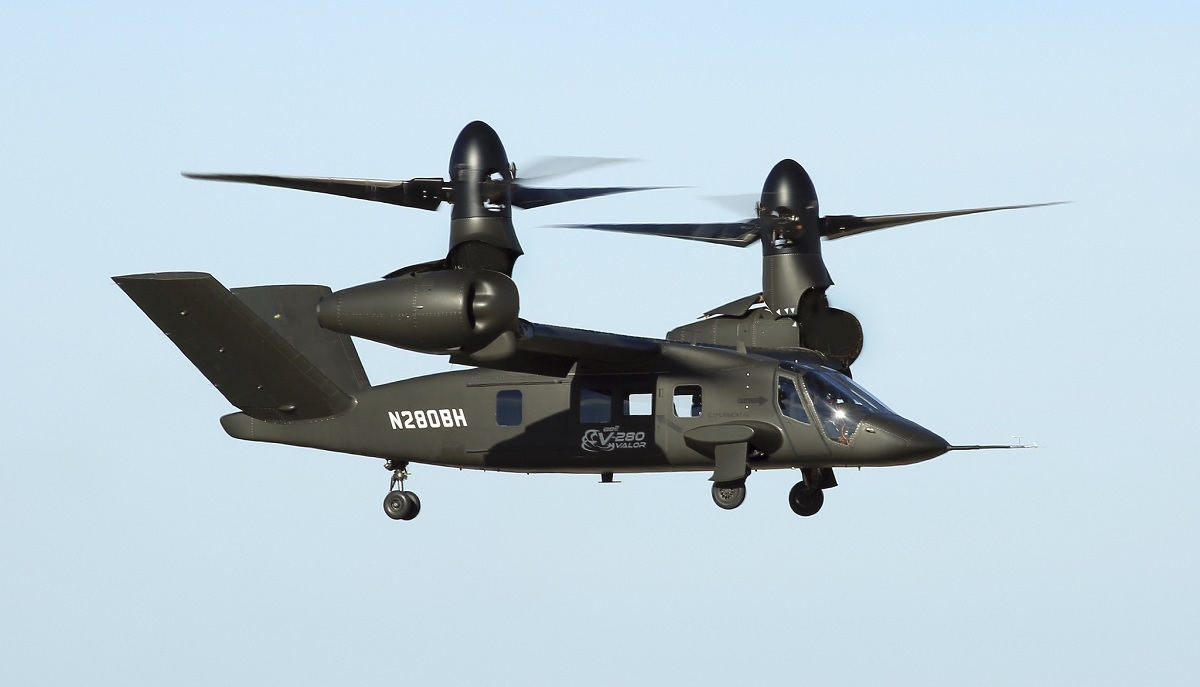
Before taking to the skies, the V-280 prototype began restrained ground run test operations at the Bell Helicopter Amarillo Assembly Center, where it underwent a series of functional tests covering all aircraft systems and fly-by-wire flight controls in preparation for first flight.
That milestone came on February 7, 2018, when Chief Warrant Officer 3 Tom Wiggins, of the U.S. Army Special Operations Aviation Command, became the first U.S. Army pilot to fly the V-280. The flight took place at the Bell Flight Test Facility in Amarillo, Texas, and included Hover In Ground Effect repositioning, pattern flight, and roll-on landings.
“One of the keys to this successful S&T demonstration effort is the nature by which the government and industry partners have completely teamed not only during the analysis, design, and early qualification efforts but also for the flight test activity,” said JMR TD Program Director Dan Bailey. Director of the Aviation Development Directorate Dr. Bill Lewis added: “With Army combat-experienced, experimental test pilots embedded in Bell’s test team, we have a unique opportunity to help bring the project across the finish line and also develop insights valuable to the FVL initiative. We’re very proud of CW3 Wiggins.”
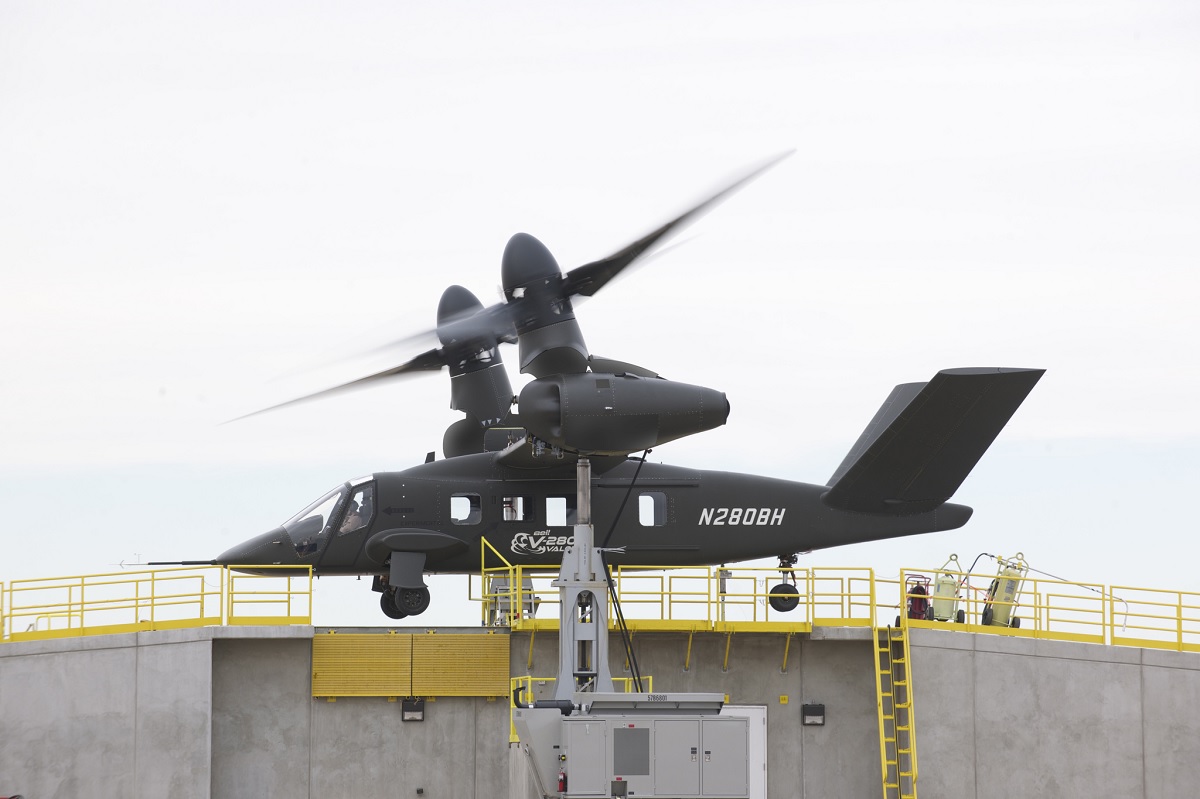
AMRDEC personnel were fully involved throughout the demonstrator effort, including the integration of experimental test pilots and flight test engineers into the mixed flight test team, with Army pilots taking part in additional flights across the test program.
Design and performance set the V-280 apart from its predecessors. Safe and survivable, it featured integrated cabin armor, fly-by-wire component redundancy, state-of-the-art countermeasures, and airborne battle boards bringing fused data and mission updates to the cabin for real-time tracking. Offering more than twice the speed and range of current helicopter platforms, the V-280 provided superior agility at the objective — access not previously available with legacy rotorcraft.
Special emphasis was placed on reducing weight compared to the V-22 Osprey to bring costs down. Composites were used extensively in the wing, fuselage, and tail. Wing skins and ribs were made of a honeycomb-stiffened sandwich construction with large-cell carbon cores for fewer, larger, and lighter parts, paste-bonded together to eliminate fasteners — reducing costs by over 30 percent compared to a scaled V-22 wing. While the Osprey carried a higher disk loading and lower hover efficiency than a conventional helicopter, the V-280 was designed with a lower disk loading and longer wing for greater hover and cruise efficiency. Bell expected the V-280 to come in at a cost comparable to an AH-64E or MH-60M.
Photo credit: Bell Helicopter

