

The UK was not against a Harrier sale, as the situation regarding the Malvinas/Falkland Islands was relatively satisfactory at that time
By 1963, the Argentine Naval Aviation Command’s front-line fighters consisted of the Vought F4U-5 Corsair and the Grumman F9F-2 Panther, both of which were becoming obsolete, particularly the Corsair. The force planned to acquire Douglas AD-5 Skyraiders to replace the Corsairs and sought some Douglas A-4B Skyhawks to succeed the Panthers. In 1966, it requested authorization from the U.S. government to purchase a batch of A-4Bs; however, Washington responded by offering 30 A-4As instead, an alternative that the Argentines declined.
In 1968, another request was submitted for ten A-4Fs and two TA-4Fs, but this sale was also denied. As Santiago Rivas notes in his book British Combat Aircraft in Latin America, this rejection pushed the Argentine Navy to seek alternative suppliers, and in 1969 it approached the British government to ask whether it could evaluate the Hawker Siddeley Harrier GR.Mk.1. While sailing the newly acquired aircraft carrier ARA 25 de Mayo (V-2) from the Netherlands, the ship stopped in the United Kingdom, where tests were carried out on September 4, 1969, using an RAF Harrier GR.Mk.1 (serial XV757, which would not be officially handed over to the RAF until September 19, nearly two weeks after the tests on the Argentine carrier). A Royal Navy Westland Wasp supported the trials, providing search and rescue coverage and photographing the test operations.
The Harrier made a very strong impression on Argentine Navy officers, so in January 1970, they requested authorization to purchase six aircraft, with an option for six more. They wanted the first two delivered by January 1971 and the remainder during 1972. By then, however, Hawker Siddeley was fully tied up meeting RAF Harrier production schedules. The British Ministry of Technology, therefore, requested that the RAF approve diverting two aircraft from its own order, aiming for delivery by March 1971, a timeframe it believed would be acceptable to the Argentine Navy.
The Ministry of Defence reported that diverting part of the Harrier order to Argentina posed major challenges, as Rolls-Royce also had to supply engines to the US Marine Corps, and there was little chance of significantly increasing engine production within the required timeframe. The MoD criticized Hawker Siddeley and Rolls-Royce for their reluctance to make ‘even the smallest speculative provision against the future exports of which they have maintained there were considerable prospects’.
Moreover, engine issues that had emerged by November 1969 reduced the number of aircraft available, and the Ministry of Defence judged that sending Harriers to Argentina along with at least two spare engines would significantly slow the rate at which RAF squadrons were being brought up to strength.
The Harrier entered service in April 1969 with the Harrier Conversion Unit (later redesignated 233 OCU) and No. 1 Squadron. The Ministry of Defence expected it to reach full operational capability by April 1970, with a second unit, No. 4 Squadron, ready by June. Projections indicated that by the end of 1971, there would be four squadrons, comprising a total of 48 aircraft, available to NATO.
Once the U.S. government became aware of the Harrier negotiations, it countered with an offer of 24 A-4B Skyhawks. Sixteen of these would be upgraded like the A-4Bs already supplied to the Argentine Air Force, though with some differences in equipment.
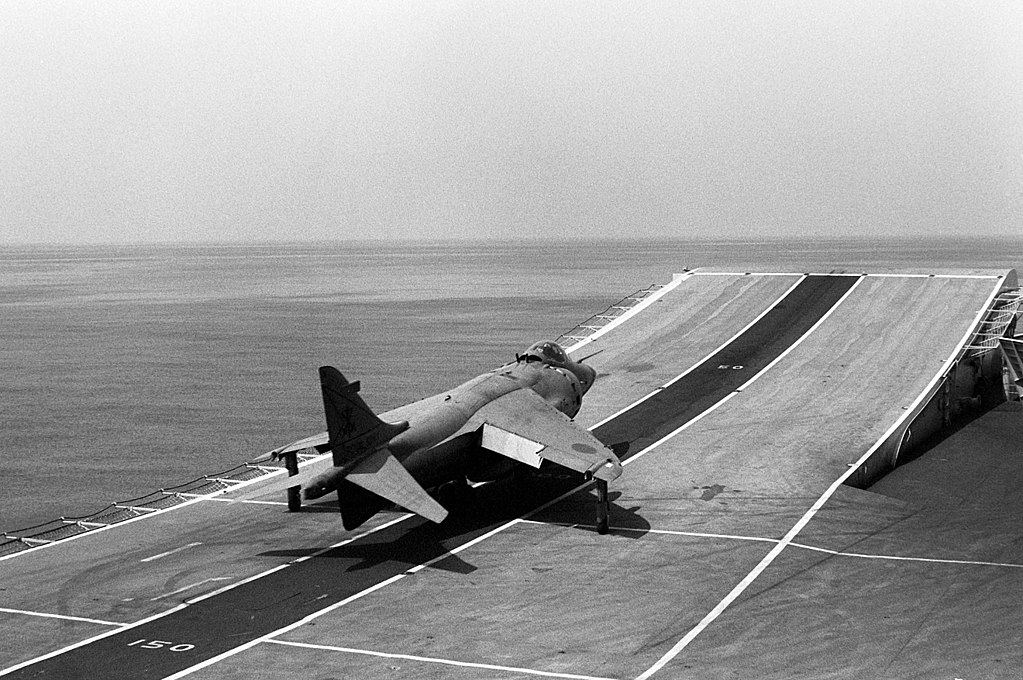
Meanwhile, on February 26, 1970, Foreign Office Minister Lord Chalfont stated that the UK did not oppose selling Harriers, since the situation over the Malvinas/Falkland Islands was relatively stable at the time and the government did not expect strong objections from either the United States or Chile.
In the end, because British government departments could not agree on a practical way to divert the first two Harriers, the Argentine Navy chose in May to proceed with the U.S. offer of A-4Bs. However, it advised Hawker Siddeley that the Harrier acquisition was not canceled and that talks could be reopened at a later date.
Less than ten years later, the UK Ministry of Defence examined the possibility of selling an aircraft carrier, along with a complement of Sea Harriers, to the Argentine Navy as a replacement for ARA 25 de Mayo and its Skyhawks. Argentina showed interest in the option, and the British evaluated a potential sale of HMS Hermes after her planned decommissioning in 1983, or an Invincible-class carrier.
The Argentine Navy had been searching for a new combat aircraft and had also shortlisted the Douglas A-4E, A-4F, A-4M, and the Dassault Super Etendard. Ultimately, however, an agreement was reached by September 1979 for the purchase of 14 Super Etendards. The Malvinas/Falklands War in 1982 then eliminated any possibility of the Harrier or Sea Harrier entering service with the Argentine Navy.
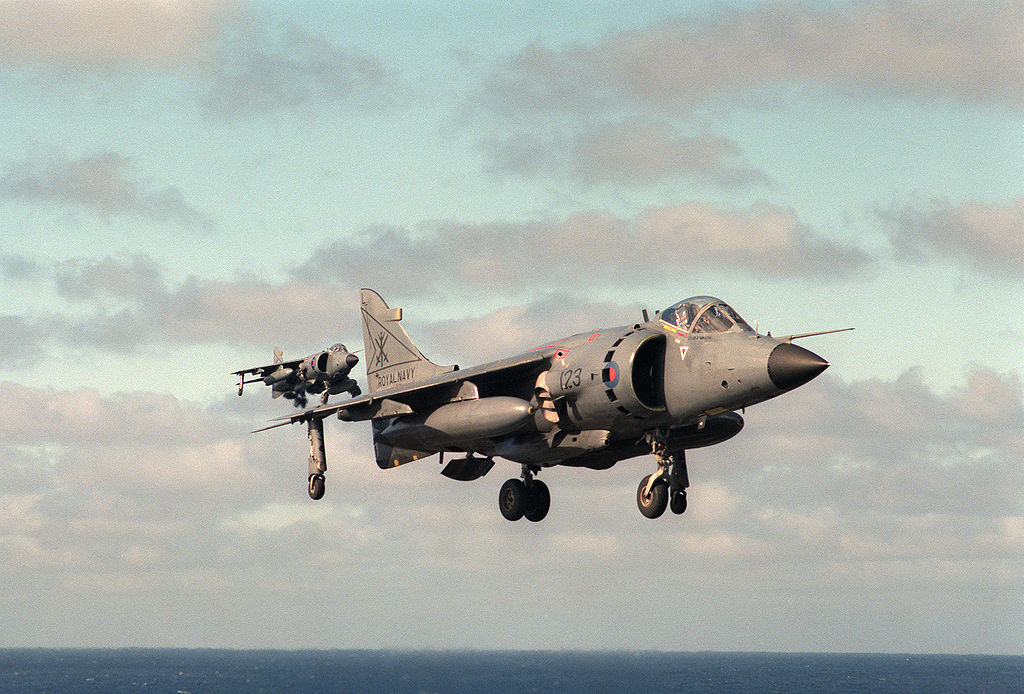
British Combat Aircraft in Latin America is published by Crecy and is available to order here.
Photo by Marcello Risolo via Wikipedia, U.S. Navy, Royal Navy

