

The U-2 cruises at 70,000 feet, or at least twice the height of a typical passenger jet. The sky is dark during the day, and the curvature of the Earth can just be seen…
Created entirely in secrecy by Kelly Johnson and the Lockheed Skunk Works, the initial U-2A had its maiden flight in August 1955. Early flights over the Soviet Union during the late 1950s offered the president and other US leaders crucial intelligence concerning Soviet military strength.
The U-2R first flew in 1967 and was 40 percent larger and more capable than the original aircraft. A tactical reconnaissance version, the TR-1A, first flew in August 1981 and was structurally identical to the U-2R. The last U-2 and TR-1 aircraft were delivered in October 1989; in 1992, all TR-1s and U-2s were redesignated as U-2Rs. Since 1994, $1.7 billion has been invested to modernize the U-2 airframe and sensors. These upgrades included the transition to the GE F118-101 engine, resulting in the redesignation of all Air Force U-2 aircraft to the U-2S.
The U-2 offers surveillance and reconnaissance capabilities at high altitudes and in all weather conditions, both during the day and at night, to support US and allied forces directly. It delivers critical imagery and signals intelligence to decision-makers throughout all phases of conflict, including peacetime indications and warnings, low-intensity conflict, and large-scale hostilities.
‘It cruises at 70,000 feet, or at least twice the height of a typical passenger jet. The sky is dark during the day, and the curvature of the Earth can just be seen,’ Shawn Santo, an aviation expert, says on Quora.
‘Pilots have to wear a space suit because the cockpit is only partially pressurized. The typical pressure in the cockpit is equivalent to 29,000 feet (as high as Mt. Everest). Before the flight, pilots have to pre-breathe pure oxygen for at least one hour to purge the nitrogen from their systems. This procedure is to prevent decompression sickness (DCS), also known as the “bends.” The nitrogen dissolved in the bloodstream will form bubbles at the reduced pressure at cruising altitude.

‘A study in 2011 looked at why the number of DCS cases was increasing after decades of flying the plane. The report found three main causes. Pilots are flying more missions in a given timeframe compared to the Cold War. The missions are longer. Finally, it was found that simple actions (like pressing a pedal or flipping a switch) increase the chance of DCS developing. On missions today, the pilots are “more active” during the mission than they were during the Cold War.
‘While maneuvering on the ground, the main landing gear is not steerable, and differential braking is not available. The tail wheels turn about 6 degrees in each direction, so a lot of space is needed to maneuver on the ground.’
Santo continues;
‘It climbs like crazy, easily passing 10,000 feet in less than 90 seconds.
‘At altitude, there is a small difference between the stall speed and its max speed [the so-called ‘coffin corner’, which is the region of flight where a fast but subsonic fixed-wing aircraft’s stall speed is near the critical Mach number]. The difference can be as small as two and a half knots of the U-2. This was increased to almost seven knots in the TR-1. A stall/spin can cause loss of control, which may not be recoverable at altitude. Exceeding the maximum speed could overstress the fuselage and cause structural failure. The autopilot is designed to hold the aircraft below the maximum speed.
‘The flight controls are all pushrods, bell cranks, pulleys, and cables. No boosted controls. Such a system would have meant more weight. It has a yoke instead of a control stick.
‘For landing, there is an automated gust protection system because the airframe cannot handle heavy gusts and maneuvering loads. ‘It has one of the best glide slopes; at 109 knots, it has a glide ratio of 28:1.
‘At landing, it comes in nose-down at about 75 knots. Any faster, and it would cause excessive floating in the ground effect space. Because the wings had fallen away from the wheels on takeoff, during landing, the pilot must work at keeping the wings level. There is a roll spoiler on each wing to assist in this. There cannot be more than a 15-knot crosswind for landing.
‘The pilot has to be one foot off the ground before he can stall the plane and touch down. A chase car paces the aircraft to give the pilot a visual reference and call out the final altitude. Also, because the center of gravity is behind the main landing gear, it lands tail-first.
‘Taxiing is challenging unless you are familiar with tail-dragging gliders. It has been likened to either dancing with a lady or wrestling a dragon, depending on the wind conditions.’
Santo concludes,
‘Also, each plane is essentially handmade, and each of them is a little different from the rest. Pilots would talk to each other and pass on warnings of key differences for a particular plane to the next pilot. Efforts have been made to eliminate these, but they remain.’
It’s hard to come up with another aircraft that has so many dangers during normal operations.
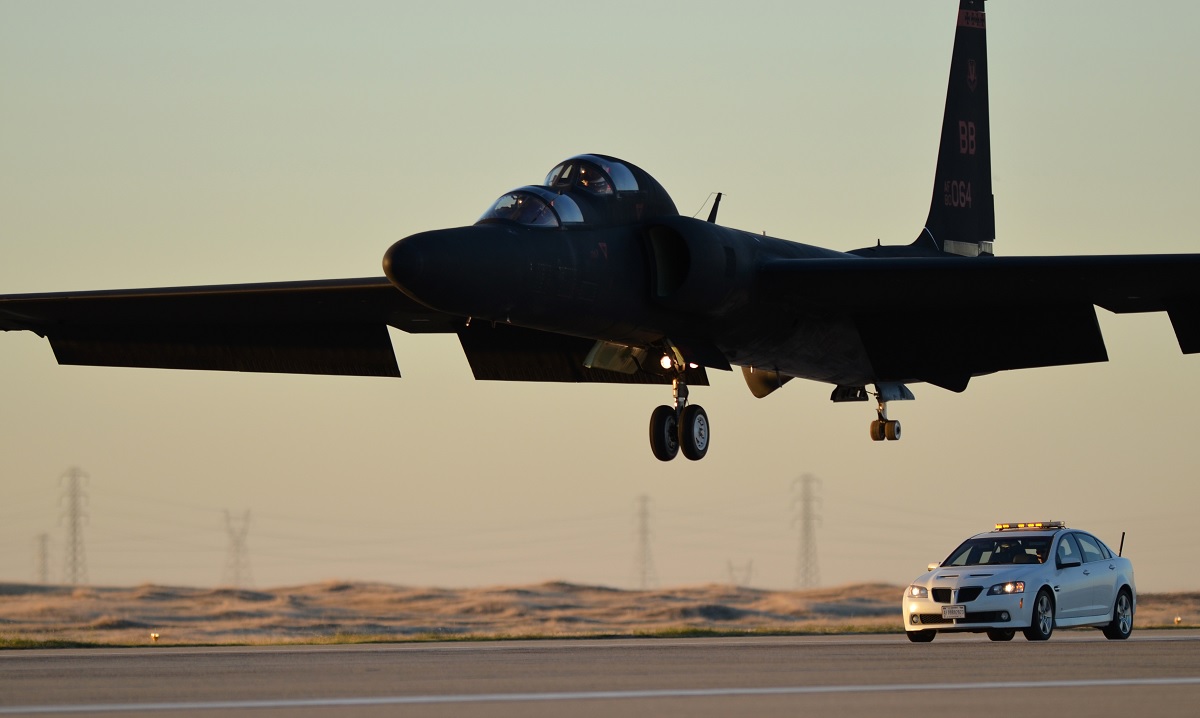
Photo by U.S. Air Force

