

‘Flying gas stations’
Modern strategists describe force multipliers, and in air operations, few are more powerful than air-to-air refueling. It has made the longest bombing missions in history possible while extending the duration of air-defense patrols, the reach of transport aircraft, and the flexibility of ground-attack missions.
First developed for transatlantic passenger flights, “flying gas stations” such as the Boeing KC-135 and Handley Page Victor later became essential to USAF and RAF operations during the Cold War.
As Chris Gibson explains in Air-to-Air Refueling Aircraft, the Soviet Long-Range Aviation branch of the Air Force, known as Dal’naya Aviatsiya Vozdushnikh Syl, faced a similar requirement to that of the USAF and RAF: carrying nuclear weapons deep into enemy territory.
Tupolev wing-to-wing in-flight Refueling System
Two refueling systems emerged in the Soviet Union: the Western-style probe-and-drogue method and the wingtip-to-wingtip system. The latter, a variation of the looped-hose technique, was developed by the Tupolev design bureau for use with the Tu-16 ‘Badger.’ The tanker variant, designated Tu-16Z, carried a hose drum inside the fuselage. The hose ran to a fairing on the starboard wingtip, where it was deployed and stabilized by a small drogue parachute.
Tupolev’s method resembled the replenishment of ships at sea. A shot line, fitted with a drogue chute, was attached to the coupling at the end of the hose. The hose drum unit (HDU), housed in the bomb bay, fed the hose along the starboard wing and out through a guide at the wingtip.
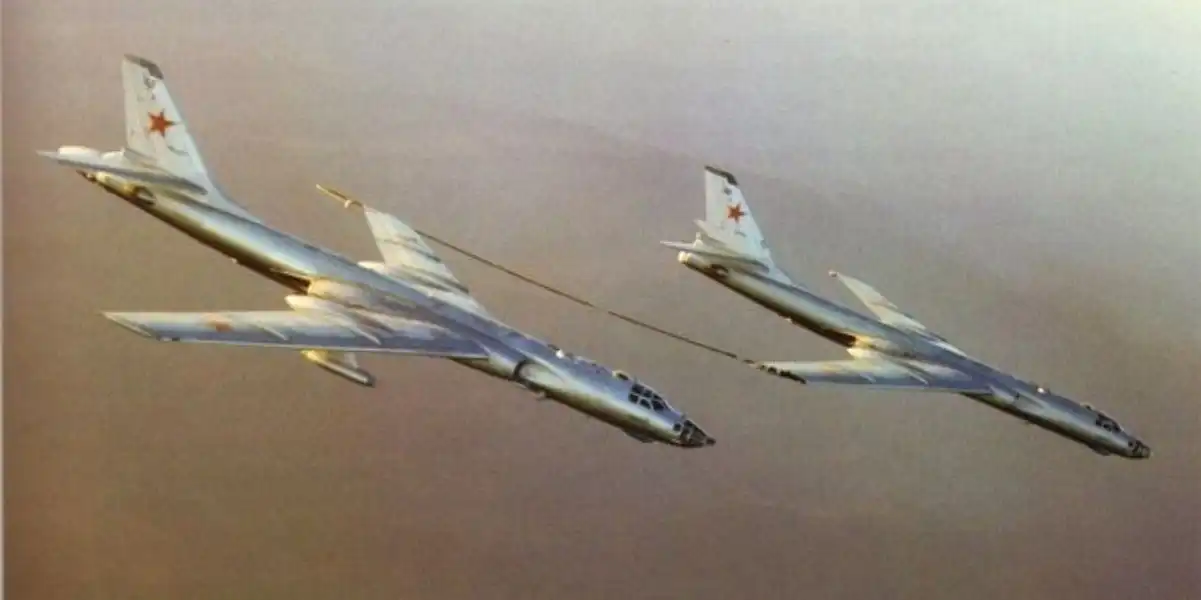
The drogue chute kept the hose stable as it streamed behind the tanker, attached to a 40 m (130 ft) shot line similar to a cable used to pass hoses between ships underway. The receiving aircraft approached the hose, and, guided by its tail gunner, the pilot positioned the port wingtip above it. A latching device beneath the receiver’s wingtip captured the hose end and connected it to the aircraft’s refueling receptacle. The tanker then hauled in the shot line, while the other end of the hose was connected to its fuel supply.
Complex and dangerous
The Tupolev refueling system was complicated and potentially hazardous. Yet once the hose ends were connected, the operation could appear almost graceful.
The system was used on two operational aircraft types: the Tu-4 ‘Bull,’ reverse-engineered from the Boeing B-29 Superfortress, and the Tu-16 ‘Badger.’ Refuelling demanded exceptional skill from the receiving pilot, as the connection point was about 52 ft (15.8 m) to port and 59 ft (18 m) behind the cockpit. The tanker, meanwhile, had to complete several distinct steps before fuel could be transferred.
By 1963, the Tu-16Z had been superseded by the Tu-16N, which used a probe-and-drogue system with a hose drum unit (HDU) in the bomb bay. Soviet Naval Aviation (Aviatsiya voyenno-morskogo flota) operated the Tu-16N to support maritime missions by Tu-22 ‘Blinder’ and Tu-22M ‘Backfire’ missile carriers. Beyond its complexity, a key drawback of the Tupolev wingtip system was wing flex. This was especially problematic for larger aircraft such as the Tu-95 ‘Bear,’ whose high-aspect-ratio wings flexed excessively at the tips.
Air-to-Air Refueling Aircraft is published by Key Publishing and is available to order here.
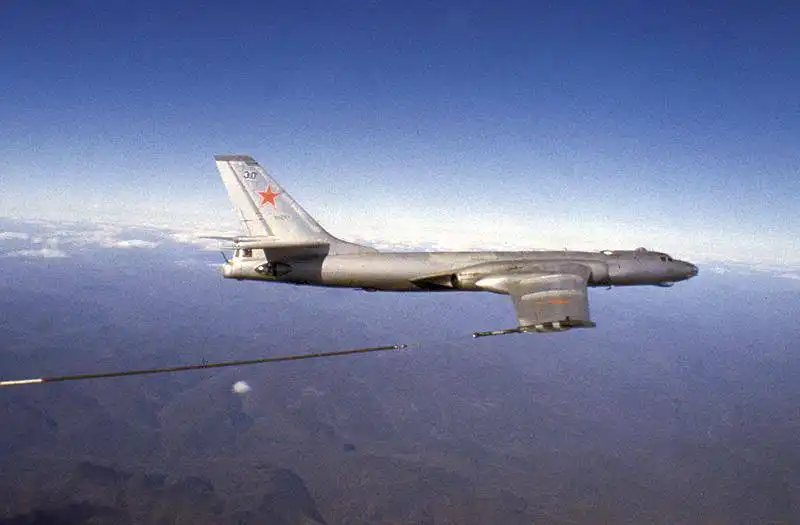
Photo credit: Pinterest

