

Phantom fighter bomber
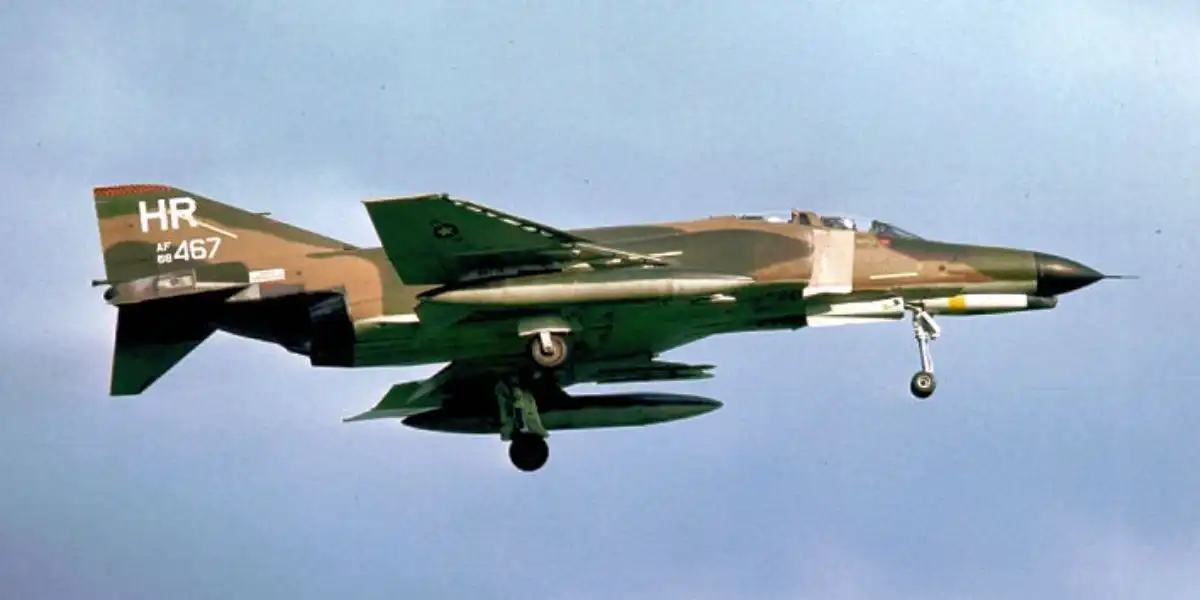
The F-4E Phantom II fighter-bomber was essentially an improved version of the F-4D, featuring J79-GE-17 engines that each delivered 900 pounds more static sea-level thrust, along with an M61A1 “Vulcan” 20mm cannon.
Combat experience in Vietnam directly prompted the addition of the cannon. Air-to-air missile fire-to-hit ratios were low, and engagements often devolved into subsonic dogfights, where the F-4 was at a significant disadvantage against the more maneuverable MiG-17 and MiG-21.
To reduce weight, engineers removed the hydraulically operated wing-folding mechanism and emergency ram-air turbine, while adding a seventh fuel cell. Beginning with Block 41 aircraft, self-sealing fuel tanks improved combat survivability but reduced fuel capacity by 139 gallons.
McDonnell Douglas built 5,057 F-4s, including 1,370 F-4Es.
Hahn Air Base
After completing flight training, Eric Coloney was selected to fly the F-4 Phantom and attended the F-4 Replacement Training Unit (RTU) at Luke Air Force Base (AFB), Arizona, from May to December 1976. At that time, the unit operated older F-4C aircraft.
Following his graduation from Luke, Eric was assigned to the 50th Tactical Fighter Wing at Hahn Air Base, West Germany, where he joined the 10th Tactical Fighter Squadron, known as the “Fighting Tenth.”
All of Eric’s RTU training at Luke was conducted in early-model F-4Cs. At Hahn, however, the 50th Tactical Fighter Wing flew F-4Es equipped with wing slats.
After arriving in Germany from Luke Air Force Base, Eric also had to adjust to the very different European weather conditions.
F-4’s fuel system indicator
In the bookazine F-4 Phantom: Tales from the Cockpit, he recalls:
“The F-4’s fuel system indicator was terrible. The fuel gauge was both digital and analog. There was an arc across the top that was analogue; we called it a tape, which showed the amount of fuel held in the fuselage. If everything failed, the fuselage would gravity feed into the forwardmost tank as your usable fuel, with some limitations. The counter was digital; it looked like an old digital clock. The numbers ticked up and down; it showed your total internal fuel, which included fuel in the wing tanks, which held 2,000 lb per wing, and there was 8,000 lb in the fuselage tanks. So, when the aircraft was full of fuel, the tapewould be on the number eight, and the counter was on 12. So, you had eight over 12.”
“When you walked around the aeroplane in the summertime, after the aircraft had been refueled, you could feel if the fuel was cool or not, provided it had been delivered well, hadn’t sat outside, and wasn’t at ambient temperature. If you gave the fuel tank a slap and the noise generated was a ‘pong,’ it was empty, and if it went ‘bong,’ it had fuel inside.”
Wing tanks
“The wing tanks were configured in sections, a forward section and an aft section, and they might not fill up because of the baffles inside. So, when a wing tank was filled up with fuel, the fuel had to go in slow enough so that the baffles didn’t stop any fuel and the tank could fill up. That was an intentional, mechanical limitation to stop the fuel slopping around and throwing the center of gravity off.”
“So, assuming the aircraft was just fitted with wing tanks and not a centerline tank, when you lined up on the runway, you selected ‘Outboard’ on a switch to select the outboard tanks. The fuel was transferred by air pressure to prevent the tanks from collapsing if you had to make a rapid descent. Two green lights on the tele light panel on the right side would light up to indicate the fuel flow was less than the threshold, one light for the left and one for the right.”
Low-level F-4E flight
“During climb-out, both the tape and the counter would indicate roughly 1,500 lb less total fuel load. The two lights were now off, so you had no indication. That told you the fuel was transferring above the threshold. Fifteen minutes after take-off, the lights should go on and after a while flicker based on the fuel transferred into the centerline tanks, but not the wing tanks. At that point you should have had eight over 12 lights blinking; that was a standard call to confirm you didn’t have an issue.”
“Eventually those lights would start flashing because they’d transferred fuel into the fuselage, and it was full up. At this point, the fuel consumption might be less than the threshold; therefore, the lights flashed on and off. Fifteen minutes after takeoff the lights should be steady, so you’d turn the switch off. At this point, the wing tanks started to feed fuel into the fuselage. When the tape showed 5,600 over 5,600, you knew the wing tanks were empty and fuel was being fed from just the fuselage. There was a period that correlated to that depending on whether you’d used afterburner, which used fuel at a faster rate than the fuel transfer.”
“On a two-ship, low-level flight, one aircraft had three tanks, the other just two. Both jets were out of fuel at the same time toward the end of the mission. The extra weight and the extra drag carried and created by the centerline tank cancelled the advantage of the extra 600 gallons of fuel carried in the centerline tank. In combat or in an emergency, you’d get rid of it.”
Photos by U.S. Air Force

