

Red Flag
Red Flag was established in 1975 through the efforts of Lt. Col. Richard “Moody” Suter as part of an initiative led by General Robert J. Dixon, then commander of Tactical Air Command, to improve the combat readiness of U.S. forces. Experience from Vietnam had shown that pilots who survived their first 10 combat missions were significantly more likely to survive subsequent missions. Red Flag was therefore created to give every “Blue” force pilot the equivalent of their first 10 combat missions at Nellis Air Force Base, helping them become more confident and effective in real combat situations.
The exercise was built around a training complex featuring air-defense fighters, radar systems, electronic countermeasures, guns, and missiles designed to replicate Soviet air defenses and their operating procedures. Known as Exercise Red Flag, the program was based at Nellis AFB in Nevada, with missions conducted across the desert training ranges north of the base.
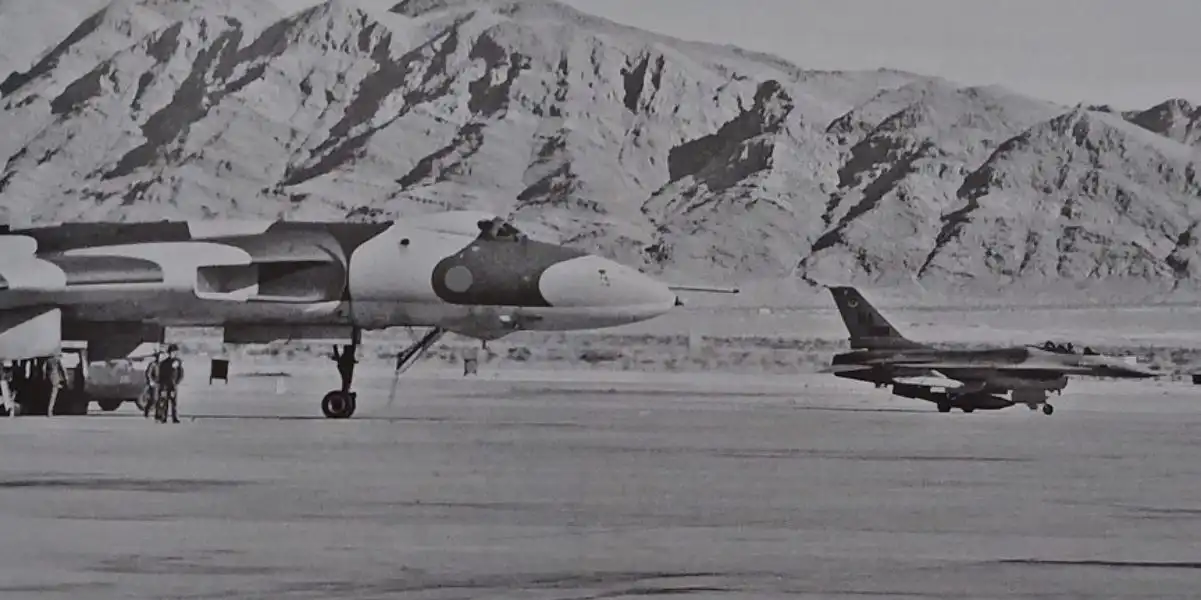
RAF Vulcan bombers participating in Red Flag
The exercise’s early success led to rapid expansion. By 1977, invitations to participate had been extended to other U.S. Air Commands, the U.S. Navy and the Marine Corps. The RAF was also invited to take part at an early stage, contributing both tactical aircraft and Avro Vulcan bombers.
Anthony Wright, a Vulcan navigator radar operator, participated in Red Flag 82-2 in 1982—the final Red Flag exercise involving Vulcans, held as the V Force was being withdrawn from its deterrent role and shortly before the Falklands campaign, Operation Corporate. In Tony Blackman’s book, Vulcan Boys: True Tales of the Iconic Delta V Bomber, Wright recounts an interesting story from the exercise.
“Because we were operating at a low level, at night, flying across miles of uninhabited desert, apart from takeoff and landing at Nellis, our pilots were flying practically blind in the darkness and had to trust the navigation teams. It was only on returning from the desert range and climbing to height that, sometime later, a huge bright area suddenly appeared and attracted the pilots’ attention. It was the lights of Las Vegas.”
“Each night on landing there followed the same pattern. First there was debriefing, followed by a swift exit to the Nellis officers’ club for a wind-down, chatting to other American participating crews, including our ‘F-16 enemies’ [the red forces on the exercise flew the F-15 and the F-16], and then back to our Casino.”
F-16 crash
Wright continues,
“There is one story concerning the F-16 that springs to mind and proves the Red Flag statistics were correct. One evening, just as we were about to enter base operations, I heard a shout and turned round to see an F-16 on fire, smoke billowing out behind it, flying, or not, as the case might be, low across the airfield parallel to the runway, and with a bang, the pilot ejected.”
“I had my camera on my shoulder and was just able to take a photograph of the aircraft on fire as it hit the ground. It was that quick.”
“We carried on to plan, briefed, and eventually walked out to the aircraft on the huge apron with smoke still coming from the F-16. When we got into the aircraft and onto the intercom, we were told by air traffic control that all aircraft crews were to close any hatches, windows, and doors and not to venture outside, as it was hazardous.”
F-16 hydrazine vapors under control
“We complied and were then told the reason. Unknown to us, the F-16 used hydrazine, which is highly toxic and highly flammable, to fuel the aircraft’s emergency power unit (EPU). If the F-16’s engine failed, then there was no power to restart the engine or operate the flying controls.”
“The EPU was there to try a restart. Failure of the EPU to generate power means that the pilot has no option but to eject. This one did. Once the fire teams and others in breathing apparatus and contamination suits got the situation under control, we were cleared for take-off.”
Wright concludes,
“Looking back, the flying on Red Flag was very testing, with much adrenaline used by all concerned. Despite that, we learned a good deal and were extremely satisfied to have completed it. Definitely an exercise not to be missed.”
Vulcan Boys: True Tales of the Iconic Delta V Bomber is published by Mortons Books.
Photos by Bill Perrins via Mortons Books

