

“The mission was to drop bombs and destroy the target, and the A-7’s ability to drop great bombs is unprecedented. It wasn’t just more accurate than the F-100… it was better than any other weapons system designed to deliver ordnance!” Captain Don Cornell
The A-7D is a single-seat aircraft designed for tactical close air support, based on the A-7 used by the U.S. Navy. The very first A-7D took to the skies for its initial flight in April 1968, with production models beginning to be delivered in December of the same year. By the time A-7D production ceased in 1976, LTV had supplied the U.S. Air Force (USAF) with a total of 459 units.
The SLUF (Short, Little, Ugly, Fucker, as her aircrews affectionately called the A-7) showcased its remarkable ground attack abilities while serving with the 354th Tactical Fighter Wing (TFW) at Korat Royal Thai Air Force Base in Thailand during the final stages of the Vietnam War. The Corsair II achieved impressive precision thanks to an automatic electronic navigation and weapons delivery system. While primarily designed for ground attack missions, it also possessed limited capabilities for air-to-air combat.
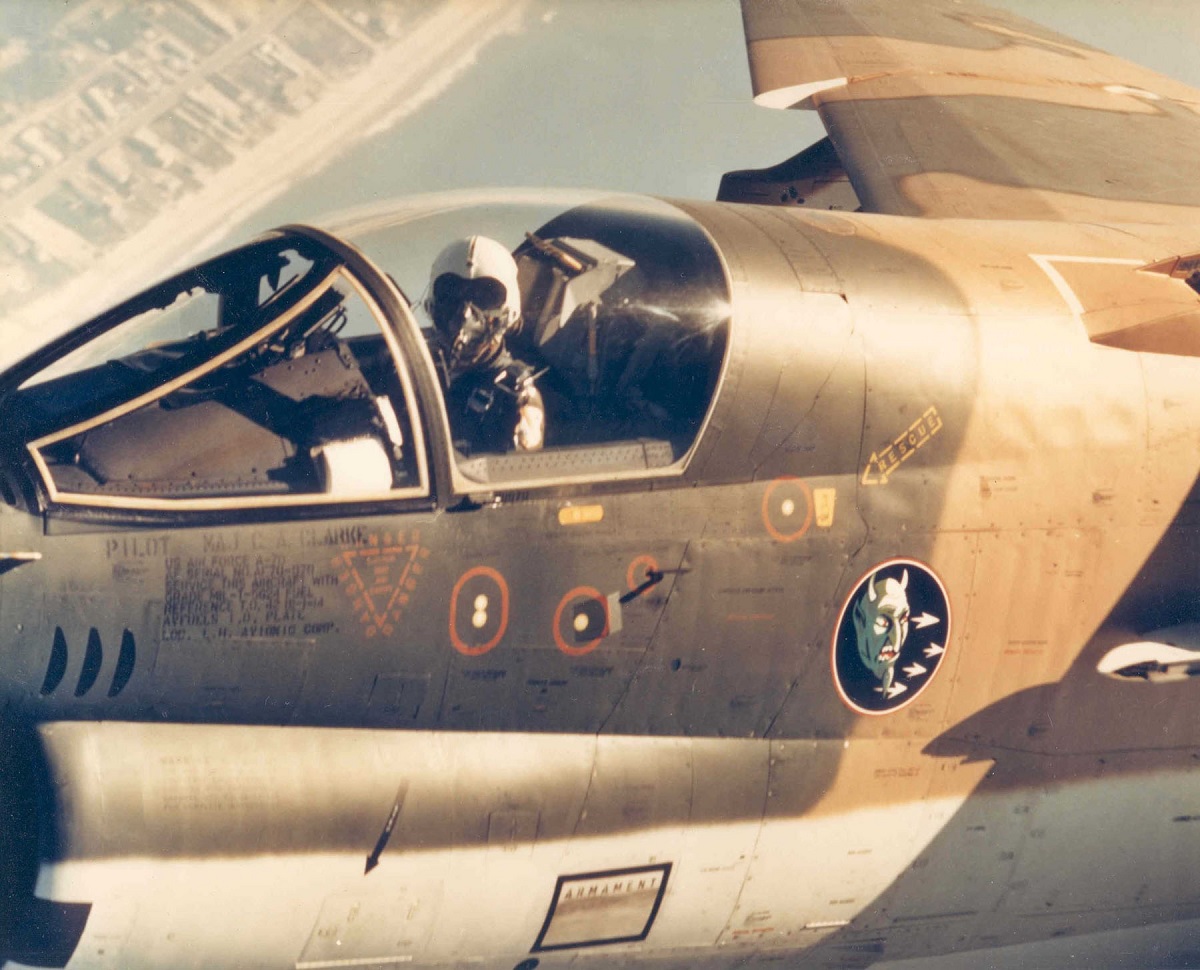
The USAF purchased the A-7 to replace the F-100. Captain Don Cornell, who flew combat tours in both of them, compares them in Lou Drendel’s book A-7 Corsair II in action. “As to a comparison of the A-7 versus the F-100 in combat, I’d have to say that the SLUF is the winner hands down. Even though I was a more experienced pilot when I flew combat in the A-7 than I was in the F-100, the A-7 was far more versatile and accurate than the F-100. This is not to badmouth the F-100, for my tour in the Hun was memorable, and I know what a tremendous contribution the Super Sabre made to the air war in Vietnam. But the fact is that the A-7 outdistances any other ground attack machine ever built!
“As for specific comparisons, at Tuy Hoa in 1970 (F-100s), we carried a load of two external fuel tanks and usually either four Mark 82 500lb. bombs or four cans of napalm. In the A-7, for longer missions, we usually carried two external tanks and 10 Mk. 82s. For shorter missions, the fuel tanks would be downloaded, and we could carry 18 500-pounders. When we went out with a two-ship, that was 36 bombs, which was a devastating load for just a couple of airplanes. Although Mk 82s were our usual load, we also frequently carried 1000- and 2000-pounders, finned napalm, 2.75-inch rockets, and various types of CBUs (Cluster Bomb Units). So, as far as bomb load goes, with the A-7 we carried a larger variety (which was not so much a function of the airplane as local planning) and as much as 450% more bomb load.”
Cornell Continues.
“Looking at range consideration, in the F-100 at Tuy Hoa, we were pretty much restricted to Military regions I, II, III, plus the eastern portions of Cambodia and the southern portions of Laos on unrefueled missions. In the A-7, working from Korat RTAFB, Thailand, no place in the whole area of hostilities could be reached unrefueled, except the northernmost part of North Vietnam, above Hanoi. It wasn’t a regular practice, but there were times when a flight would take off from Korat for a target south of Saigon, be diverted to a target in Steel Tiger (the southern area of Laos), then diverted again to the Plain of Jarres (northern Laos), expend there, then recover at Korat, all unrefueled. These flights could last three hours and cover a total distance of 1000 miles, a physical impossibility in the F-100.”
“There are a lot of other comparisons that could be made: Old age versus brand new, vulnerability (I have no data on the respective vulnerabilities of the F-100 and the A-7, but I know that the SLUF took very few hits and flew to the highest threats), abort rates, turn-around times, etc., etc., but I don’t think I’m in a position to speak thoroughly in a limited space on them.”
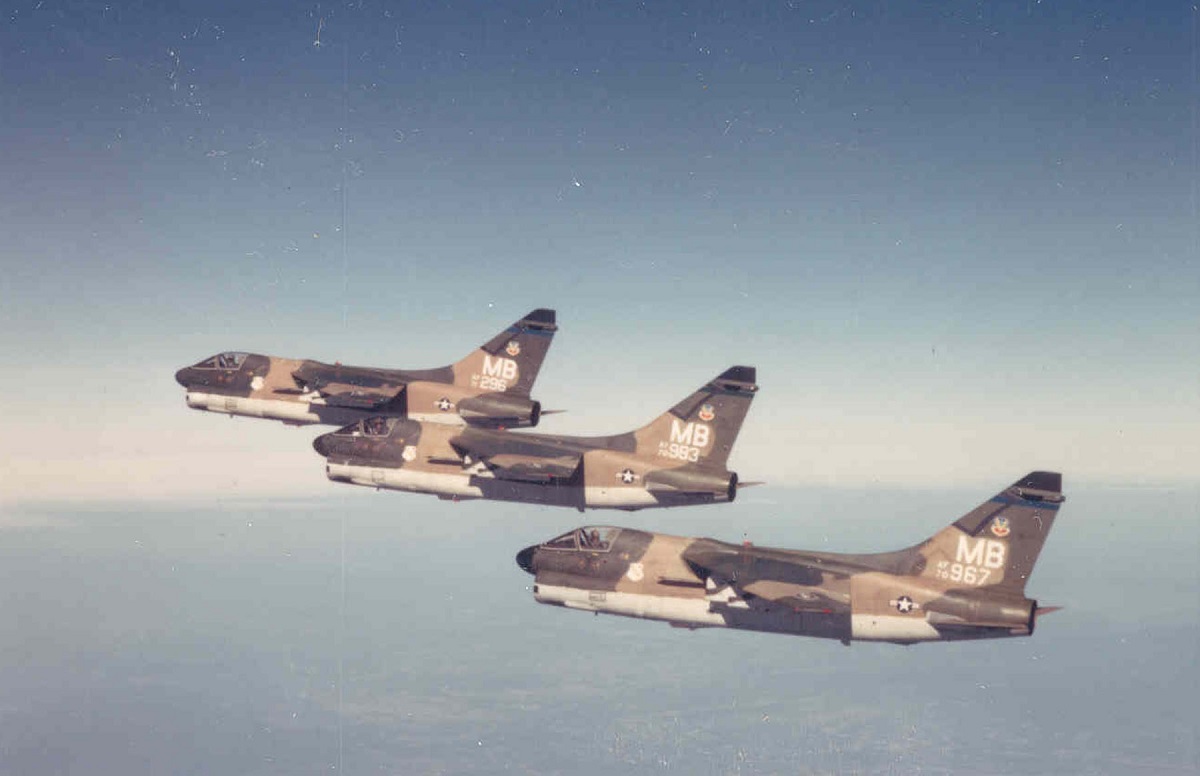
“What I can attest to is both the navigation and weapons delivery accuracy of the A-7. Through the use of the IBM digital computer, which is tied to a highly accurate inertial platform, a pilot could program in up to 9 destinations, then get range and bearing to them via a great circle route. He could keep track of his progress on the Projected Map Display (a fantastic instrument), plus move the map ahead if he wished to get a sneak preview of the target area. On the way to the target, he could contact the FAC on one of two radios, an FM or a UHF. Once in the target area, he could choose to drop his ordnance singly, in pairs, or ripple as many as he wanted with whatever ground spacing he desired. By selecting “Visual Attack” (we have many other options, too, using radar, etc., but they weren’t utilized in SEA), he would then fly so as to put an aiming symbol in the HUD (head-up display) on the desired target, designate that as the target with a button on the stick, then fly according to steering provided in the HUD, finally consenting with another button on the stick to let the computer decide when to release the bomb. The accuracy was phenomenal! I’m really not trying to take anything away from the F-100 or any of us who flew it. The Hun was a great bombing platform, and we got to where we were pretty accurate. But with the A-7, we could go into any area and use any type of dive angle, airspeed (usually as fast as we could go), release altitude, etc., that we wanted to without worrying about establishing specific parameters. This is particularly important in high-threat areas, where you must not stay wings level on final to the target, or you yourself become the target. This was a bitter pill to swallow for a lot of us former Hun drivers who could take full credit for any good bombs we dropped. (The corollary was that we had to take the blame for any bad bombs we dropped, too, but you’d never get us to admit that we dropped bad bombs.) You can’t argue with success. The mission was to drop bombs and destroy the target, and the A-7’s ability to drop great bombs is unprecedented. It wasn’t just more accurate than the F-100… it was better than any other weapons system designed to deliver ordnance!”
Photo by U.S. Air Force

