

‘One of the interesting discoveries from the Eagle Bait was that F-15s couldn’t even find us when everything was shut down and we told them exactly where we were,’ Dave Peters, SR-71 Blackbird pilot
The SR-71, often referred to as the “Blackbird,” is a sophisticated, long-range strategic reconnaissance aircraft that was derived from the Lockheed A-12 and YF-12A models.
Throughout history, no reconnaissance aircraft has entered more dangerous airspace or operated with the level of freedom achieved by the SR-71 Blackbird. As the fastest aircraft powered by air-breathing engines, the Blackbird’s unmatched speed and mission record established it as the pinnacle of aviation technology during the Cold War era.
The Blackbird was engineered to operate at extremely high speeds and altitudes; at 80,000 feet, it was capable of observing 100,000 square miles of Earth’s surface per hour. This made it extremely challenging for enemy aircraft to achieve a radar lock on it.
Nonetheless, as detailed by former Blackbird pilot Col. Richard H. Graham, USAF (Ret.), in his book The Complete Book of the SR-71 Blackbird: The Illustrated Profile of Every Aircraft, Crew, and Breakthrough of the World’s Fastest Stealth Jet, there were two fighter jets capable of achieving (simulated) SR-71 kills, but only under specific circumstances.
“Don [Don Emmons was the Graham Reconnaissance System Officer, or RSO, the Blackbird back seater] and I, as well as many other crewmembers, had flown numerous ‘Tomcat Chase’ and ‘Eagle Bait’ sorties against our best fighters—the Navy’s F-14s and the Air Force’s F-15s. We flew the SR-71 to provide the fighters practice at finding, tracking, locking on, intercepting, and simulated firing of their sophisticated F-14 Phoenix missiles and the F-15’s Sparrow missiles at a high-altitude, high-speed target. The Tomcat Chase missions were flown over the Pacific Ocean, and the Eagle Bait missions in the Nellis AFB training area, north of Las Vegas, Nevada.”
Graham continues. “To maximize scarce, high-altitude/high-speed intercept practice for the fighters against the SR-71, we stacked the deck in their favor to avoid a multitude of missed intercepts, and consequently, wasted time. The intercepts were conducted in a very controlled environment, favoring a successful outcome by the fighters. […] Even under these highly controlled flying conditions, the F-14s and F-15s had extreme difficulty achieving a satisfactory SR-71 kill.”
U.S. fighter pilots were only able to lock onto the SR-71 when its crew disabled the aircraft’s defensive countermeasures. Achieving a lock on the Blackbird was nearly impossible unless it had already sustained damage. SR-71 pilot Dave Peters also offers some insightful and humorous anecdotes about these experiences.
‘One of the interesting discoveries from those missions, especially the Eagle Bait, was that they couldn’t even find us when everything was shut down and we told them exactly where we were. It was then realized that the F-15 had a speed gate on its radar at 1500 kts. We were casually warping along from 1850 to 2000. So, for them, we didn’t exist. We flew them fairly regularly from about ’82, and they were still doing them after I retired in ’86. We flew the Eagle Bait with the F-15s and the Tomcat Chase with the F-14s. The 14s could find us, but they couldn’t do anything until we modified and gave them times, route of flight, speed, and altitude beforehand so they could have a pre-planned setup. The 15s didn’t do that well for quite some time.
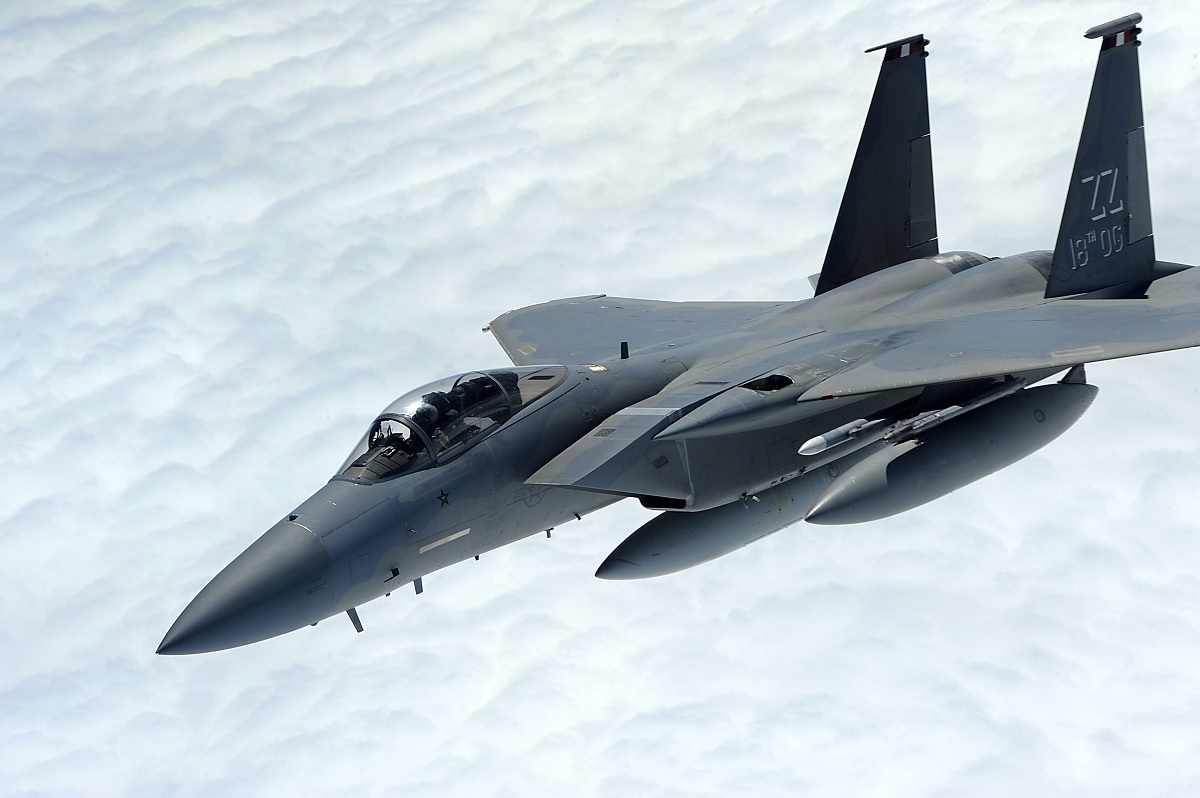
‘Another mission we flew that was interesting was to come in over the California coast at speed and altitude to give the air traffic controllers an idea of what they would see on a space shuttle approach.
‘There was some animosity at first with both the Eagles and the Tomcats because they kept accusing us of not showing up. It was fun in the vain as the LA speed story, except it’s true, because we were on the same frequency with them and could listen to all the bitching because we didn’t show up. They got a little huffy because nobody told them we weren’t coming.’
Check out Born into the Wilde Blue Yonder‘s Facebook page for further Blackbird photos and stories.
Photo by U.S. Air Force


