

The only EF-10 Skyknight pilot to conduct strafing missions during the Vietnam War
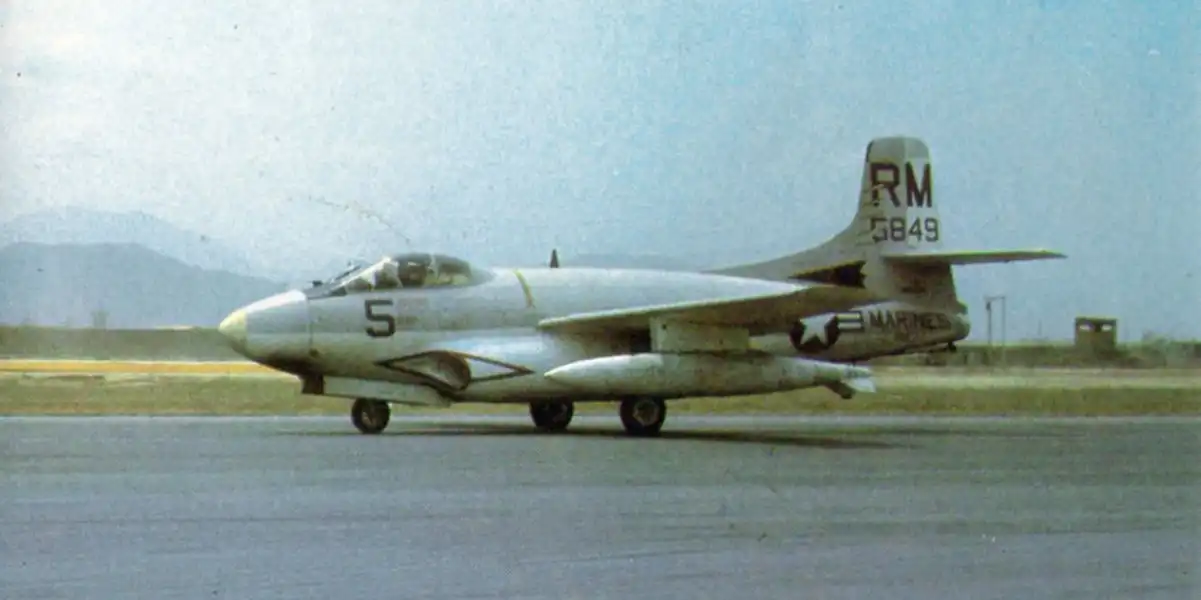
The Douglas F3D Skyknight was an early yet effective effort to combine emerging technologies into a lethal aircraft capable of operating from ships. While most fighters depended on speed and maneuverability, the bulky, straight-winged F3D relied on three radar systems, four 20 mm cannons, and—above all—the cover of darkness. The Skyknight first flew in March 1948 and entered combat in September 1952, when Marine Night Fighter Squadron 513 [VMF(N)-513] deployed to Korea.
Following the war, 35 Skyknights were converted into electronic warfare (EW) aircraft. As US air operations over North Vietnam intensified in early 1965, the need became clear for a tactical EW jet capable of accompanying strike packages and providing electronic countermeasures (ECM) protection.
During the conversion from the F3D-2 to the F3D-2Q/EF-10B, the US Marine Corps (USMC) retained two of the aircraft’s original four M2 20 mm cannons. Because the guns were not needed during the late 1950s and early 1960s—the US State Department had assured the Soviets that the “Shark Fin” flights were unarmed—maintenance had gradually been neglected. By mid-1965, however, the squadron’s ordnance shop had restored the weapons to full working order, and EF-10Bs routinely carried loaded cannons as a last-resort defensive measure.
According to Joe Copalman’s book F3D/EF-10 Skyknight Units of the Korean and Vietnam Wars, the limited number of “Whales” operating in Vietnam, combined with the importance of their EW mission, meant that EF-10 crews were prohibited from using their cannons offensively. That restriction, however, did not prevent one pilot from doing so.
Firing the guns in anger
The first known occasion on which a Skyknight crew fired its guns in anger during the Vietnam War occurred on Dec. 23, 1965. First Lt. Ken Crouch and his ECMO, ‘Woody’ Wood, had launched to support a US Navy strike in the Thanh Hoa area. However, the mission was soon abandoned after Crouch’s wingman aborted and the Navy cancelled the strike.
While returning to Da Nang, Wood detected a signal coming from Tiger Island, a small North Vietnamese-held island located a few miles off the coast, just north of the DMZ. Crouch descended to investigate. As the Skyknight approached a hill that appeared to be the most likely location for a radar installation, the crew saw tracer fire heading toward the aircraft. Crouch aimed at the apparent source and fired the twin 20 mm cannons, taking a hit as he pulled away from the target. Although the aircraft shuddered only slightly, Crouch decided to make another pass and used the remainder of his ammunition before returning to Da Nang with smoke streaming from the left wing.
The crew later discovered that a 37 mm AAA round had penetrated the left wing and destroyed the tyre. When Crouch lowered the landing gear, the damaged tyre fell into the ocean. Despite the loss, he managed to make an arrested landing at Da Nang using only the right main gear and the nose gear. The incident demonstrated why EF-10 crews had been prohibited from strafing ground targets. With only six aircraft available to provide jamming and ECM support over North Vietnam, the ‘Whale’ was far too valuable to risk on ground-attack missions, particularly when other aircraft were much better suited to the task.
Firing the ‘Whale’s’ guns once again
Three months later, on Mar. 1, 1966, Crouch fired the ‘Whale’s’ guns again after a USAF forward air controller (FAC) urgently requested assistance from any available aircraft during a troops-in-contact firefight. Crouch conducted several strafing passes, disrupting the enemy attack, and the FAC credited the crew with two enemy killed in action. After returning to Da Nang, Crouch and his ECMO on the mission, Capt. Jim Gazzale, kept the incident to themselves. Crouch’s earlier violation of the strafing restriction had already made him unpopular with his superiors.
However, 1st MAW leadership later received an after-action report from the USAF FAC praising the ‘Whale’ crew that had answered his call and effectively engaged the enemy. As a result, Crouch and Gazzale found themselves in trouble. Wayne Whitten, an EF-10 Skyknight ECMO, recalled:
‘The powers that be found out about it and said, “What? Who in the hell did that? How did that come about?” So they had to go up and stand tall before the Wing G-3 [Operations officer], a Colonel, and got their asses chewed. Just as they were walking out the door, he said, “And, by the way, boys, it was sure nice to hear that old ‘Willie’ got a piece of the action.”’
Although the mission violated standing orders, it marked the last time a Skyknight fired its guns in anger.
F3D/EF-10 Skyknight Units of the Korean and Vietnam Wars is published by Osprey Publishing and is available to order here.
Photos by U.S. Navy / U.S. Marine Corps

