

When the Gear Won’t Drop: A Harrier Pilot’s Fight to Save His Aircraft
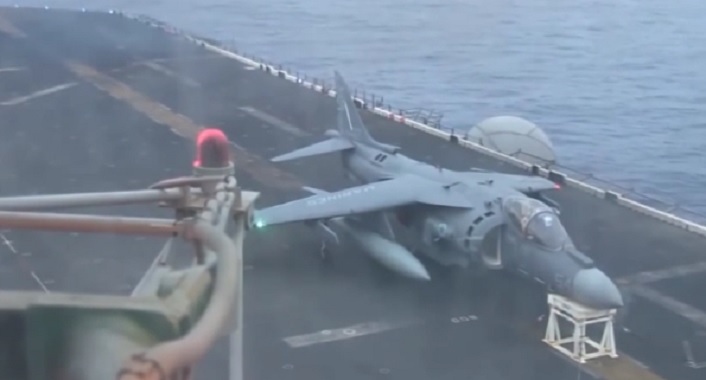
On June 7, 2014, somewhere in the U.S. 6th Fleet area of operations, a Marine Corps AV-8B Harrier II climbed away from the amphibious assault ship USS Bataan (LHD-5) on what should have been a routine mission. Within minutes, Capt. William Mahoney of Marine Medium Tiltrotor Squadron 263 (Reinforced) — flying with the 22nd Marine Expeditionary Unit — discovered his nose landing gear had malfunctioned and would not extend. The math was brutally simple: land a roughly 30,000-pound jet on a moving ship without the very gear designed to support its nose, or ditch a $30 million aircraft into the Mediterranean. What followed was one of the most remarkable aircraft recoveries in recent U.S. naval aviation history, a testament to Harrier pilot training, shipboard ingenuity, and the unique capabilities of a jet unlike any other in the Western inventory.
The Aircraft That Makes the Impossible Possible
The McDonnell Douglas (later Boeing) AV-8B Harrier II is the second-generation development of the British Hawker Siddeley Harrier, the world’s first operational fixed-wing V/STOL (Vertical/Short Take-Off and Landing) jet. In U.S. Marine Corps service since 1985, the AV-8B provides the Corps with organic close air support that can operate from amphibious assault ships, forward air strips, and austere expeditionary bases. Its Rolls-Royce Pegasus turbofan — with four vectorable exhaust nozzles — gives the Harrier capabilities that no conventional aircraft can match, including the ability to take off vertically, hover, and land without forward speed. It was precisely these characteristics that made Mahoney’s emergency recovery conceivable at all.
The Malfunction: A Gear That Wouldn’t Come Down
The sequence of events began moments after Mahoney launched from Bataan’s flight deck. Standard post-launch checks revealed the nose gear — the single forward strut that supports the aircraft’s nose on the ground — had failed to cycle correctly and would not extend to the down-and-locked position. Harrier pilots train for hydraulic and gear emergencies, but a nose gear failure at sea, with no divert airfield within reach, compressed every option to two: attempt a risky landing aboard the ship or eject and let the aircraft sink.
Mahoney, a Harrier pilot with the reinforced VMM-263, began working the problem with Bataan’s air traffic control and the ship’s aviation department. The critical question was whether the ship had any equipment capable of supporting the aircraft’s nose during touchdown. The answer, it turned out, was yes — though using it would require extraordinary precision from a pilot who couldn’t actually see the device he was aiming for.
The Crash Cradle: An Obscure Piece of Shipboard Equipment
Bataan carried a crash cradle — a purpose-built support structure sized specifically to the height of a Harrier’s nose. The device is designed for exactly this scenario: to receive the nose of the aircraft and prevent it from contacting the flight deck at speed, which could have resulted in catastrophic structural damage, fire, or worse.
The cradle was positioned on the flight deck, but its placement presented Mahoney with a second, critical problem. Seated in the Harrier’s cockpit, his sightlines during a vertical or near-vertical descent placed the cradle entirely out of view beneath the aircraft’s nose. He would have to execute the landing blind — relying entirely on verbal guidance from personnel on deck, his instruments, and his own spatial awareness developed through hundreds of hours in the aircraft.
The Descent: Landing Sight Unseen
What followed was a demonstration of the Harrier’s unique handling qualities under extreme circumstances. Conventional carrier aircraft — the F/A-18 Hornet, the F-35C — recover using arrested landings at forward speeds of 130–150 knots. A nose gear failure in that scenario means certain disaster. The Harrier’s vectored thrust allows it to decelerate to a near-hover before touchdown, dramatically reducing the energy involved and giving the pilot far greater control over exactly where the aircraft contacts the deck.
Mahoney positioned the aircraft over the deck and began a controlled vertical descent toward a crash cradle he could not see. The Harrier’s nozzles rotated to provide vertical lift, the throttle managed with the precision that distinguishes experienced V/STOL pilots from their conventional counterparts. With guidance from the ship, he brought the aircraft down.
The video of the recovery, later widely circulated online, tells the story plainly: the Harrier’s nose drops onto the cradle with enough force to bounce several times before coming to rest. It is a jarring image — the controlled violence of a heavy jet running out of altitude — but the aircraft stayed on deck, stayed upright, and Mahoney walked away.
The Human Moment: Shaking Hands and a Clear Head
In the aftermath, Mahoney reflected on the psychological experience of the recovery in terms that any aviator will recognize. The focus required during the descent left no bandwidth for fear — that came later.
“I remember feeling it just hit and that’s it, but then I had to sit there for a minute and remember how to turn the jet off and shut everything off,” Mahoney said in a Marine Corps news release. “It was just a pretty big relief and I didn’t realize how much I was shaking until I actually got out of the aircraft.”
This account captures something essential about emergency aviation: the physiological stress response is suppressed during acute task saturation, only emerging when the immediate threat is resolved. For Mahoney, the professionalism required to safely shut down the aircraft’s systems — fuel, avionics, the Pegasus engine — after landing was itself an act of discipline.
Recognition: The Air Medal and What It Signifies
On February 12, 2015, Col. William Dunn — commanding officer of the 22nd MEU — awarded Mahoney the Air Medal in recognition of his actions. The Air Medal, established in 1942, is awarded for meritorious achievement in aerial flight. In Mahoney’s case, it recognized both his airmanship in executing the recovery and his decision to bring the aircraft back rather than eject.
Col. Dunn’s comments at the ceremony illuminated the broader calculus of the decision. “In the world of ejection seat aircraft, it is not always the first choice to bring the airplane back after something like this and risk the pilot, but this was incredible,” Dunn said in a release, as reported by Marine Corps Times.
The phrasing is significant. In most aircraft, the calculus in a gear emergency tilts toward pilot preservation — eject, lose the jet, save the aviator. The Harrier’s V/STOL capability fundamentally changes that equation. A skilled Harrier pilot facing a nose gear failure at sea has a genuine third option that simply does not exist for pilots of conventional aircraft: a controlled, near-hover recovery that minimizes risk to both crew and airframe. Mahoney’s Air Medal was, in part, recognition that he correctly identified and executed that option under pressure.
Why the AV-8B Specifically Makes This Possible
It is worth dwelling on what made this recovery achievable, because the answer lies entirely in the Harrier’s design philosophy rather than any procedural improvisation.
The Pegasus engine’s four-poster nozzle system gives the AV-8B the ability to vector thrust from fully aft (conventional flight) through 98 degrees forward of vertical (for braking and reverse taxi on deck). During vertical landing, all thrust is directed downward, allowing the aircraft to descend at a controlled rate with minimal forward velocity. This means touchdown speed can be reduced to near-zero — a fundamentally different energy state than any arrested carrier landing.
For Mahoney’s recovery, this capability meant the impact energy at the moment the nose contacted the cradle was a fraction of what it would have been in a conventional approach. The aircraft bounced, but it did not cartwheel. The nose gear bay was presumably inspected and the airframe assessed for structural damage, but the aircraft was recoverable — precisely because the Harrier allowed its pilot to arrive at the deck on his own terms.
Frequently Asked Questions
How did Capt. Mahoney manage to land without seeing the crash cradle?
Mahoney relied on verbal guidance from flight deck personnel and his instruments during the descent. The Harrier’s near-hover capability allowed him to control the rate of descent precisely enough to place the aircraft on the cradle despite having no visual reference to it from the cockpit. It was a demonstration of the situational awareness developed through extensive V/STOL training.
What is a crash cradle, and is it standard equipment on all Harrier-capable ships?
A crash cradle is a purpose-built support structure sized to the height of a Harrier’s nose, designed to receive and stabilize the aircraft in the event of a nose gear failure. Crash cradles are standard equipment on all LHD/LHA class ships. Their presence aboard Bataan proved decisive in giving Mahoney a viable recovery option beyond ejection.
What are the main features of the AV-8B Harrier II that made this emergency landing possible?
The AV-8B’s defining feature is its Rolls-Royce Pegasus vectored-thrust turbofan, which enables vertical and short take-off and landing (V/STOL) operations. Four swiveling exhaust nozzles allow the pilot to direct thrust in any direction from fully aft to slightly forward of vertical. This gives the Harrier the ability to hover, land at near-zero forward speed, and manage its descent rate with precision no conventional fixed-wing aircraft can match — the precise set of capabilities that made Mahoney’s nose-gear-down recovery achievable aboard a moving ship at sea.
Did the aircraft fly again after the emergency landing?
Marine Corps accounts confirm the aircraft was recovered intact aboard Bataan. Col. Dunn specifically praised Mahoney for saving the aircraft, suggesting it was deemed structurally sound following the recovery, though full repair and return-to-service details have not been publicly documented in available sources.
The June 2014 recovery aboard USS Bataan stands as one of the clearest demonstrations in recent memory of what makes the AV-8B Harrier II irreplaceable to the Marine Corps. No other fixed-wing aircraft in the U.S. inventory could have given Capt. Mahoney the option he used. His Air Medal was well earned — not just for airmanship under pressure, but for recognizing that the aircraft he flew offered a path back to the deck that most pilots never have. The Harrier’s era in USMC service is drawing to a close as the F-35B assumes the V/STOL mission, but recoveries like this one argue compellingly for the operational value of what is being retired.
Modeler’s Corner
For modelers interested in VMM-263 “Thunder Chickens” markings as worn during the 2014 22nd MEU deployment, Hasegawa’s 1:48 AV-8B Harrier II Plus kit provides the most accurate foundation; aftermarket decal sheets from Caracal Models cover USMC fleet squadron markings including MEU-deployed aircraft from this period.
Further Reading
- Nordeen, Lon O. Harrier II: Validating V/STOL. Naval Institute Press, 2006.
- Gunston, Bill. Harrier. Scribner, 1984.
- Marine Corps Times archive coverage of the 22nd MEU 2014 deployment and Mahoney Air Medal award, February 2015.

