

The Eagle
The F-15 Eagle continues to hold an unmatched combat record, having achieved 104 air-to-air victories without suffering a single loss.
It is an impressive fighter in every respect—and a remarkably large one.
Its expansive upper surfaces earned the aircraft the nickname “The Tennis Court.”
First entering production in the early 1970s, the F-15 remains in service with the US Air Force (USAF), which is now beginning to operate its latest variant, the F-15EX Eagle II.
Admired by pilots, weapon system operators, maintainers, and aviation enthusiasts alike, the F-15 Eagle remains at the forefront of US defense.
RAF Lightning instructor becomes F-15 instructor
Royal Air Force (RAF) officer Bob Bees described his experience flying the F-15 during an exchange tour with the US Air Force (USAF).
Bees arrived at Tyndall toward the end of 1987, where he completed three months of transition training with the 2nd Tactical Fighter Training Squadron. He then undertook instructor-pilot conversion with the 95th before joining the 1st Tactical Fighter Training Squadron as a newly qualified F-15 instructor pilot.
Recalling his first impressions of the aircraft in Key Publishing Bookazine Inside The F-15 Eagle, Bob said that the F-15’s power and acceleration were very similar to those of the Lightning, although it was not as aerodynamically clean. Overall, the F-15 was brilliant to fly, but it relied heavily on its thrust. If you came out of the afterburner while airborne, you were pulled into your straps, so you quickly learned not to tighten them too much. Visibility was fantastic; when you turned to look behind, you could see between the tails.
American way of instructing
As Bob adopted the American way of instructing, he realized that US Air Force instructors taught students everything from instrument flying to their instrument rating to doing tanking and gunnery. By comparison, in the RAF a qualified flying instructor taught a student how to fly and undertook instrument ratings before a weapons instructor taught them how to employ the aeroplane as a weapons system, so slightly different.
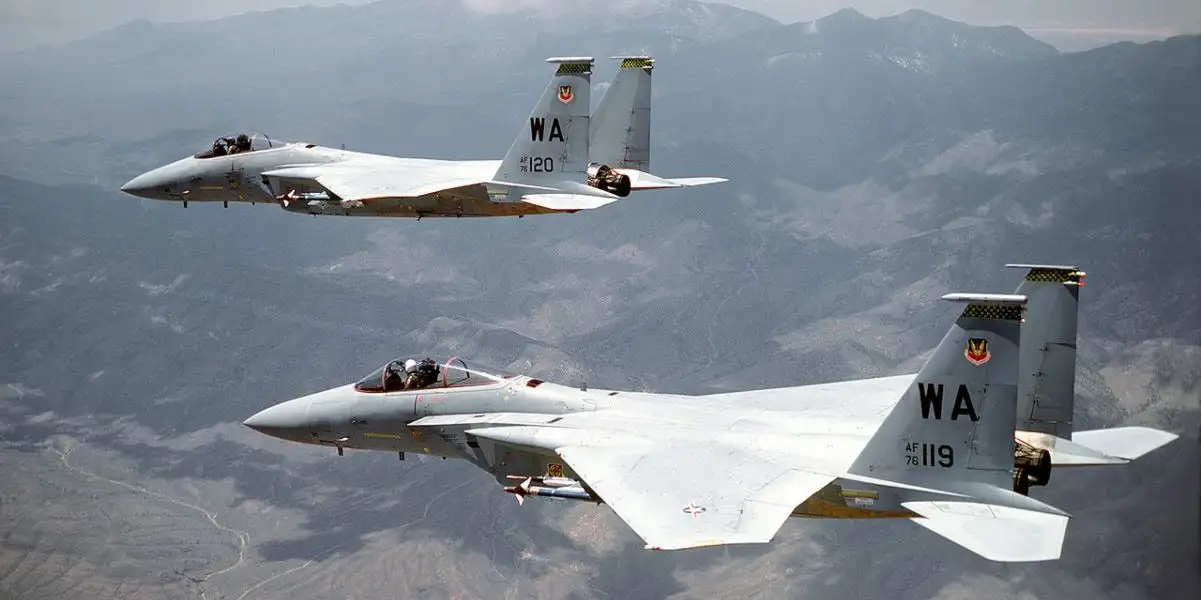
Discussing his job with the 1st Tactical Fighter Training Squadron, Bob said, “Lieutenant Colonel Richie Smith, who became a two-star general, was my new boss, and we were teamed up to do a lot of flying together because he was new to the F-15. He nominated me to become assistant director of operations, third in command, with four flight commanders under my watch. I had responsibility for scheduling and running the flight schedule and making sure we got plenty of days away at weekends to meet the monthly and annual flight hour requirements.”
“We flew to Ellington Air National Guard Base, Texas, where the resident 111th Fighter Interceptor Squadron was converting from the F-4D Phantom to the Block 15 F-16A. The squadron wanted us to work with them. Some of the squadron’s pilots flew with NASA, including the first space shuttle commander, who was a general.”
Big mission plan
“Our big mission plan involved flying combat air patrols and intercepting low-level targets. A KC-135 tanker, led by an RAF exchange officer, was tasked to fly on a tow line that was positioned such that we would not be able to aerial refuel and get to our points for the next CAP timings. We explained the tactical situation to him and asked if he could fly south to meet us. With me leading four F-15s and another RAF pilot leading the tankers, we made the maneuver just as we would in the UK, with the tankers flying towards us. During the maneuver, I told them when to turn so we could run in behind them.”
“We got the first F-15 plugged straight away, followed by the other three; all four aerial refueling contacts were conducted with a faster fuel flow rate. Everyone involved in the mission thought it was a great maneuver, made possible because of the way the two lead RAF pilots had been trained and were allowed to fly the maneuver.”
Bob completed his final F-15 flight at Tyndall in December 1990 before returning to the UK, where he took up the role of Typhoon Operational Requirements Liaison Officer (ORLO) at the Ministry of Defence’s main building in London. After that posting, he became BAE Systems’ de facto flight operations officer for Eurofighter before leaving the military to join Virgin Atlantic, where he flew Boeing 747s.
Inside The F-15 Eagle is published by Key Publishing and is available to order here.
Photos by Mike Freer – Touchdown-aviation via Wikipedia and U.S. Air Force


