

“I locked a target 38 km [20.5 miles] from me, and at 29 km [15.6 miles], I fired [the] R-40RD missile from under my right wing. I kept the target locked with my radar [un]till I witnessed a huge explosion in front of me,” said Lt. Zuhair Dawoud, an IrAF MiG-25 pilot.
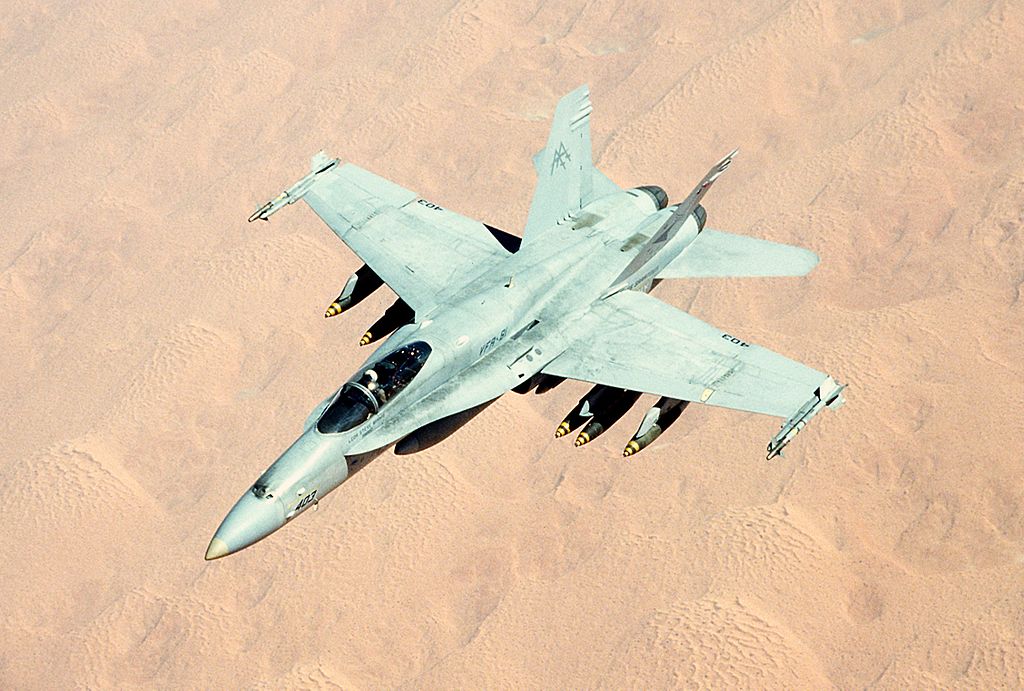
The opening phase of Operation Desert Storm began at 0300 hours on January 17, 1991. That night, the U.S. Navy launched three strike packages: two groups tasked with suppressing enemy air defenses (SEAD) and an “alpha strike” against Tammuz Air Base. Crossing the Saudi border at altitudes between 25,000 and 29,000 feet, the alpha strike was led by ten F/A-18C Hornets from VFA-81 and VFA-83 aboard USS Saratoga (CV-60). The aircraft flew in a broad formation, technically a wide right echelon, with two to five miles between them. Each aircraft was positioned 1,000 feet above the one ahead to reduce the risk of mid-air collisions.
As Douglas C. Dildy and Tom Cooper explain in F-15C Eagle vs MiG-23/25, the Hornets swept the airspace ahead of the strike aircraft and provided SEAD support. Five VFA-83 “Rampagers” formed the western half of the formation, while five VFA-81 “Sunliners” made up the eastern side. The Hornets then spread out to reach individual HARM launch points arranged in a semicircle around Tammuz’s western perimeter.
The strike force consisted of eight Grumman A-6E Intruders. Between 0400 and 0403 hours, four aircraft from Saratoga’s VA-35 conducted dive-bombing attacks from 25,000 feet, each releasing four 2,000-pound Mk 84 bombs against two large hangars. Between 0404 and 0407 hours, four A-6Es from VA-75, embarked aboard USS John F. Kennedy (CV-67), attacked two hardened MiG-29 assembly facilities with 2,000-pound GBU-10 laser-guided bombs.
The Intruders were supported by three EA-6Bs from VAQ-130 and escorted by two pairs, or “sections,” of F-14As from VF-32, all operating from Kennedy. However, because the Tomcats lacked an onboard electronic identification system, they were not permitted to sweep ahead of the Navy strike packages, apart from the distant H3 area in the west. This restriction was intended to prevent fratricide, or “blue-on-blue” fire, against USAF F-15Cs and F-15Es leaving the area. Instead, the F-14s were assigned to closely protect the slower and comparatively vulnerable carrier-based attack and support aircraft.
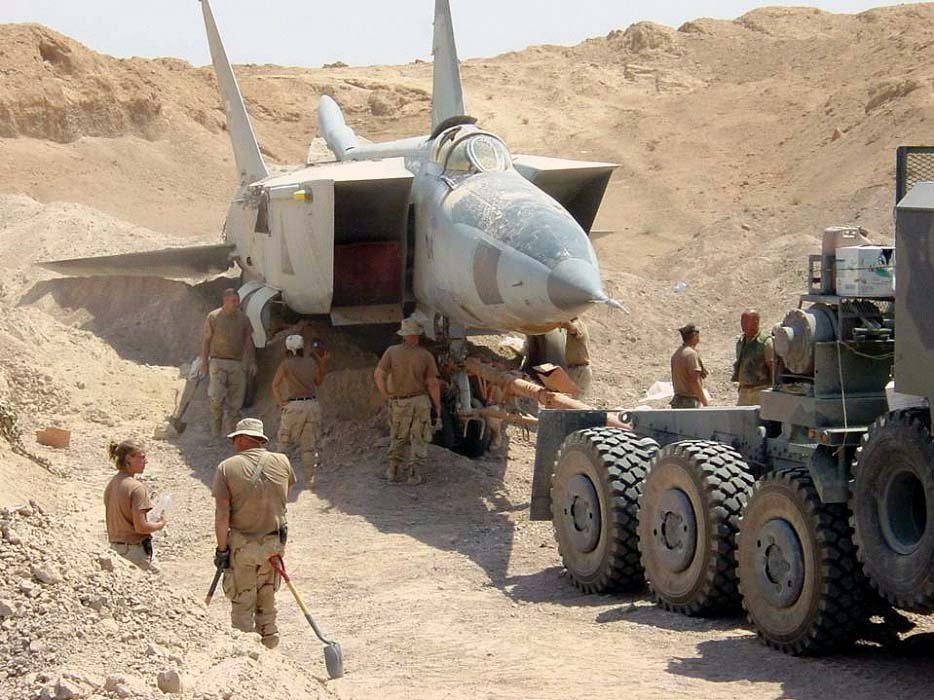
Because the remaining Iraqi radars had a longer detection range at higher altitudes, they detected the large U.S. Navy strike formation before it crossed the border while heading north. At approximately 0330 hours, the only Iraqi Air Force fighters still airborne were two MiG-29s attempting to intercept B-52s attacking Talha. After the Tammuz Integrated Operations Center determined that the largest group of attackers appeared to be heading north toward Qadessiya Air Base, also known as Al Asad, No. 96 Squadron was ordered to scramble a MiG-25PD against the approaching “alpha strike.”
The mission was assigned to Lt. Zuhair Dawoud, one of four Foxbat pilots on standby alert in Qadessiya’s main aircraft shelter. Dawoud later recalled that, at 0238 hours Baghdad time, or 0338 hours Riyadh time, the Air Defense telephone rang. The caller urgently ordered an immediate MiG-25 takeoff, prompting Dawoud to hurry to the aircraft. The technicians and aircraft had already been prepared for such an alert, allowing him to become airborne only three minutes after receiving the call.
After takeoff, Dawoud switched to the secure frequency and established contact with the Ground-Control Intercept station responsible for the Air Defense Sector. Visibility was excellent under clear skies, and the GCI controller began directing him toward a group of aircraft that had entered Iraqi airspace south of the base.
Dawoud immediately turned south and climbed under full afterburner to 8,000 meters, or 26,247 feet, accelerating to Mach 1.4. His Smerch-A2 radar remained in standby mode while it warmed up. In the darkness ahead, he was directed toward the center of the Hornet formation, almost directly toward the aircraft flown by the “Sunliners” commander, Cdr. Michael T. “Spock” Anderson.
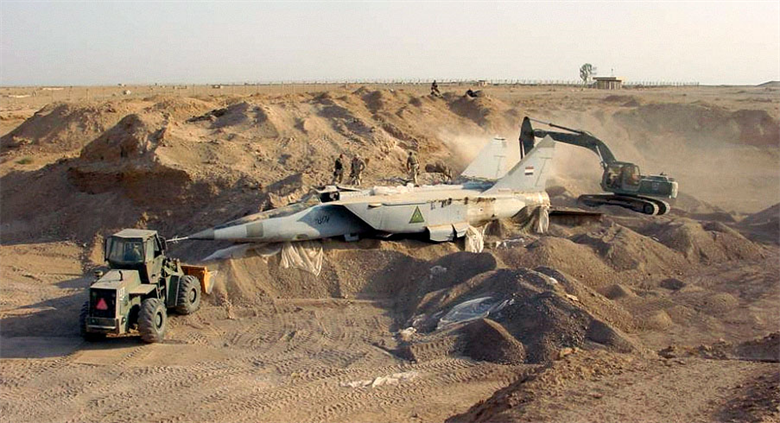
Approximately 70 miles south of Qadessiya, at an altitude of 25,000 feet, Cdr. Michael T. “Spock” Anderson, flying aircraft “AA401,” detected the MiG-25 on radar. He later recalled receiving an immediate radar contact on an aircraft climbing out of an airfield ahead of the formation. The F/A-18’s electronic identification equipment indicated that the contact was hostile. Anderson also saw an afterburner flame, which he recognized as characteristic of a MiG-25 because of its unusually long, bright-yellow appearance.
After Anderson locked the target, the MiG-25 turned right and began maneuvering counter-clockwise around the Hornet. Anderson followed, completing several circles with the aircraft. Dawoud later confirmed the initial geometry of the encounter, explaining that his radar was still warming up and that he was approximately 90 kilometers, or 48.6 miles, from the strike formation when an opposing aircraft locked onto him. He responded with a hard defensive maneuver that broke the lock.
Although Anderson had both a positive electronic identification and visual confirmation of the MiG-25, he withheld fire while awaiting confirmation from the AWACS controller, callsign “Cougar.” The rapidly climbing Foxbat had only just appeared at the outer edge of the E-3 Sentry’s radar coverage. Because Dawoud’s radar was not transmitting, there was no electronic signature that could be correlated with the contact, leaving Cougar unable to confirm that the aircraft was hostile.
The Hornet and Foxbat continued turning toward one another and completed a full circle in the darkness, their afterburners glowing brightly. They then passed each other in opposite directions. Dawoud rolled out and disengaged his afterburner, causing Anderson to lose visual contact. The MiG-25 then broke away toward the east, passing almost directly over Anderson’s wingman, flying aircraft “AA406.”
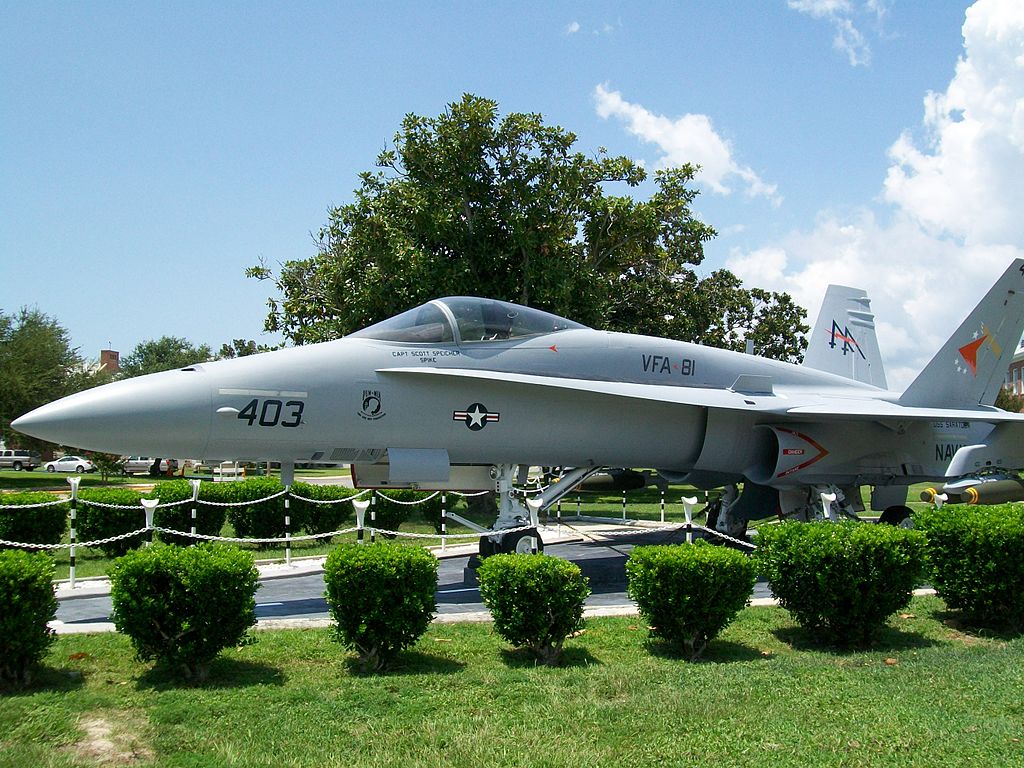
Flying at the rear of the long, wide echelon was Lt. Cdr. Scott “Spike” Speicher in “AA403” (BuNo 163484). As he approached his HARM launch point at 364 knots and 28,160 feet, Speicher disengaged the autopilot at 03:49:43 and selected afterburner. He then lowered the nose slightly to accelerate for the first HARM launch. The recovery of “AA403’s” digital storage unit during the 1995 examination of the crash site later provided a detailed record of the aircraft’s flight parameters. Within 17 seconds, Speicher had accelerated to 540 knots while descending to 27,872 feet.
Dawoud continued his account by reporting the earlier encounter to the GCI controller. He was instructed to resume his original intercept course after being told that targets were located 38 kilometers, or 20.5 miles, away. By then, the MiG-25’s radar had become operational. Dawoud locked onto a target at that range and launched an R-40RD missile from beneath the aircraft’s right wing when the distance had closed to 29 kilometers, or 15.6 miles. He maintained the radar lock until a large explosion appeared ahead of him, then watched the stricken aircraft spiral toward the ground engulfed in flames.
At 0350 hours, an AWACS controller observed two radar contacts merge. The R-40RD detonated beneath the Hornet’s cockpit, striking from the left side. Its 154-pound high-explosive blast-fragmentation warhead violently slewed the aircraft 50 to 60 degrees to the right and generated lateral forces of approximately 6G. The resulting stresses tore away the external fuel tanks and their pylons, along with one HARM.
Speicher ejected from the aircraft but later died from his injuries. “AA403” crashed approximately 48 miles due south of Qadessiya.
F-15C Eagle vs MiG-23/25 is published by Osprey Publishing and is available to order here.
Photo by U.S. Navy, U.S. Air Force, Mikejapp and Dmitriy Pichugin via Wikimedia Commons

