

Roger Ball!
He was the younger of two children, born on January 25, 1940, at Shandon Baptist Hospital in Columbia, South Carolina. By all outward appearances, he was a normal, healthy boy of average height—slender, but not thin. History would prove he was anything but ordinary.
His name was John Monroe Smith, and Roger Ball! tells his story—a story worth telling. It weaves together the firsthand experiences of a fighter pilot with the major developments in the fighter community and the historical events that shaped Captain John Monroe Smith, USN, known by the call sign “Hawk.” In the end, it also honors the men who put their careers—and sometimes their lives—on the line for their shipmates and their country.
Hawk was a legend in the fighter community. Over a 30-year career, he earned a reputation as a formidable air-to-air combat pilot, a natural tactician, and an exceptional leader. To many, he was one of the key figures who helped modernize naval air warfare.
He was only one man, but his life is a vivid account of achievement in naval tactical aviation, dedication to a cause, and service to his country. It was an era during and after the Vietnam conflict, when America was deeply divided. The military was frustrated by civilian interference in the conduct of the war, and tactical aviation across the services was struggling to absorb the harsh lessons of combat. The Navy needed leaders and determined thinkers to set things right again. It was Hawk’s time.
USS Enterprise during Operation Frequent Wind
By early 1975, the rapid advance of North Vietnamese forces into the south made it clear that the South Vietnamese defenders would not be able to hold out for much longer. In response, South Vietnamese leaders planned to abandon the northern cities and provinces to strengthen and defend positions in the south.
On March 28, Captain C. C. Smith sailed Enterprise out of Subic Bay and headed west—toward the sound of gunfire. The next day, Easter Sunday, North Vietnamese troops entered Danang, and Enterprise took station off the South Vietnamese coast. For the next ten days, she patrolled offshore, provided airborne and deck-alert combat aircraft, and served as a forward logistics platform for Amphibious Task Force Seven Six (ATF-76).
USS Midway (CV-41) relieved Enterprise on April 9, and the Big “E” was placed on twelve-hour alert. If the situation turned critical, she could quickly return and support the operation.
On April 18, Enterprise entered Manila Bay and anchored. She had barely settled in before receiving emergency orders to proceed at 25 knots to a position 150 miles east of Vung Tau, Vietnam, a small village on a narrow spit of land.
Even before Enterprise reached its station, CAG-14 already had aircraft airborne. Around-the-clock surge operations began immediately. At all times, at least one E-2, one Vigi, and a flight of fighters or attack aircraft were in the air. They protected the ships, Marine helicopters, and ground forces. The LSOs stayed on the platform day and night.
USS Enterprise during Operation Frequent Wind
Enterprise was one of fifty Navy combat and support ships in a vast armada. Their role was to build the surface radar picture, defend against hostile air or sea threats, take on evacuees escaping in small boats and aircraft, and provide combat air patrol for the helicopters.
Enterprise operated alongside three other carriers in the South China Sea. She and Coral Sea (CV-43) retained their full air wings, while Midway (CV-41) and Hancock (CV-19) had their air wings removed to carry ground forces and helicopters.
Coral Sea brought five hundred elite Marines from the 9th Marine Amphibious Brigade, who would help spearhead the move into Saigon and secure areas as needed. HMM-165, with twenty-seven CH-46s, along with helicopters from HML-367, HMA-369, and the 21st Special Operations Squadron, played leading roles in the rescue effort. The main lift force, however, was Heavy Marine Helicopter Squadron 463, which fielded thirty-four CH-53s and three hundred aircrew and maintenance personnel under III Marine Expeditionary Force. The USAF also stood ready to provide close air support and armed escort missions with more than 120 fighters and support aircraft operating from as far away as Udon Air Base in Thailand, 450 miles from Saigon.
The final assault on Saigon began in the last week of April. Communist forces faced only scattered resistance, and South Vietnam’s defenses were collapsing rapidly. At 2245 Washington, D.C. time—1045 in Saigon—on April 29, President Ford ordered Frequent Wind, the emergency helicopter evacuation of all remaining Americans in Saigon. By the time the operation began, 6,000 Marines were leading the largest helicopter evacuation in history.
Tomcat’s first combat sortie
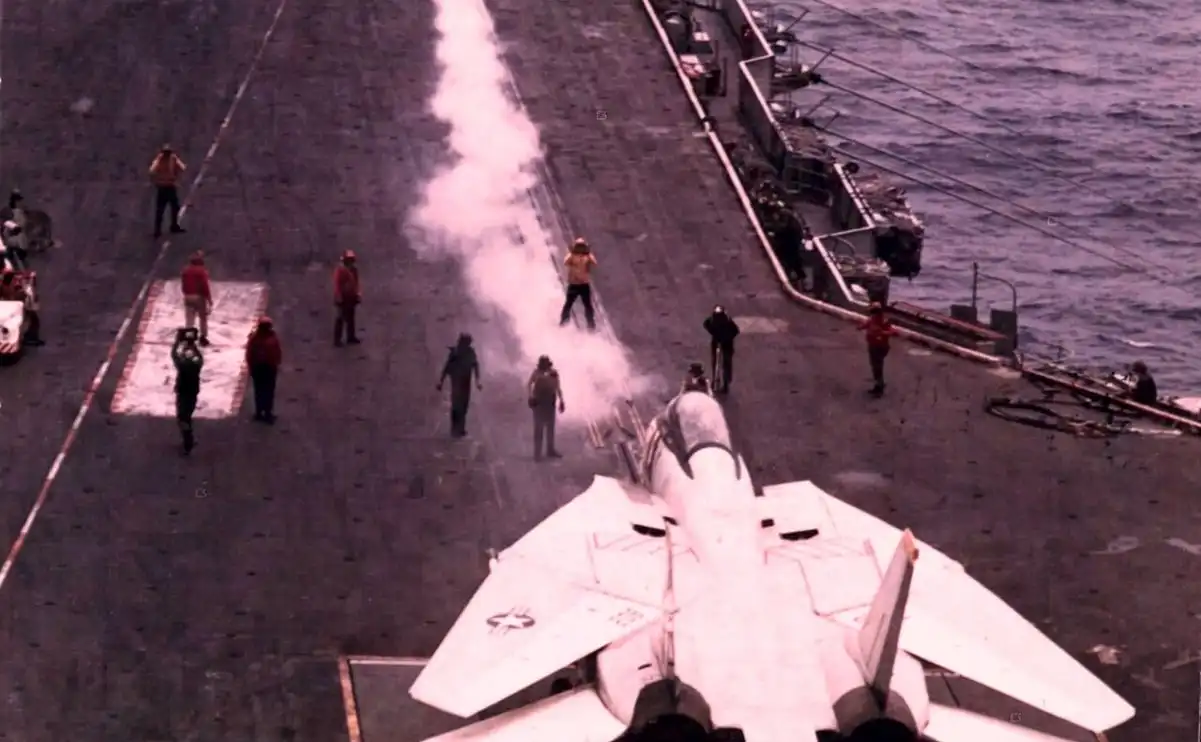
Hawk and his RIO, Joel Graffman, launched from Enterprise on the morning of April 29 for what became the Tomcat’s first combat sortie and Hawk’s only one. Their assignment was to fly Combat Air Patrol (CAP) and provide armed escort for the helicopters evacuating personnel. Before takeoff, they were warned to expect small-arms fire and possibly SAM-7 shoulder-fired surface-to-air missiles in the area. Intelligence officers noted that the SAM-7 threat reached from the surface to 5,000 feet, and anything flying in that band below 500 knots was fair game.
Hawk and Joel made their way to the CAP station near Vung Tao. After checking in with the USAF airborne command post, they were vectored to cover several Marine helicopters. Hawk picked them up a few miles out and flew a racetrack pattern overhead as they moved away from the Embassy and toward the ships.
Everyone involved in Frequent Wind knew the war was only hours from being lost, and no one wanted to be the last American casualty. The tactical air crews kept the surface threat in mind, but the F-14 crews were especially alert to the possibility of stray small-arms fire.
Clutching the American flag
Hawk established a 3,000-foot, 350-knot moving orbit over the helicopters and escorted them all the way to the ship. In Hawk’s words, “It seemed pretty uneventful to me. We saw small arms flashes, and a lot of vehicle and troop movement, and the helos even popped flares occasionally but it seemed like a pretty humdrum sortie to me. It wasn’t really what I had in mind when I thought of green-ink 1 time and combat. I’ve had a lot more excitement on any number of test flights.”
During the early hours of April 30, gunfire could be heard throughout the embassy area, and anti-aircraft fire was described as “heavy.” Admiral Noel Gayler, CINCPAC, personally escorted Ambassador Martin, his wife, who was clutching the American flag, and his close staff to a waiting helicopter. At 0458, “Lady Ace 09,” a HMM-165 CH-46 flown by Marine Captain Berry, departed the American embassy and flew to Hancock offshore.
At 1100 on April 30, a North Vietnamese tank came to a noisy, dusty stop in the courtyard of the Saigon presidential palace. Colonel Bui Tin, deputy editor of the North Vietnamese Army newspaper, Qwan Doi Nhan Dan, dismounted, entered the palace, and went up to a second-floor reception area. There he found South Vietnamese General Duong Van Minh and the remaining members of his staff. General Minh formally surrendered South Vietnam to Colonel Bui Tin.
After Action
On behalf of the North Vietnamese government, Colonel Bui Tin accepted the surrender and then said, “Between Vietnamese, there are no victors and no vanquished. Only the Americans have been beaten. If you are patriots, consider this a moment of joy. The war for our country is over. Only the Americans have been beaten.”
That was not entirely true. Millions of South Vietnamese, Laotians, and Cambodians had already been killed, and millions more would die before the insurgency ended.
Although Frequent Wind would be considered a success, there was no way to make the outcome of the war easy to accept. The Enterprise crew had taken part in a historic moment. They had just witnessed the end of America’s longest war and its first major military defeat. The world’s greatest military power had just been defeated by a nation smaller than California.
1 Green Ink time referred to the color of the ink used to designate air combat time in the logbooks of aircrew.
Photos by U.S. Navy

