

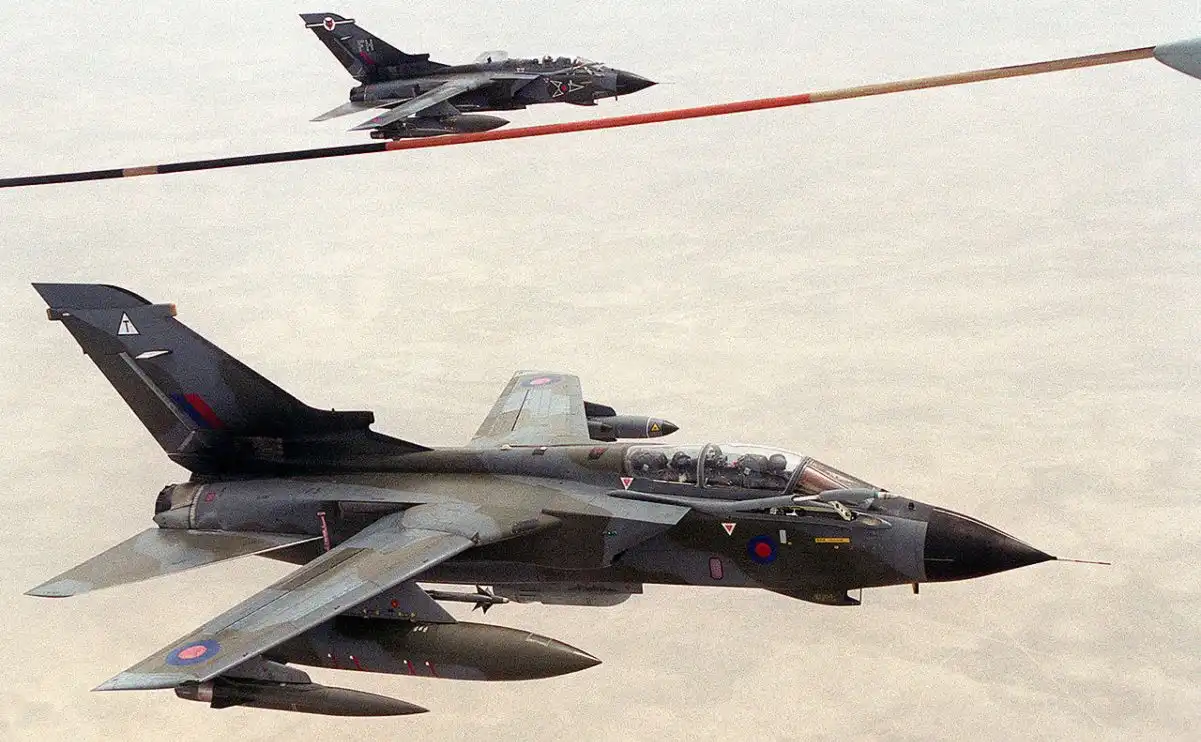
RAF Tornado GR1 low-level training during Exercise Red Flag
During the late 1980s, as the Cold War entered its final years, NATO air tactics remained centered on low-level operations. Routine training sorties were conducted in the Low Flying Areas (LFAs) of Germany and Belgium, including the Ardennes region, where aircraft could operate at altitudes as low as 250 feet. The UK’s 250-foot LFAs were open to RAF and USAFE aircraft based in Britain, as well as squadrons stationed in RAF Germany.
Several areas in Scotland were also designated as Tactical Training Areas (TTAs). In these zones, RAF Tornado crews could be authorized to fly as low as 100 feet while preparing for demanding exercises such as Red Flag.
Michael Napier, an RAF Tornado GR1 pilot attached to 31 Squadron at RAF Brüggen, describes one such 100-foot low-level training sortie during Exercise Red Flag in his book In Cold War Skies:
Michael Napier recalled that, at 500 knots, the scenery seemed to rush past. He said that a pair of anti-aircraft artillery sites attempted to engage the aircraft, forcing him to fly as low as possible and use the terrain for protection. At 100 feet above the desert floor, even the smallest fold in the ground could provide some cover.
He explained that, while hugging the ground, he made slight evasive maneuvers to give the guns a wider miss distance while keeping them within the coverage of the aircraft’s Skyshadow jamming pod. In the back seat, the navigator, Kev, released a cloud of chaff to further confuse the radar. Napier added that they soon passed beyond the sites’ effective range, leaving the guns unable to threaten them.
Simulating the JP233 runway denial weapon
Michael Napier explained that a small knoll in an otherwise featureless stretch of desert marked the Initial Point (IP) for their attack. He noted that this differed considerably from the conditions they were accustomed to in Europe, where crews could spend the final minutes before reaching the target following a detailed map. With numerous recognizable landmarks across any ten-mile stretch of European terrain, map reading remained relatively straightforward even at 500 knots.
He added that the navigator in the back seat would normally have plenty of identifiable features appearing clearly on the radar. The Nevada desert, however, was largely devoid of such references. Although the Red Flag targets were large, most had been created by bulldozing shapes into the sand, giving them no vertical profile. They were easy to see from 20,000 feet, but much harder to identify from a Tornado cockpit travelling at 100 feet above the ground.
Napier said that Kev did his best to use the radar as they thundered towards the target area, Tolicha Peak, which was a full-scale replica of the Soviet airfield at Jüterbog in East Germany. He explained that it represented the kind of target they might have been assigned if war had broken out in the Central Region. During the exercise, they were simulating the JP233 runway-denial weapon by dropping a “hollow stick” of two 3kg practice bombs. The first bomb would mark the beginning of the trail of JP233 submunitions, while the second would mark its end.
Bombs gone!
Michael Napier recalled that the time-to-go circle on the Head-Up Display (HUD) unwound rapidly, counting down the final 60 seconds before they reached the target, while the desert floor flashed past beneath them at breathtaking speed. At the 30-second mark, they had to cross a slight ridge before the target came into view. As they cleared it, a massive airfield appeared ahead of him, with a thin wisp of orange smoke lingering at the far end of the runway from attacks carried out by aircraft earlier in the formation.
He said that Kev had done an excellent job and that they were perfectly aligned with the runway. Napier explained that he pulled up slightly to 150 feet to ensure the weapons were not released from too low an altitude, as they might otherwise fail to fuse correctly. Suddenly, another “Firecan” radar site locked onto them. Napier responded by hauling the Tornado onto its wingtip and pulling hard while pushing the throttles into full reheat to maintain their speed. When the radar lock broke, he turned back towards the target. With only enough time to align with his aiming point, level the wings, and stabilize the aircraft’s speed, he released the bombs. They then raced straight ahead to clear the defenses before executing two hard 90-degree turns and heading for home.
In Cold War Skies is published by Osprey Publishing and is available to order here.
Photos by PH2 (NAC) Jeff Viano / U.S. Navy and Anidaat Own work via Wikipedia

