

The Flashback Test Vehicle was larger by far than any other nuclear bomb in the US inventory at the time. It is a little bit bigger than the Soviet Tsar Bomba, the 50-megaton monster that detonated in 1960 and was designed to be 100 megatons in yield.
After entering service in 1955, the B-52 Stratofortress served as the U.S. Air Force’s principal long-range heavy bomber throughout the Cold War and remains a key element of the USAF bomber fleet. Almost 750 aircraft were produced before manufacturing ended in the autumn of 1962.
Over its long operational career, the B-52 established numerous records. On Jan. 18, 1957, three B-52Bs completed the first nonstop around-the-world flight by jet aircraft, covering the distance in 45 hours and 19 minutes with only three aerial refuelings. The aircraft also conducted the first airborne hydrogen bomb drop over Bikini Atoll on May 21, 1956.
One B-52 was later modified to carry a mysterious device codenamed Flashback.
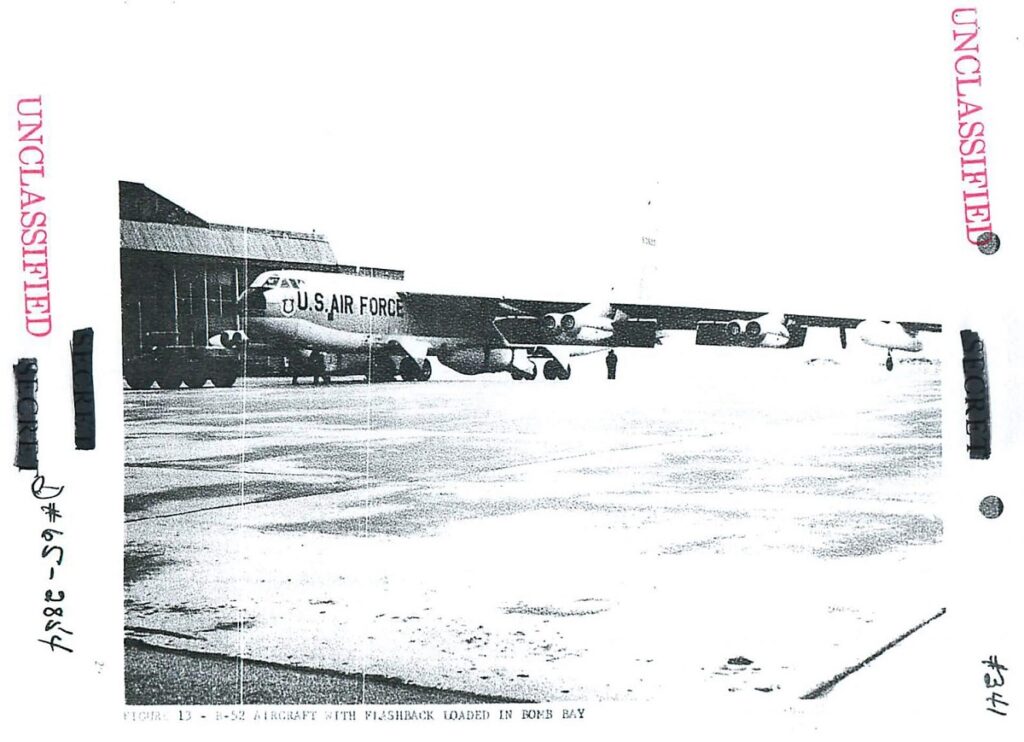
As Scott Lowther explains in Boeing B-47 Stratojet & B-52 Stratofortress Origins and Evolution, mystery is often the most effective way to spark intrigue. The mid-1960s modification of a B-52C for the Flashback program is a perfect example.
The modifications to the bomber itself are not especially noteworthy; the real mystery lies in the Flashback Test Vehicle (FBTV). Designed as a payload carried beneath a B-52 and released in the manner of a bomb, the vehicle raises several questions. Was it actually a bomb, a purely scientific experiment, or a prototype intended to lead to a practical device? Since Flashback first became publicly known around 2017, its purpose has remained unclear. However, new information has gradually begun to shed light on the program.
Flashback emerged from a program established after the 1963 signing of the Limited Test Ban Treaty. Its purpose was to provide a means of rapidly developing and demonstrating a high-yield hydrogen bomb—estimated at between 50 and 100 megatons—if the Soviet Union violated the agreement, an action U.S. planners reportedly considered likely. Flashback tested the bomb’s supporting systems without using an actual nuclear explosive, allowing engineers to evaluate its hardware, ballistics, and electronics. The casing and associated components would therefore be ready, with the fission-fusion package expected to be installed and prepared for detonation within 90 days of a Soviet test.
In January 1965, the Flashback Test Vehicle underwent testing at Kirtland Air Force Base, New Mexico. These trials did not involve dropping and detonating a nuclear weapon. Instead, they examined whether the device could withstand electromagnetic emissions from the B-52’s ARC-58 transmitter and from its own telemetry transmitters. For the flight tests, all high-explosive and nuclear components were removed and replaced with a warhead simulator.
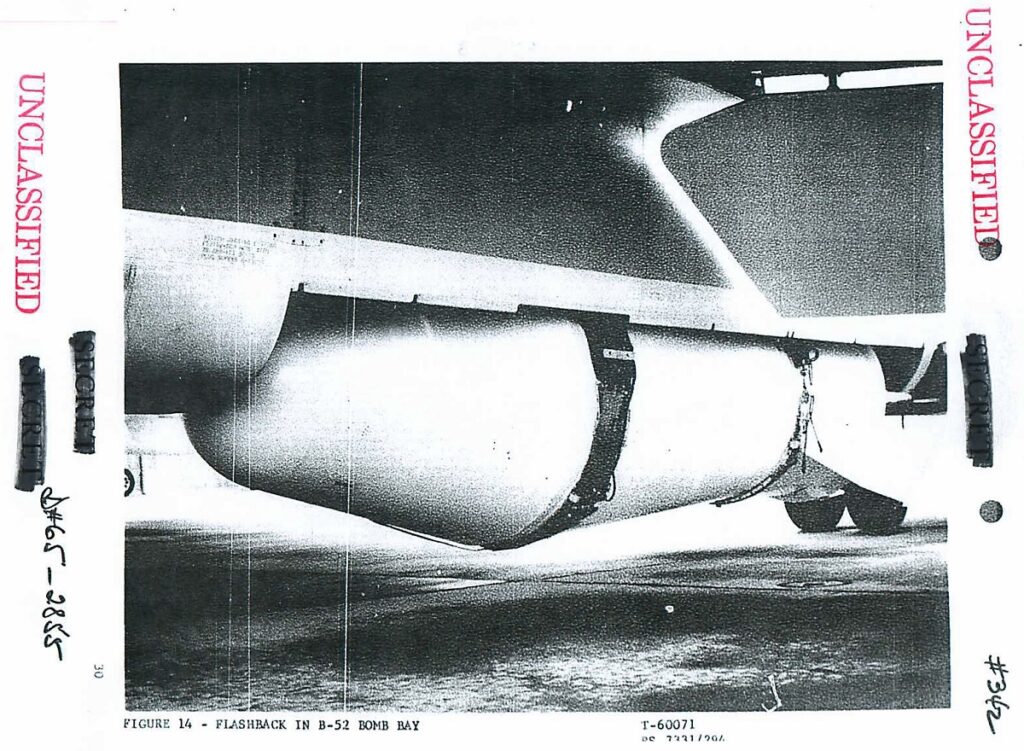
The Flashback vehicle itself was enormous. To accommodate it in the B-52’s bomb bay, the bay doors had to be removed, yet the device still extended below the aircraft’s fuselage. Excluding the projecting parachute pack and antennas, it measured approximately 96 inches in diameter and 297 inches in length.
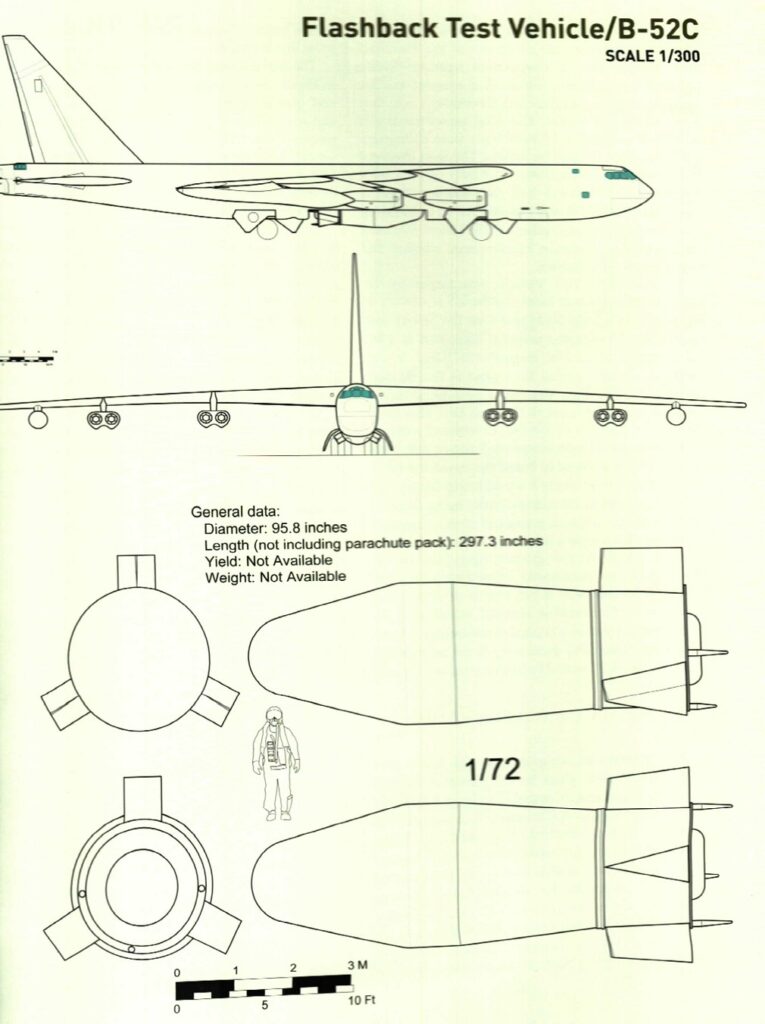
The Flashback Test Vehicle had a distinctive configuration. Its rounded, conical nose closely resembled—though did not exactly match—the Mark 6 reentry vehicle used by the Titan II intercontinental ballistic missile. If the component was indeed derived from the Titan II RV, its selection may simply have reflected convenience and availability. However, it could also suggest that engineers envisioned a common warhead design for a Titan-delivered version of the high-yield weapon.
Behind the nose was a short cylindrical section, followed by a tapered rear body fitted with three wedge-shaped fins. A large parachute pack occupied the back of the vehicle, while several antennas extended from the rear, presumably transmitting telemetry during a drop. The fins were notably similar to those used on large hydrogen bombs of the period.
The FBTV and its modified B-52C were depicted in a handful of poor-quality photographs, along with clearer wind-tunnel model diagrams. These materials helped establish the vehicle’s approximate shape and dimensions. In 1966, the Cornell Aeronautical Laboratory conducted wind-tunnel tests for the Sandia Corporation, which had designed the Flashback Test Vehicle. Sandia Corporation operated Sandia National Laboratories, a leading facility specializing in nuclear-weapons ordnance engineering. Sandia supplied Cornell with aluminum models of both the FBTV and the B-52. The tests examined the vehicle’s aerodynamic behavior while mounted in the bomber’s bomb bay and after release. The FBTV may have been scheduled for an actual drop from the B-52 over Johnston Atoll in September 1967, as part of Operation Paddlewheel, although it is not known whether the test took place. The Flashback Test Vehicle was considerably larger than any other nuclear bomb in the U.S. inventory at the time. It was slightly larger than the Soviet Tsar Bomba, the 50-megaton weapon detonated in 1960 that had originally been designed for a yield of 100 megatons. Flashback was not the only concept for an enormous hydrogen bomb, either. Another design, known as the Big Test Vehicle, was cylindrical and shaped to fit inside the B-52’s bomb bay. Its intended yield was also comparable to that of the Tsar Bomba. The presence of the parachute pack indicates that the vehicle was not intended to descend at supersonic speed. Instead, the parachutes would most likely have begun deploying almost immediately after release. Sandia had pioneered the concept of the “laydown” bomb, which used a parachute to bring the weapon gently to the ground. Rather than detonating on impact, such a bomb could be programmed to explode after a preset delay. Combined with the slowed descent, this delay would give the bomber more time to escape the blast area. For a weapon with a potential yield of hundreds of megatons, the B-52 would have needed every additional second available to get clear.
Boeing B-47 Stratojet & B-52 Stratofortress Origins and Evolution is published by Mortons Books and is available to order here.
Photo by: U.S. Air Force


