

Four USMC F-35Bs from VMFA-214 made a quick stop at Coeur d’Alene Airport. Coeur d’Alene is the hometown of World War II ace Gregory “Pappy” Boyington, who was also the commanding officer of VMF-214 Black Sheep during the conflict
As shown in the video accompanying this post, four U.S. Marine Corps (USMC) F-35B Lightning II strike fighters from VMFA-214 flew over Coeur d’Alene Airport on June 17, 2023. The Idaho city was the hometown of World War II ace Gregory “Pappy” Boyington, who commanded VMF-214—the Black Sheep—during the conflict.
According to FOX28, members of the public were invited to view the aircraft at close range. The F-35Bs were stationed at the Aviation and Maintenance ramp from 1 p.m. to 2 p.m., where Marines displayed the aircraft for visitors.
“Our original CO was Pappy Boyington in World War Two,” said Soaker, a USMC F-35B pilot. “So obviously [the] hometown of Pappy Boyington. And so, the Marine Corps League invited us up so we can see our squadron’s heritage.”
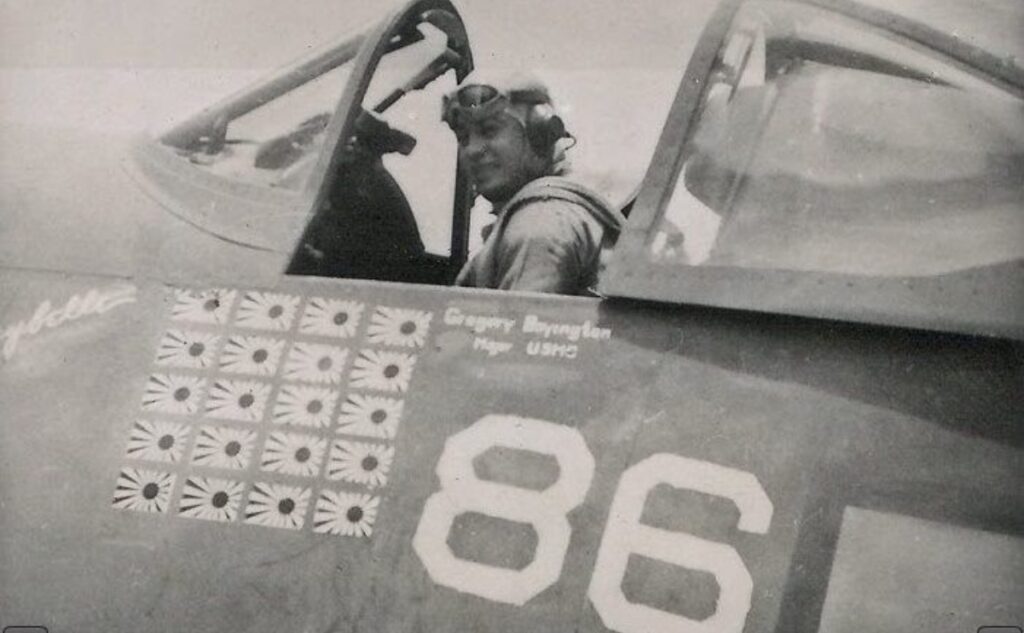
Major Gregory “Pappy” Boyington, a Marine Corps ace credited with destroying 28 Japanese aircraft, received the Medal of Honor “for extraordinary heroism above and beyond the call of duty” while commanding a Marine fighter squadron in the Central Solomons from September 12, 1943, to January 3, 1944. He was also awarded the Navy Cross and numerous other decorations for his combat service.
Boyington was born in Coeur d’Alene, Idaho, on December 4, 1912. Located in northern Idaho, Coeur d’Alene is known for its scenic surroundings and namesake lake. Boyington grew up there and attended high school in the city before enrolling at the University of Washington in Seattle.
He began his military career while still in college. On March 11, 1937, he became a Naval Aviator, and on July 2 of the same year, he was commissioned as a second lieutenant in the U.S. Marine Corps.
On August 26, 1941, Boyington resigned his Marine Corps commission to join the Central Aircraft Manufacturing Company, a civilian organization established to help protect the Burma Road. The unit later became the American Volunteer Group, better known as China’s famed “Flying Tigers.” During his time with the group, Boyington became a squadron commander and shot down six Japanese aircraft, building a significant lead over many American aces who did not enter the war until after December 7, 1941. Before the AVG was disbanded, he had flown 300 hours in combat.
Boyington earned the nickname “Pappy” during World War II because, at 31, he was considered one of the older pilots in his squadron. He initially served with VMF-122 in the Pacific, but gained widespread recognition after assuming command of VMF-214 in September 1943.
According to Marine Corps University, Boyington’s victories continued to mount during operations in the Russell Islands, New Georgia, Bougainville, New Britain, and New Ireland areas. During his squadron’s first combat tour, he personally shot down 14 enemy fighters in just 32 days. On December 17, 1943, he led the first Allied fighter sweep over Rabaul, an area regarded as nearly impregnable. By December 27, his tally had reached 25 aircraft. On January 3, 1944, he shot down another Japanese fighter over Rabaul, tying the existing American record of 26 aerial victories.
Under Boyington’s command, the Black Sheep Squadron became renowned for its aggressive and highly effective air-combat tactics. Flying Vought F4U Corsairs, the Marines engaged Japanese forces in numerous intense battles across the Pacific.
Boyington was shot down on January 3, 1944, and spent the next 20 months as a prisoner of war. When he returned to the United States, he was welcomed as a national hero. He left the military in 1947 with the rank of colonel and later wrote Baa Baa Black Sheep, a memoir describing his wartime experiences. After the war, Boyington returned to Coeur d’Alene, where he lived for a time before eventually settling in Fresno, California. He maintained strong ties to his hometown throughout his life and remained one of Coeur d’Alene’s most notable residents. Today, the city commemorates his legacy with several tributes, including a statue near the Coeur d’Alene Resort.
Photo by U.S. Marine Corps, U.S. Navy and Own Work Coloured by Johnny Sirlande via Wikipedia

