

VA-35’s A-6E ‘Ray Gun 502’ was hit by an Iraqi Roland SAM just as it started dropping its six Mk 83 Snakeyes
Taken on Jan. 18, 1991, the impressive photos in this post show VA-35’s A-6E ‘Ray Gun 502’ BuNo 158539 sitting off the runway at Al Jouf, in Saudi Arabia, the morning after having been hit by an Iraqi Roland SAM while attacking H-3 airfield. The crew was able to get the aircraft down on the ground safely, in spite of heavy damage. It carries an ALQ-167 `Bullwinkle’ self-defense jamming pod on station five.
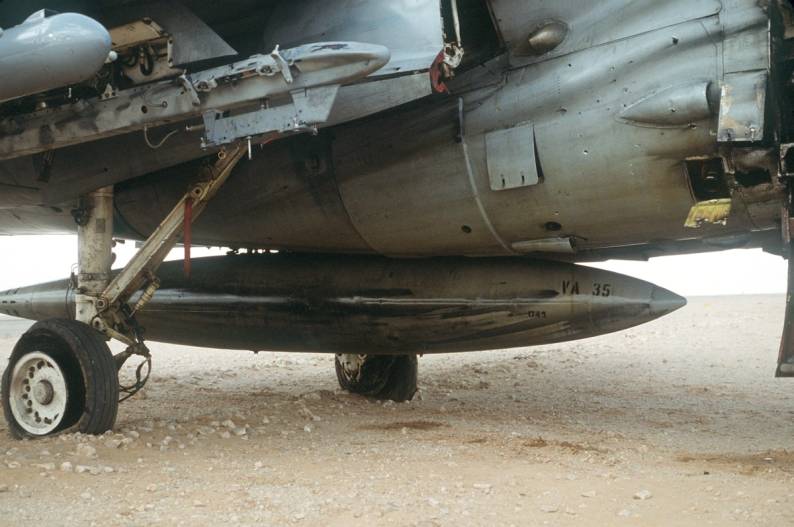
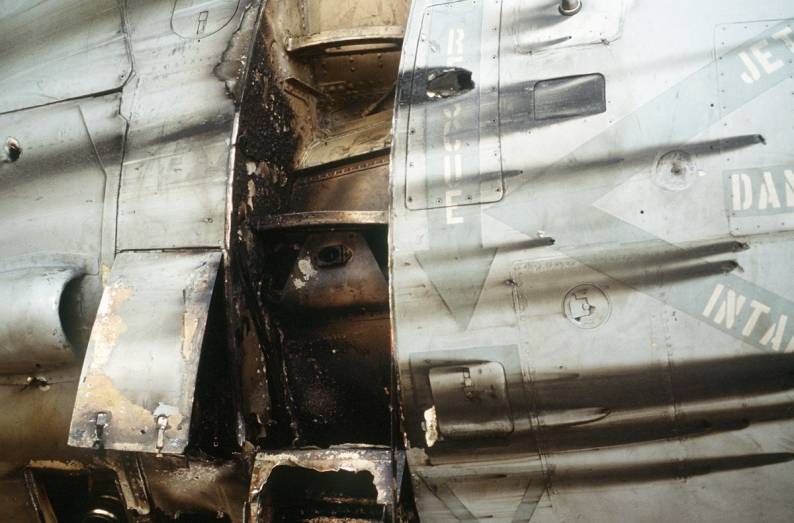
As explained by Rick Morgan in his book A-6 Intruder Units 1974-96, this Intruder was part of the second section of VA-35 aircraft tasked to strike H-3 airfield. The second section of the flight had planned to approach the target from the southwest, but, as happened to the first section, it was lit up by Iraqi defenses. While the lead aircraft made it through the hail of fire, ‘Ray Gun 502’ was hit by a Roland just as they started dropping their six Mk 83 Snakeyes. The aircraft was crewed by Lt John Snevely and his B/N Lt Mark Eddy. ‘We took a Roland aimed right at the nose while over the target at weapons commit,’ Snevely explained. `The missile impact interrupted the release pulse so we had bombs hung on both wings, which we got rid of on our egress from the area. The E-2 and E-3 controllers followed us into Saudi Arabia and got the field at Al Jouf to turn its lights on for us. We did a no-flap/no-slat no radio landing.’
Photographs would show the Intruder had sustained heavy damage, with numerous holes throughout the forward half of the fuselage, the wings, and the canopy. The tough aircraft would later return to CONUS on board the destroyer tender USS Yellowstone (AD-41) where it was rebuilt as a SWIP jet by Grumman. It was eventually retired and placed in storage with AMARC at Davis-Monthan AFB in 1994 (USAF).
Photo by U.S. Air Force
A-6 Intruder Units 1974-96 is published by Osprey Publishing and is available to order here.

