

RAF Phantom
In response to the U.S. Navy’s need for a high-altitude interceptor capable of defending aircraft carriers with long-range air-to-air missiles, McDonnell Aircraft Company developed the F4H Phantom II, later redesignated the F-4. The aircraft first flew in 1958, and deliveries to Navy and Marine Corps squadrons began in 1960. Its impressive performance and versatility soon attracted interest from the U.S. Air Force and the air forces of ten other countries, making the Phantom one of the most widely operated aircraft in aviation history.
The Phantom served as a central component of the Royal Air Force’s combat fleet for more than two decades, providing the Service with one of the world’s most capable strike fighters. The RAF operated two Rolls-Royce Spey-powered variants: the FG1, which was also flown by the Royal Navy in the interceptor role, and the FGR2, used by the RAF in Germany for ground attack and tactical reconnaissance missions.
From 1977 onward, RAF Phantoms were used almost exclusively as interceptor fighters responsible for protecting UK airspace.
Bastille Day 1987
“The French, without doubt, are proud of their way of life, and French folk will usually be eager to claim the virtues of their je sais quoi factor. Sometimes, however, the quoi in question can cause a problem or two for everyone else. I discovered myself in July 1987, on a day known as Bastille Day or La Fête Nationale. The day when the storming of the Bastille prison on 14 July 1789 is remembered as a symbol of the modern nation and thus a cause of considerable celebration all over the place,” says Alan ‘Al’ Winkles, former RAF Phantom pilot, in Robert Pike’s book Phantom Boys.
“The day for me and for my navigator started well enough. It was an unexceptional Tuesday with the two of us on duty with another pilot/navigator crew. We were supported by a team of squadron engineers in the quick reaction alert (QRA) setup at RAF Leuchars. Two Phantoms, kept at readiness to be airborne in a matter of minutes when ordered by the ground radar controller at RAF Buchan, were in a special hangar next to a couple of crewrooms, one for the aircrew and one for the engineers. As the commanding officer of 43(F) Squadron at the time, I was not often on QRA duty, although I liked to ensure I was rostered for the occasional stint. If, as the saying goes, all was quiet on the Western Front, it was, for one thing, an opportunity for me to catch up on irksome paperwork from HQ,” Winkles continues.
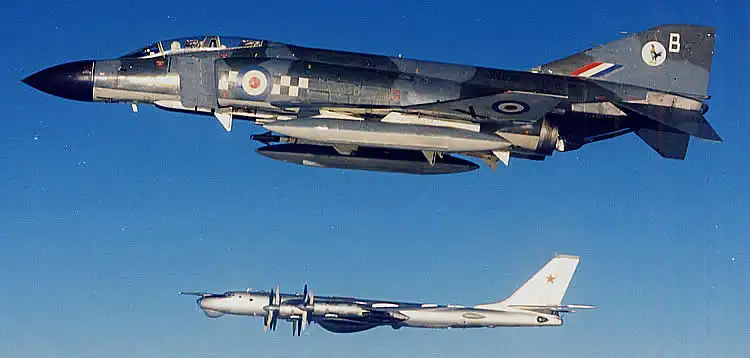
However, on Bastille Day in 1987, Al Winkles was scrambled to patrol east of the Faeroes and await the expected passage of two Bear Deltas en route to Cuba—an otherwise routine mission.
RAF Phantom Fighters Shadowing Soviet Bears
“Sure enough, my trusty navigator made radar contact with them at an astounding range, and we motored in behind them. First we closed in on the rear Bear to read its door number before edging forward to the leader to read its number. Fully satisfied, we then stayed with the Bears for the next 30 minutes or so, seeing them safely off on their westerly heading over the Atlantic. Turning away to the south-east, we headed for home—or so we thought.”
As Al and his back-seater approached Scotland’s north-western coast, Benbecula radar directed them to a rendezvous with a VC10 tanker. However, as Jimmy Bedle recounts in his book The Fighting Cocks, it soon became clear that more activity was expected. After refueling to capacity, the crew was unexpectedly vectored south through the Irish Sea to a point roughly 100 miles southwest of Cornwall.
Portreath radar then informed them that the Soviet aircraft they had previously been tracking had not continued towards Cuba as anticipated. Instead, they had turned south along Ireland’s western coast and appeared to be heading towards the Bay of Biscay. Another VC10 tanker was dispatched to their position, allowing the Phantom to intercept and shadow the Bears. The targets soon appeared to the west, prompting the Phantom to make a 120-degree turn to intercept them.
Soviet Bears over the Bay of Biscay
Al Winkles continues the story.
“We were joined by a VC10, pulled off its training sortie over the North Sea. The tanker fell into line astern as we stationed ourselves on the Bear’s port side. By this time the two Russian aircraft had joined together in loose formation. About 150 miles south of Cornwall, my navigator announced in a small voice that we had fallen off his map. However, as we entered the Bay of Biscay, we were certain that we would soon be relieved by the French Air Force, and we therefore kept a sharp lookout for Mirage fighters.”
“By now we had lost contact with Portreath radar and had just the VC10 for company. The tanker captain then announced that as it was Bastille Day he had been told that we would have to look after the ‘trade’ alone and that, consequently, we could not anticipate any form of relief from Mirage units. Far be it for me, I reasoned, to deny the French their day of Bastille celebrations, but surely there were other considerations too. I could not avoid a feeling of irritation when I pictured our Mirage colleagues as they attended their Bastille barbecues on this mid-summer’s day.”
Epic 5-hour sortie
“The VC-10 captain said he was trying to find a selection of French airfields that might be open for any possible diversion if we got into difficulties. However, thus far, the airfields he had tried had not even replied to his radio calls! Having given us this good news, he then said he was getting short of fuel, that he would give us what he could spare, and then he would leave us, as there was another VC10 due to pitch up in around 30 minutes or so. We took on a few thousand pounds of fuel, and he left us, having given us a selection of vectors towards the nearest airfields in the St. Nazaire/La Rochelle areas – all probably closed.”
“At this point we felt very vulnerable. We had no maps of France, no specific diversions, no weather information, and no radio contact with anyone except for the departing tanker. At this point the Bears seemed quite friendly, and, possibly having been monitoring our situation over the radio, they turned towards the northwest. At least now we felt we were heading home. A very long 30 minutes passed, and then very faintly we heard what appeared to be a distant conversation between our departing VC10 and the one arriving. Sure enough, the new tanker soon appeared and carried out an immaculate join-up using our air-to-air Tacan. The return route was flown in reverse by the Bears and ourselves, and we finally handed the Soviets over to Norwegian fighters, which escorted them on their way back to Murmansk.”
Following that epic five-hour sortie, Al ordered all future 43 Squadron QRA aircraft to carry maps of northern France. It was a case of better late than never.
Photos by Crown Copyright and U.S. Air Force

