

A Strategic Move to Counter China’s Naval Dominance and Understanding the Submarine XO Role
Strategic Enhancement: Anti-Ship Tomahawks on Submarines
The US Navy geared up to enhance its submarine capabilities with ship-targeting versions of the highly versatile Tomahawk missile, marking a strategic move to bolster military strength in the face of growing challenges from Chinese maritime forces, especially in the vicinity of Taiwan, according to Alert 5.
As programme manager Captain Jon Hersey stated, the Maritime Strike version of the Tomahawk—traditionally used as a ground-attack weapon—was fielded after October 1, 2024, according to The Strait Times. The latest models were modified with a new guidance system enabling them to “engage a mobile target at sea.” The US Navy had taken delivery of the initial version in 2022 for tests before declaring it combat ready.
Extended Range and Strategic Advantage
The missiles were deployed on Los Angeles– and Virginia-class submarines, which could carry as many as 12 land-attack Tomahawks, although some modified versions of the Virginia-class could carry as many as 40. With a range of up to 1,600 km, these missiles provided a significant strategic advantage by offering greater standoff distances from Chinese anti-access and area-denial missile systems.
“The long range provides greater stand-off from Chinese anti-access and area-denial missile forces, and this would complicate Chinese planning for a blockade/invasion of Taiwan,” explained Brent Sadler, a senior research fellow in naval warfare and advanced technology at the Heritage Foundation, as well as a former submariner and head of the navy’s Asia-Pacific advisory group.
Implementation and Ongoing Development
Experts pointed out that to refine strategies on how these missiles would be employed to overwhelm Chinese forces effectively, more work was needed. The US Navy’s Submarine Forces Commander, Vice-Admiral William Houston, expressed commitment to deploying the Maritime Strike Tomahawk as swiftly as possible, highlighting that the dynamic nature of procurement, modernization, and fielding schedules involved various factors, including industrial base capacity and shipyard capabilities.
The US Navy also planned to integrate these missiles into its surface vessels. However, the latter faced heightened vulnerability to China’s anti-ship capabilities, both on land and at sea.
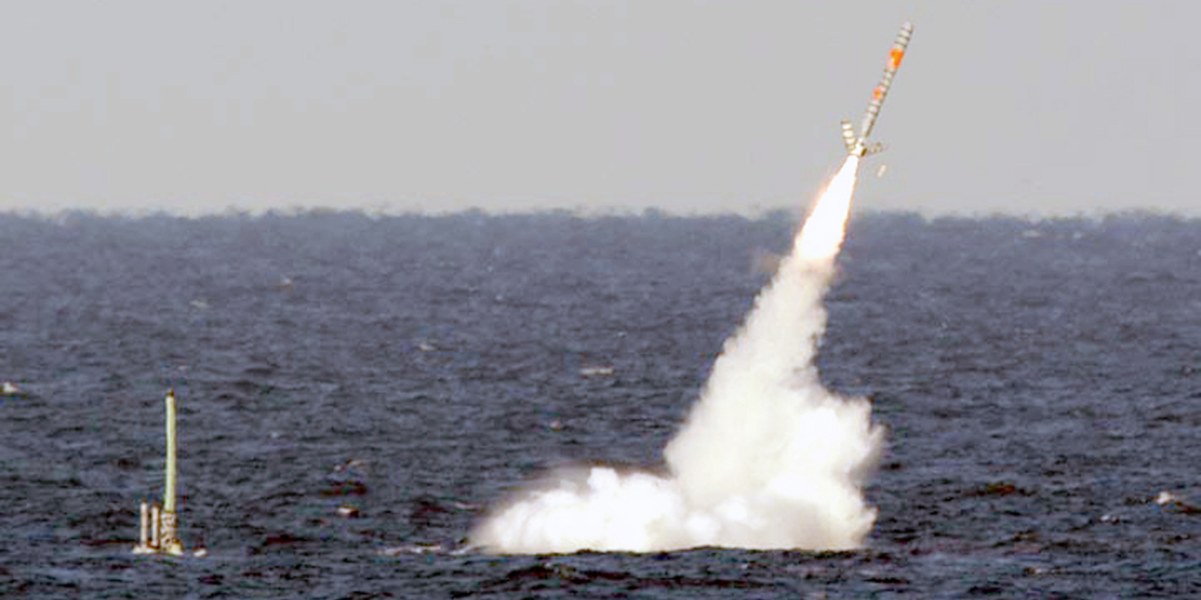
The Tomahawk: Evolution of a Precision Weapon
Historical Development and Combat Record
The Tomahawk Land Attack Missile (TLAM) had long been a cornerstone of US naval strike capability. The Block III Conventional variant (TLAM-C) contained a 1,000-lb class blast/fragmentary unitary warhead, while the Submunition variant (TLAM-D) included a submunitions dispenser with combined effect bomblets.
The Tomahawk Block IV (Tactical Tomahawk, TLAM-E), which entered the Fleet in 2004, added the capability to reprogram the missile while in-flight via two-way satellite communications to strike any of 15 pre-programmed alternate targets or redirect the missile to any Global Positioning System (GPS) target coordinates.
Advanced Capabilities
The Block IV missile was capable of loitering over a target area in order to respond to emerging targets or, with its on-board camera, provide battle damage information to warfighting commanders. Tomahawk Block IV was in Full Rate Production (FRP), and mid-life recertification began in FY19, increasing the capabilities and extending service life. During recertification, upgrades to navigation and communication systems were completed. Plans for a maritime strike capability were developed concurrently with recertification.
Tomahawk provided on-scene commanders with the flexibility to attack long-range fixed targets or support Special Operations Forces with a lethal, responsive, precision weapon system, making it the weapon of choice for the U.S. Department of Defense.
Combat Operations
Tomahawk cruise missiles were designed to fly at extremely low altitudes at high subsonic speeds, piloted over an evasive route by several mission-tailored guidance systems. The first operational use occurred in Operation Desert Storm, 1991, with immense success. Since January 1991, more than 2,000 Tomahawks had been fired in combat operations, including during Operation Odyssey Dawn in Libya (2011) and Operation Inherent Resolve in Syria (2014).

The Submarine Executive Officer: Understanding Naval Command Structure
The Role Behind the Command
While films like Crimson Tide dramatized the relationship between submarine captains and their executive officers (XOs), the actual role of an XO in submarine operations is far more multifaceted than cinema suggests. Captain William Toti, US Navy (retired), a former commodore and former commanding officer (CO) and XO of USS Florida (SSBN-728), an Ohio-class ballistic missile submarine, clarified the role’s true scope on Quora. Toti was involved in the making of Crimson Tide and offered insight into how the movie took dramatic liberties with the position.
Primary Responsibilities
The Executive Officer (XO) of a submarine filled several critical roles:
Command Authority: The XO was the second in command of the boat and the only other officer aboard who had gone through the submarine Prospective Commanding Officer course, making him fully qualified for command should something happen to the Commanding Officer.
Operational Authority: As the second most experienced officer, when the captain required rest during stressful tactical situations—the captain could not remain awake 24/7—the XO could be assigned as “Command Duty Officer,” with authority to make decisions normally reserved for the captain, such as permission to proceed to periscope depth.
Fire Control and Tactical Operations: The XO served as the Fire Control Officer or Assistant Approach Officer during battle stations, with the responsibility to advise the captain when the “solution” was sufficient to conduct an attack on a ship, submarine, or land-based target.
Training and Readiness: The XO was the ship’s Training Officer, responsible for ensuring drills and training events were sufficient to keep the crew adequately trained.
Emergency Response: During casualties (fire, flooding, etc.), the XO was responsible for going to the scene to take charge while the captain remained in the Control Room, advising on how operations were progressing. This required the XO to maintain good physical condition to handle wearing personal protective equipment for prolonged periods—submarine crews at sea were their own fire department.
Administration and Crew Management: The XO oversaw ship administration, wrote and executed the ship’s Plan of the Day, and often served as the “bad cop” in crew engagement, allowing the captain to be the “good cop.”
The Unwritten Duties
Beyond formal responsibilities, the XO had numerous informal, unofficial duties. Like Spock in Star Trek, the XO was expected to be the officer, along with the Chief of the Boat (senior enlisted person), who “whispered” into the captain’s ear if he thought the captain was about to make a bad decision. In that capacity, he was the most capable and trusted advisor to the captain.
The XO, along with the Chief of the Boat, needed to keep his “fingers on the pulse of the crew” to advise the captain if something was amiss. Toti reflected that while he initially viewed his XO tour as something to merely endure on the way to command, he ultimately loved it because he was in the middle of—and in control of—everything in the submarine’s operations.
Can a Submarine Function Without an XO?
Regarding whether a submarine could function without an XO: yes, for short periods. When the XO went on leave, the “Third Officer” (most senior department head) filled in for him. However, the Navy never allowed the XO to go on leave while the ship was deployed. When the CO was on leave, the XO filled in for the captain, though it was rare that the commodore would authorize the ship to get underway without the CO onboard—this happened only in emergencies.

Strategic Implications
The arming of US submarines with advanced ship-targeting Tomahawk missiles marked a pivotal development in naval warfare capabilities, shaping the strategic landscape in the Indo-Pacific region as geopolitical tensions continued to unfold. Understanding the command structure—from the decisive captain to the indispensable XO—remains critical to comprehending how these advanced weapons systems are effectively deployed and managed in defense of national interests.
Photo credits: General Dynamics Electric Boat, US Navy, and Hollywood Pictures

