

An icon of World War II
The Spitfire became one of the defining symbols of World War II, winning the admiration of the British public through its role in defending the country during the Battle of Britain.
Its exceptional combat performance and outstanding handling also earned the respect of British, Commonwealth and American pilots. Few aircraft have achieved the same level of worldwide recognition. Even today, the Spitfire remains instantly familiar and strongly associated with the war.
However, the aircraft was never designed to engage in dogfights with supersonic interceptors.
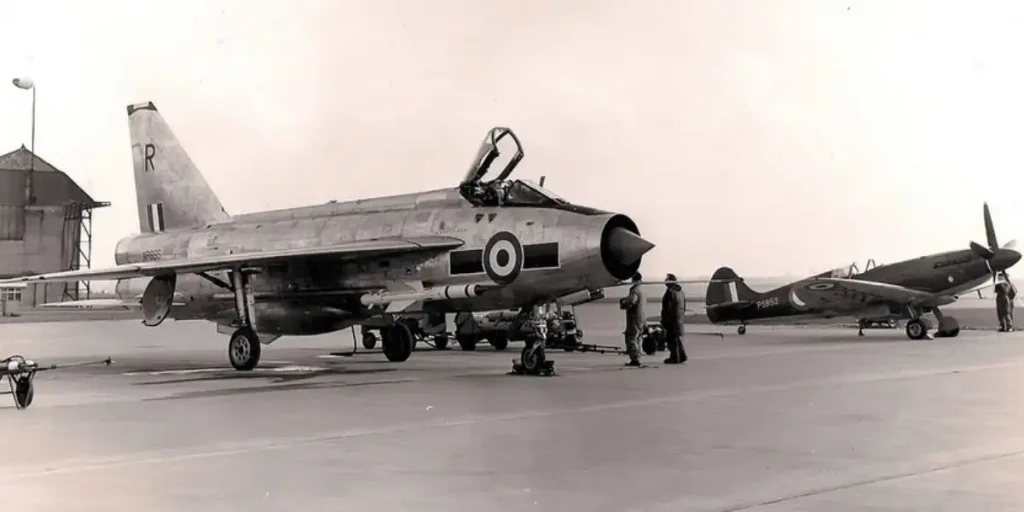
Taken at RAF Binbrook in 1963, the photograph accompanying this post shows Spitfire PR XIX PS853 parked alongside one of the station’s English Electric Lightning Mach 2 fighters.
Lightning Mach 2 interceptor vs WWII Spitfire
That year, Wing Commander John Nicholls, Officer Commanding the Air Fighting Development Squadron at the Central Fighter Establishment (CFE), flew PS853 during a series of trial sorties against Lightnings based at Binbrook.
Nicholls was an experienced combat pilot who had flown the Spitfire XVIII in Malaya and later became a MiG killer while serving on exchange with the USAF during the Korean War. He explained the purpose of these unusual exercises, as well as the lessons learned from them, in Alfred Price’s 1974 book Spitfire At War. His account was later reproduced in John Dibbs and Tony Holmes’ Spitfire: The Legend Lives On.
The trials took place during the Indonesian confrontation. Because the Indonesian Air Force operated numerous P-51 Mustangs, the RAF wanted to determine how effectively a Lightning could engage that type of aircraft. Britain had no Mustangs available for testing, but the Spitfire at Binbrook offered comparable performance in several respects. As a result, it was used in a brief combat evaluation against a fighter that had succeeded it by three generations.
From the outset, everyone understood that the Lightning could overtake the Spitfire by almost 1,000 mph, so there was little point in conducting a trial merely to demonstrate that advantage. However, the piston-engined fighter proved to be a difficult target for infrared-homing missiles, particularly when approached from behind.
This meant that a Lightning pilot would probably need to follow a missile attack with a gun pass. At such a high overtaking speed, however, making accurate fire would be extremely challenging.
Playing the slower and more maneuverable fighter’s dogfighting game
On the other hand, if the Lightning pilot reduced speed too much, they risked allowing the Spitfire to dictate the engagement. The slower but more manoeuvrable fighter could then draw the Lightning into a conventional dogfight and potentially defeat it. This was not an entirely new lesson, as similar results had emerged during earlier trials between the Lightning and the Hunter.
There was another difficulty: if the Spitfire pilot received enough warning, they could turn toward the attacking aircraft and meet it head-on, presenting the most challenging target possible.
Ultimately, the pilots developed an attack method that ran completely counter to the tactics Nicholls had learned during his own fighter-versus-fighter combat experience over Korea. Rather than climbing above the enemy and diving down to attack, the preferred approach was to use the Lightning’s exceptional power-to-weight ratio to make a climbing attack from behind and below.
From this position, the Spitfire pilot had limited visibility, increasing the likelihood of surprise. It also provided the infrared-guided missile with the best opportunity to detect and lock onto the aircraft.
The final operation in Spitfire’s long career
If the Lightning pilot failed to identify the target or line up a gun attack during the first pass, they could continue the steep climb, which the Spitfire was unable to match. Once safely out of range, the Lightning could dive back down and repeat the attack. With this approach, the pilots concluded that a capable Lightning pilot would almost always defeat an equally skilled Spitfire or Mustang pilot.
The Binbrook trial was almost certainly the final serious operational action undertaken during the Spitfire’s long career.
In April 1964, PS853, which had originally been completed on September 5, 1944, joined the Battle of Britain Memorial Flight at Coltishall in Norfolk. Four years later, it took part in the filming of The Battle of Britain.
Spitfire: The Legend Lives On is published by Osprey Publishing and is available to order here.
Photos by Crown Copyright

