

“They shot at least two missiles at us. I’m screaming at the pilot to get back down and move the aircraft, which he does, but not before one of the missiles passes right behind us, where it explodes. I’ve never seen anything move that fast in my life—from a dot on the canopy to a streak right by the aircraft: VERY FAST!” Lt. Joe Kuzmik, former A-6 B/N in VA-34.
By January 1986, President Reagan had classified Libya as an “unusual and extraordinary” threat to the United States, one that required a firm response. The Sixth Fleet then comprised two carrier battle groups: USS Saratoga (CV-60) with Carrier Air Wing 17, recently returned from the Indian Ocean, and Coral Sea with CVW-13, which had been deployed in the area for several weeks. Meanwhile, back in Norfolk, America and CVW-1 were preparing to depart in March and join them.
According to Rick Morgan’s A-6 Intruder Units 1974-96, Operation Attain Document, a major freedom-of-navigation operation, began on 15 January. Libya placed its forces on “full alert” and accused America of “practicing state terrorism against a small, peaceful country.” Fighter aircraft from both sides maneuvered against one another over the Gulf of Sidra, but no shots were fired. A month later, on 12 February, the Sixth Fleet returned for Attain Document II, with its ships crossing what had come to be known as “The Line of Death” because of Muammar Gaddafi’s increasingly threatening statements. Throughout these operations, the two deployed A-6 Intruder squadrons, VA-85 aboard Saratoga and VA-55 aboard Coral Sea, carried out surface-search and tanker-support missions for both carrier air wings.
Attain Document III began on 24 March and included the recently arrived America, carrying VA-34 Intruders. This brought the Sixth Fleet’s strength to 26 warships and 250 aircraft, many of which operated deep inside the Gulf of Sidra in what Libya clearly regarded as a provocative move.
The shooting began at 1452 hrs, when Libyan SA-5 missile batteries near Sirte launched surface-to-air missiles at orbiting F-14 Tomcats. The US Navy responded with radar jamming and HARM strikes. The pre-planned action, later known as Operation Prairie Fire, continued into the evening. At 2100 hrs, an E-2C detected a lone Libyan patrol boat heading north toward the three carrier battle groups. The 250-ton, French-built La Combattante II-class missile craft Waheed was attacked by VA-34 Intruders, which employed Harpoon missiles in combat for the first time. VA-85 aircraft then followed with Mk 20 Rockeye cluster bombs, completing the vessel’s destruction.
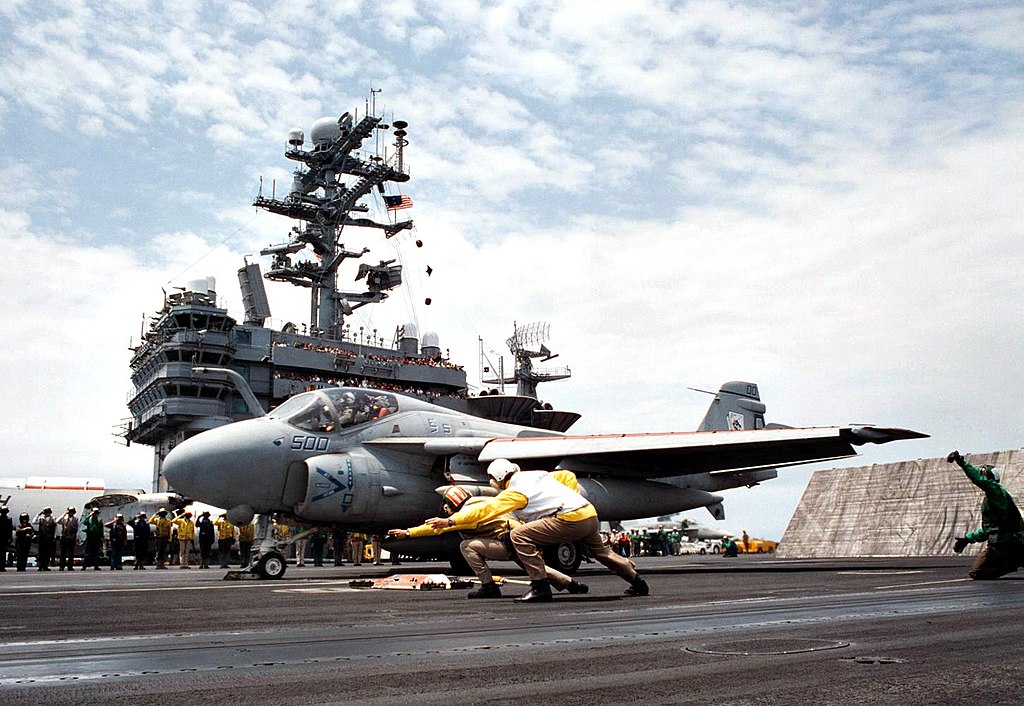
While Libyan forces continued to fire the occasional SAM at US Navy aircraft, none of the missiles found their mark. At 2335 hrs, a 560-ton Nanuchka-class corvette was attacked by Rockeye-armed ‘Black Falcons’. Because friendly surface traffic was operating nearby, the Intruders withheld their Harpoons. Although badly damaged, the warship managed to limp back to port. On the morning of the 25th, another Soviet-built Nanuchka was attacked, this time by VA-55 aircraft from Coral Sea. The vessel was hit by a pattern of CBU-59 Anti-Personnel/Anti-Material bombs, followed by a Harpoon fired by a VA-85 A-6E. Burning fiercely, the corvette eventually sank.
The identities of the two Libyan corvettes have remained a source of confusion. Official US Navy records identify the first vessel as Ain Zaquit and the sunk corvette as Ain Mara. Jane’s Group, regarded as an authoritative source, reverses those identifications, stating that Ain Mara was the first ship attacked. According to Jane’s, it later sailed to the USSR for repairs before returning to Libya in 1991 under the name Tariq ibn Ziyad.
At roughly this point, both sides disengaged and withdrew to regroup. Saratoga headed home, while the two remaining carriers resumed routine operations. The apparent setback did little to moderate Gaddafi’s rhetoric, however, and he vowed to “continue the struggle until victory.” On 5 April, a Berlin nightclub was bombed, killing two American servicemen. Libya was immediately implicated, setting the stage for the next confrontation.
Ten days later, US forces launched coordinated strikes against targets inside Libya. Designated Operation El Dorado Canyon, the mission involved Intruders from both remaining carriers and USAF F-111s operating from Lakenheath in Suffolk. The targets were located in Tripoli and Benghazi. VA-34 was assigned to attack the al-Jamahiriya military barracks in central Benghazi, while the ‘War Horses’ targeted Benina airfield on the outskirts of the city. The USAF’s objectives included Tripoli airfield and several political sites in the capital. Supporting the strike aircraft were numerous aircraft tasked with suppressing Libyan air defenses, providing MiG combat air patrol, refueling, and command and control.
The UK-based F-111s had already been airborne for several hours when America began launching its aircraft at 0045 hrs on 15 April. The strike group consisted of six ‘Blue Blasters’ and an equal number of A-7Es armed with AGM-45 Shrike or AGM-88 HARM missiles. The Corsair IIs remained over the water to keep the Libyan air-defense forces suppressed, assisted in that role by the EA-6Bs of VMAQ-2 Detachment Y, also assigned to CVW-1. The ‘Blasters’, meanwhile, continued inland toward the Libyan coast.
As Mark Morgan and Rick Morgan report in Intruder: The Operational History of Grumman’s A-6, the mission encountered several immediate difficulties. According to Blue Blaster bombardier-navigator Lt. Dee Mewbourne:
“We had some problems with getting good targeting information from the ship. There wasn’t much in the Intell Library in Libya or the targets in question. Still, we planned a high-speed attack, launched under EMCON, and performed a very interesting high-speed rendezvous. We went in as low and as covertly as possible. The SINS wasn’t working, and the radars weren’t lit off until we approached the coast.”
“We managed to fly past Benghazi; as we turned into the coast, we noted the radar predictions didn’t match what we were seeing. Aircraft one and three turned back north, then east, and entered the target area as planned. The four others came in from the opposite direction and entered the target area as planned. The CO (Cmdr. Coleman, with Lt. Cmdr. Bill ‘Frog Balls’ Ballard) dropped the first bombs, and No. 2 did a visual delivery. We did a backup delivery and got good hits on the target, as did everyone. The last three aircraft used Offset Aim Points and plastered the front gate.”
VA-34’s Lts. Joe Kuzmik and Bob Ayres were in-dash six; Kuzmik has similar recollections of their squadron’s raid on Benghazi:
“I was a pretty junior B/N in VA-34 and didn’t expect to fly the strike. We’d spent a lot of time working up plans for a variety of targets and only found out that the F-111s would be involved about two days prior. At that time, we were told to expect only four Intruders over our targets in Benghazi, which left me out. About a day prior, we were told to send six, and my pilot, Bob Ayres, and I were laid on as dash-last. The target was the Revolutionary Guards barracks in downtown Benghazi, which was directed by higher authority, as was the bomb load. Four aircraft carried 16 Mk. 82 Snakeyes, the last two carrying eight Mk. 83 1000-pounders with high-drag mine fins (true Snakeye fins being unavailable for the Mk. 83 at the time). Our plan was to go in very low in a bomber stream, a series of aircraft in a line. We would be the last over the target and well after the Skipper, which meant the air defenses would be fully alerted by the time we got there.”
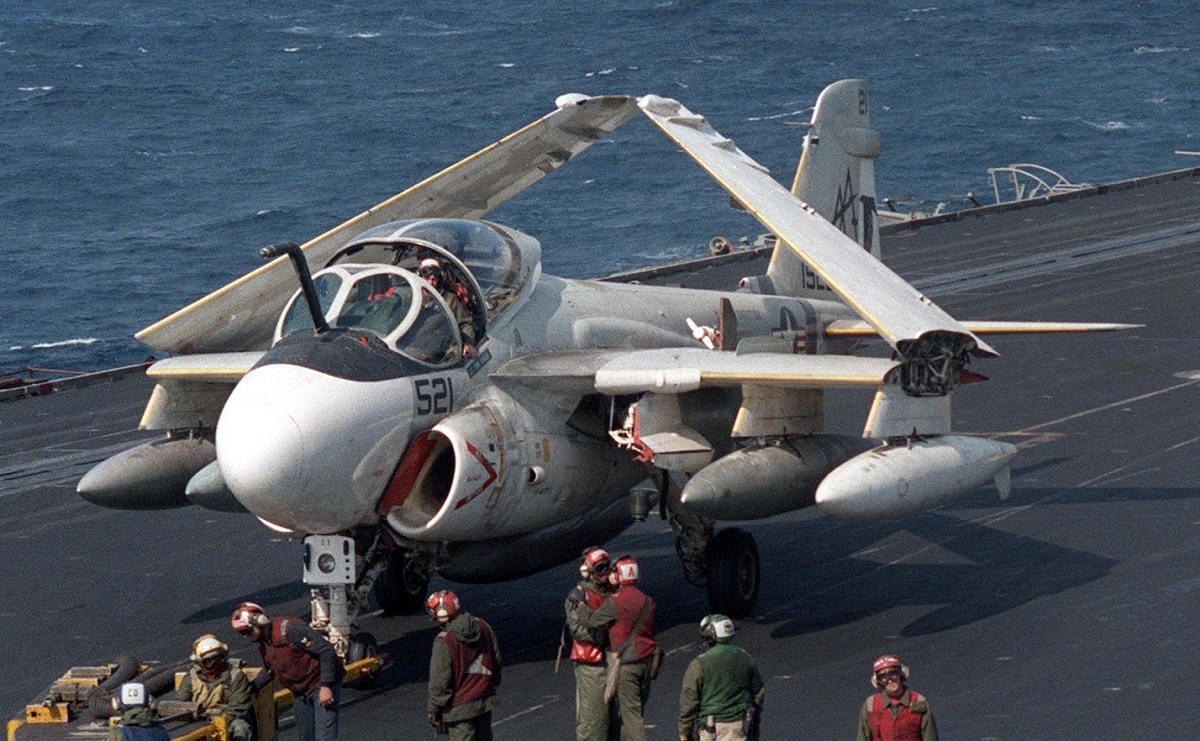
“We launched from America with three bombers chasing a single KA-6D, executed a 1000-foot night over-water rendezvous, took gas, and set up for the push time. This sounds a lot easier than it really was. After the push, we went in at 500 feet and were at 300 ft by coast-in. We weren’t even feet dry when we could see the skipper’s bombs going off, as well as some AAA and at least two SA-2s airborne. This was still five minutes before our TOT, so we knew things would be fully stirred up by the time we got there.”
Kuzmik and Ayres were absolutely right about the reception, as Kuzmik continues:
“From feet dry we were 15 seconds to TOT, so we elevated to 500 ft AGL, and I found the predicted radar points. The FLIR was down, which was no big deal since I wasn’t planning to use it in a fully lit-up city anyway. The bombs came off at the right time, and we made a 5G turn back to the water. I’d never seen that much ordnance explode at night before, and that—along with the flashes from our chaff squibs—initially made me think we were taking a lot of AAA, or maybe even on fire.”
“It was during the egress that we ran into trouble.”
He adds:
“We got indications of SAM activity and started jinking. We ballooned up to 1,200 ft and immediately were locked onto by an SA-3 site. They shot at least two missiles at us. I’m screaming at the pilot to get back down and move the aircraft, which he does, but not before one of the missiles passes right behind us, where it explodes. I’ve never seen anything move that fast in my life—from a dot on the canopy to a streak right by the aircraft: VERY FAST! Meanwhile, we were headed back to the ground in a big hurry, and we bottomed out at about 150 ft with a 5G pullout. We’d almost hit the ground trying to dodge the SAMS but had made it.”
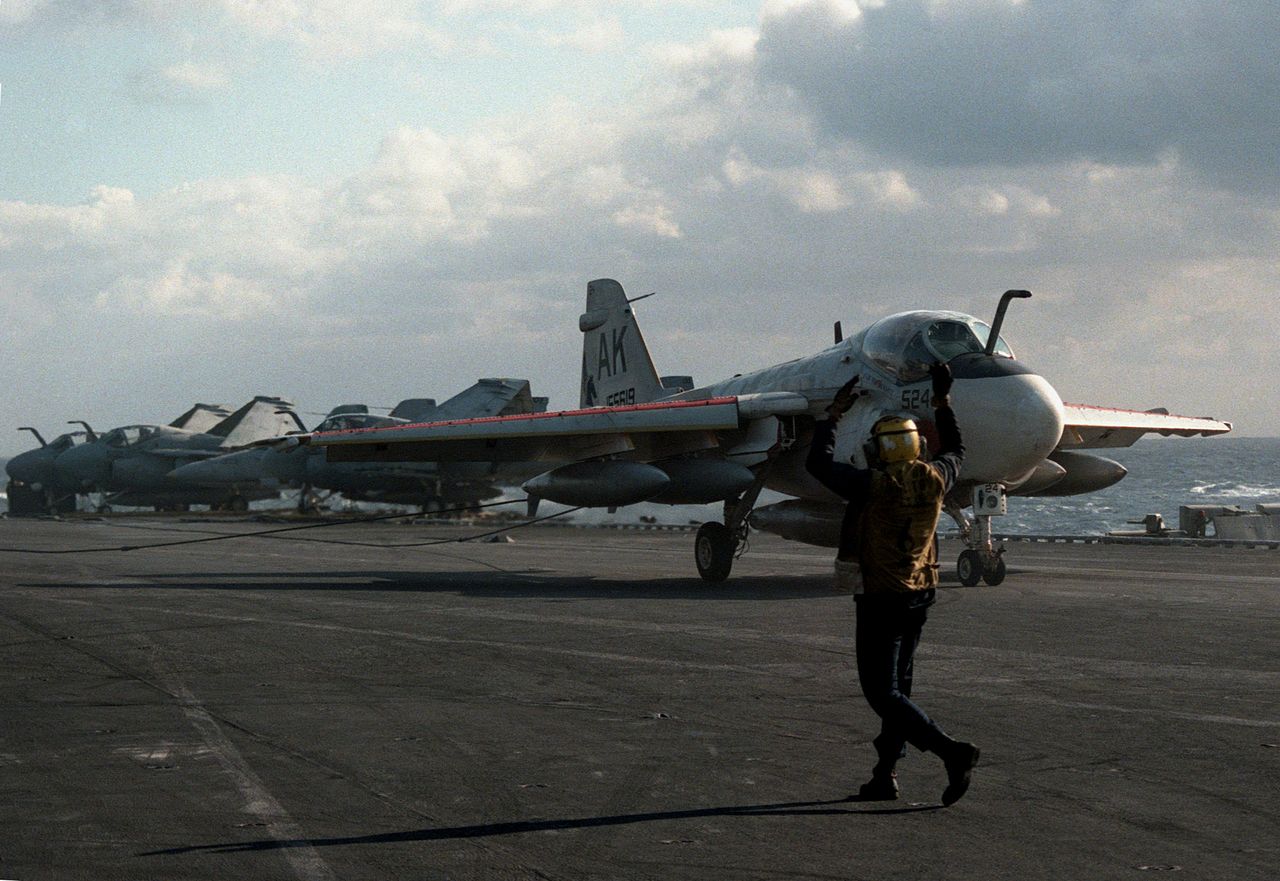
The Rob Weber-led ‘War Horses’ were tasked with launching eight A-6Es from Coral Sea to attack Benina Airfield near Benghazi, while CVW-13’s EA-6Bs and F/A-18s suppressed Libyan air defenses. Two Intruders aborted after takeoff, in accordance with the rules of engagement, which required all systems to be fully operational in order to minimize the risk of bombs striking civilian areas. The remaining six A-6s delivered their cluster-weapon loads accurately on target. They were credited with destroying three MiG-23 Floggers, two Mi-8 helicopters, and a Dutch-built Fokker F-27 turboprop transport. The attack also damaged several other aircraft and hangar facilities, while rendering the airfield’s runways unusable. Results against the urban targets were less conclusive, but VA-34 later reported:
“… (the squadron) struck Libyan terrorist barracks and aircraft storage facilities, inflicting over 70 casualties on the enemy and virtually eliminating Libyan MiG-23 spare parts inventory.”
The USAF F-111Fs also struck their targets successfully. Because the aircraft carried a far more advanced video-recording system than the Intruders, their FLIR footage was broadcast in news reports around the world, something the US Navy took note of. One F-111 was lost with its crew, while the rest returned to England after an impressive 15-hour combat mission, although one aircraft diverted to Spain.
The US Navy quickly declared that Operation El Dorado Canyon had met its limited objectives. The US State Department later concluded, however, that Gaddafi had continued sponsoring international terrorism. That assessment was reinforced by the destruction of Pan Am Boeing 747 over Scotland on 21 December 1988, followed the next year by the bombing of a French airliner over Chad, which was also attributed to Libyan agents. Even so, the US government maintained that “the United States had not only the means but the will to deal effectively with international terrorism.”
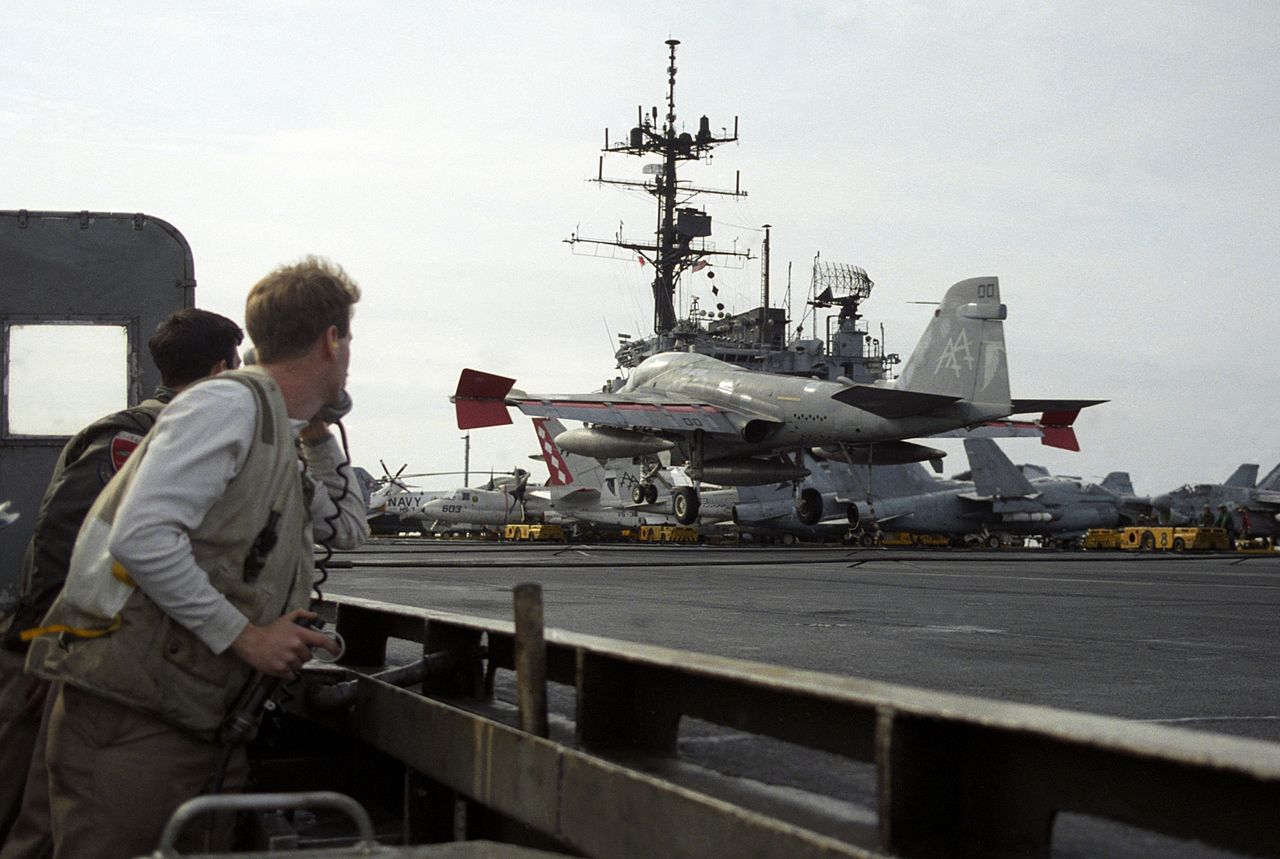
Photo by U.S. Navy

