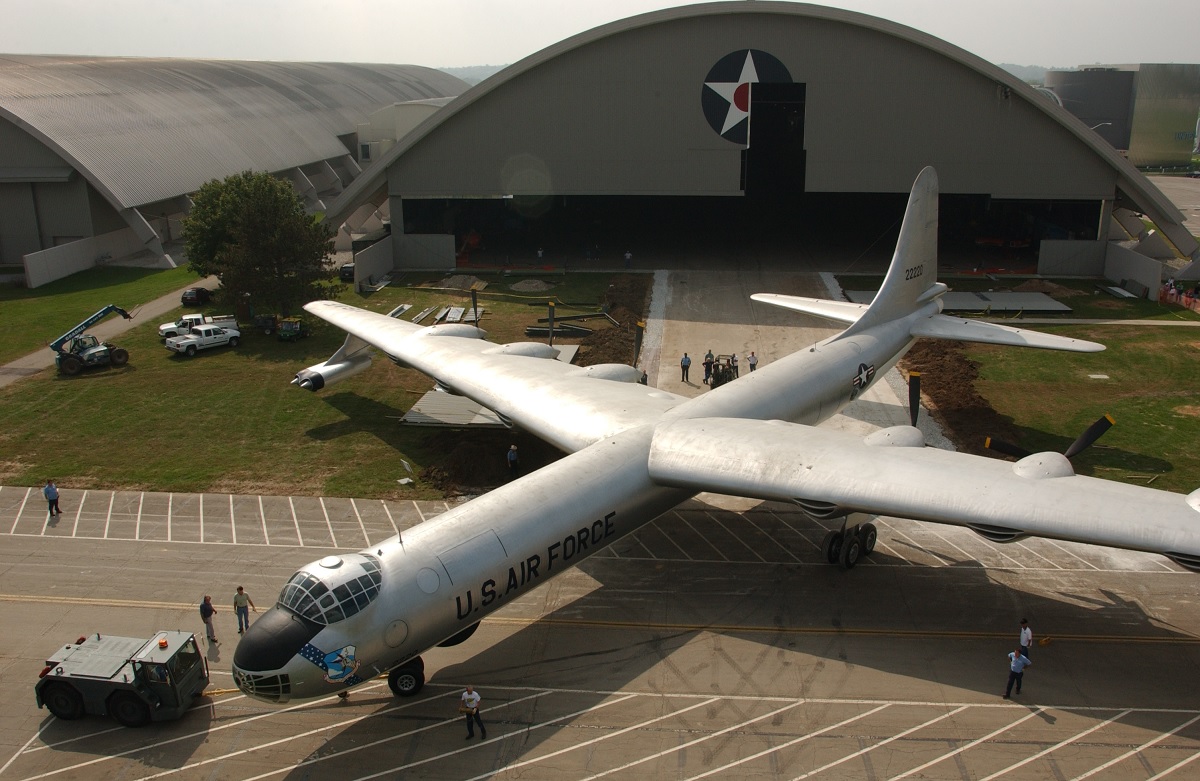
When the ‘effects’ B-36D conducted the first test (the Mike shot on Oct. 31, 1952, using a Mk 5 thermonuclear device detonated at Eniwetok atoll in the Pacific), it was almost caught in the mushroom cloud following the detonation
The tale of some of the B-36 bombers used for Peacemaker’s operational procedures for nuclear strikes was established via realistic tests with actual bombs.
Developed in 1941 for use in the event Germany occupied Britain—leaving US bombers without the range needed to strike back—the B-36 was intended primarily as a “10,000-mile bomber,” equipped with heavy defensive armament and capable performance to evade interception by fighters.
Even though rapid advances in jet engines and high-speed airframe design soon rendered it outdated, the B-36 participated in numerous significant nuclear test programs. It also served as the backbone of the US nuclear deterrent until the faster B-52 entered service in 1955.
As explained by Peter E. Davies in his book B-36 ‘Peacemaker’ Units of the Cold War, operational procedures for nuclear strikes conducted by B-36s could only be established via realistic tests with actual bombs. The US conducted a series of atmospheric tests involving high-flying B-36s between 1952 and 1956, the ‘Peacemakers’ performing as bombers, atmospheric sampling platforms, and photographic aircraft. The sampling (or ‘effects’) missions also collected radioactive material from nuclear tests by the Soviet Union and Britain.
The first of these tests, code-named Operation Ivy, was held in August 1952 and required a full-scale practice run called Operation Texas, flown from Bergstrom AFB in Texas. This rehearsal used 39 aircraft, among them two B-36H bombers and one B-36D configured for sampling and observation. A non-nuclear ‘training’ bomb was dropped in the Gulf of Mexico, and conditions were set up to mimic those of a real 500‑kiloton Mk 18 weapon in order to determine the best speeds, release altitudes, and escape maneuvers for the B-36. Even after the exercise, it remained uncertain whether the bombers could get far enough away to avoid being killed by radiation from the blast.
During the actual Ivy missions, when the ‘effects’ B-36D carried out the first live test—the Mike shot on October 31, 1952, using a Mk 5 thermonuclear device nicknamed ‘Sausage’ and detonated at Eniwetok Atoll in the Pacific—it came close to being engulfed by the mushroom cloud. This happened even though the aircraft was flying at 40,000 feet and was 15 miles from ground zero. The bomber was subjected to extremely high temperatures and severe bending stresses on its tail section. Strategic Air Command had previously rejected proposals to equip the bomb with a drogue parachute to slow its descent.

The second test, code-named King, used an Mk 18 weapon. As before, a practice run was flown by an unmarked B-36H, which dropped a dummy Mk 18 near Eniwetok on November 8, 1952. One week later, the real Mk 18 was released from 40,000 feet, producing a massive 500‑kiloton blast after a 56‑second fall. Although the B-36H completed its escape turn, it still suffered blast damage and tail loads that came close to the aircraft’s structural limits. These initial tests led to two major changes to the B-36: heat-reflective white paint was applied to the underside of the bomber, and removable aluminized asbestos shields were added inside the cockpit canopy to give the crew some protection from the flash.
Carswell’s 7th BW supplied 12 B-36s to support the unusually named nuclear weapons tests Operations Upshot-Knothole and Tumbler-Snapper at the Nevada Test Site. These trials included dropping a lower-yield Mk 7 tactical bomb from a B-36 to determine safe release altitudes and to measure the shockwave stresses imposed on the bomber’s airframe. In 1954, they were followed by Operation Castle, which used several different bomber types, among them a Featherweight B-36, an RB-36, and the Ivy “effects” B-36D.
The ‘effects’ B-36D-5, serial 49-2653, commanded by Maj. Frederick Bachmann of the 436th BS was subjected to blast forces at altitudes up to 50,000 ft that pushed the airframe to its structural limits and damaged the bomb bay, landing gear doors, radome, scanner blisters, and the undersides of the engine nacelles. Extensive damage also resulted from the scorching of unpainted sections of the lower surfaces, some of which were exposed to temperatures as high as 322°F. Much of the protective white paint was stripped off, and numerous components—including the gun turrets, propeller spinners, and the crew communication tunnel—were damaged.
Upon its return to Carswell, the aircraft was found to be so radioactive that it was parked well away from other aircraft on base for a year to ‘cool off’. When 49-2653 could finally be inspected in 1955, the airframe damage it had suffered was considered terminal, and the bomber was scrapped. Other B-36s used in the tests were eventually decontaminated up to a year after their sampling flights.
B-36 ‘Peacemaker’ Units of the Cold War is published by Osprey Publishing and is available to order here.
Photo by Jack Fellows illustration via Weapons and Warfare and U.S. Air Force