

The reconnaissance versions of the Tu-16 saw the most action in the Cold War. In the course of such sorties, the Badgers were often intercepted by shore-based or shipboard NATO fighters over international waters…
Conceived to satisfy a Soviet Ministry of Defense requirement for a fast bomber capable of countering the NATO threat, the Tupolev Tu-16 (NATO reporting name: Badger) represented a breakthrough. It was the first Soviet medium bomber with swept wings and was designed around a pair of turbojet engines that were, at the time, the most powerful jet engines in the world. First flown in 1952, the Tu-16 went on to serve in multiple roles, including nuclear strike, missile attack, reconnaissance, and electronic countermeasures (ECM).
As noted by Yefim Gordon, Dmitriy Komissarov, and Vladimir Rigmant in their book Tupolev Tu-16: Versatile Cold War Bomber, reconnaissance variants of the Tu-16 took part in combined-arms exercises on land as well as naval maneuvers. The Tu-16R, in particular, was routinely employed to track the movements and drills of NATO fleets in the seas and oceans bordering Soviet territorial waters. Typically, this mission was carried out by a pair of Tu-16Rs.
These missions were always flown by two aircraft for two main reasons. First, one bomber typically carried the SRS-1 ELINT system while the other carried the SRS-3, ensuring that all radar frequencies used by NATO warships could be thoroughly monitored. Second, if one Tu-16 went down at sea, the crew of the accompanying aircraft could radio the crash coordinates back to base, increasing the chances that the downed crew would be located and rescued before succumbing to exposure.
After the Tu-16RM-1 and Tu-16RM-2 joined the Soviet Navy, they were also assigned to these operations, as tracking NATO carrier task forces was a permanent mission. Throughout the 1960s and 1970s, Western aviation magazines often published photographs of Soviet Tu-16Rs and RMs passing over the decks of US Navy and Royal Navy aircraft carriers.
The reconnaissance variants of the Tu-16 were arguably the ones that saw the most operational use during the Cold War. On these missions, Badgers were frequently intercepted over international waters by NATO fighters operating from land bases or ships. To reduce the risk of pilots opening fire, a permanent rule stipulated that neither side was to treat the other’s aircraft as practice targets during such encounters to avoid an accidental shootdown. In addition, Tu-16 tail gunners always kept their cannons elevated to signal that they had no hostile intent.
Nevertheless, incidents did occur, particularly during periods of heightened political tension between East and West.
On Oct. 4, 1973, a Tu-16R from the Northern Fleet’s 967th ODRAP, commanded by Lt. Col. A. P. Sviridov, was flying a mission over the Norwegian Sea to locate a U.S. Navy carrier task force led by USS John F. Kennedy. As the Badger closed in on the formation at an altitude of 100 m (330 ft), a McDonnell Douglas F-4 Phantom II was launched from the carrier to intercept it. The fighter pilot favored a ‘wait until you can see the whites of their eyes’ tactic—the F-4 maneuvered dangerously, approaching within 4-6 m (13-20 ft) of the Tu-16R.
Eventually, after moving in beneath the Badger’s starboard wing, the pilot advanced the throttles and pulled the fighter’s nose up, apparently in an attempt to intimidate the Soviet crew. He misjudged the maneuver, and the F-4’s fin struck the Tu-16, tearing the skin of the wing. Since it could no longer make a standard carrier recovery, the Phantom was forced to land in Norway. Despite the serious risk of fire and explosion, the Tu-16R also managed to return to the Severomorsk-3 air base. For this mission, Sviridov received the Order of the Red Banner of Combat.
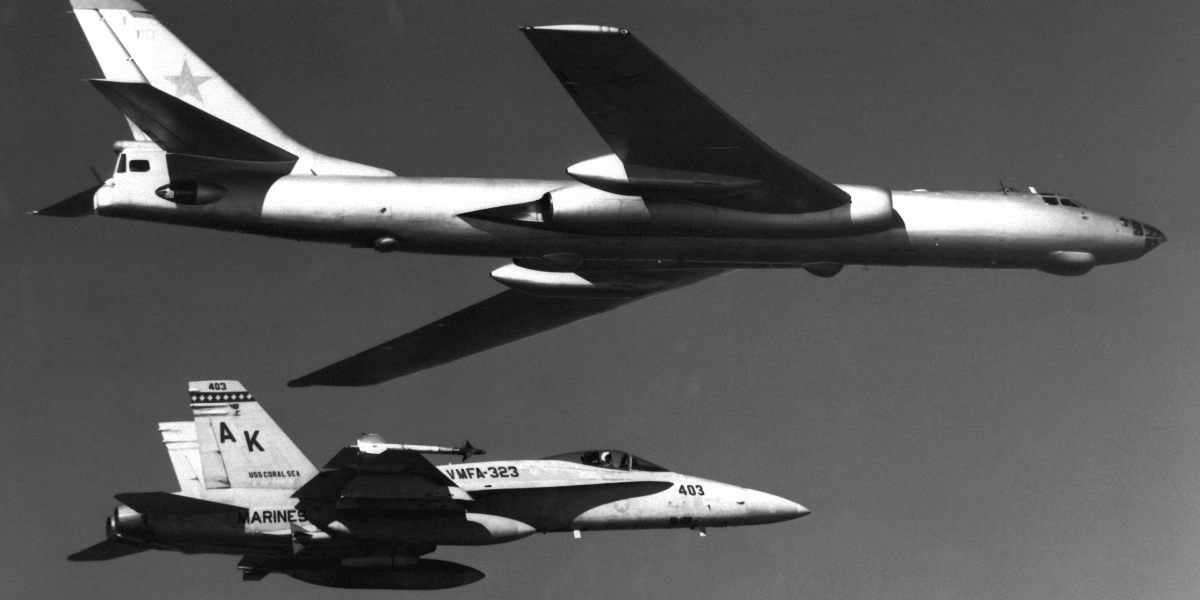
In the early 1980s, a Tu-16 carrying out a patrol over the Atlantic Ocean was intercepted by three of the U.S. Navy’s latest carrier-based fighters, the McDonnell Douglas F/A-18A Hornet. In an effort to drive the Soviet aircraft off its route, the Hornet pilots carried out dangerous maneuvers, including head-on passes. Eventually, this high-stakes game ended in disaster: two of the fighters collided directly above the Tu-16 and exploded. One pilot was killed, while the other managed to eject. The Badger was also hit and damaged by the resulting debris, but thanks to the crew’s skill and bravery, the aircraft was able to struggle back to base.
At other times, however, U.S. Navy fighters actually guided Tu-16s toward the carrier task force. The logic was straightforward: the fighters always flew in pairs or groups of three, and the crews photographed one another’s aircraft so they could be paid for a properly documented intercept. There appeared to be an unspoken agreement between the Soviet and American aircrews along the lines of, “Look, we’re both pros; we’re both doing our job, so we’ll let you do your job if you let us do ours.”
Tupolev Tu-16: Versatile Cold War Bomber is published by Schiffer Publishing and is available to order here.
Photo by U.S. Navy

