

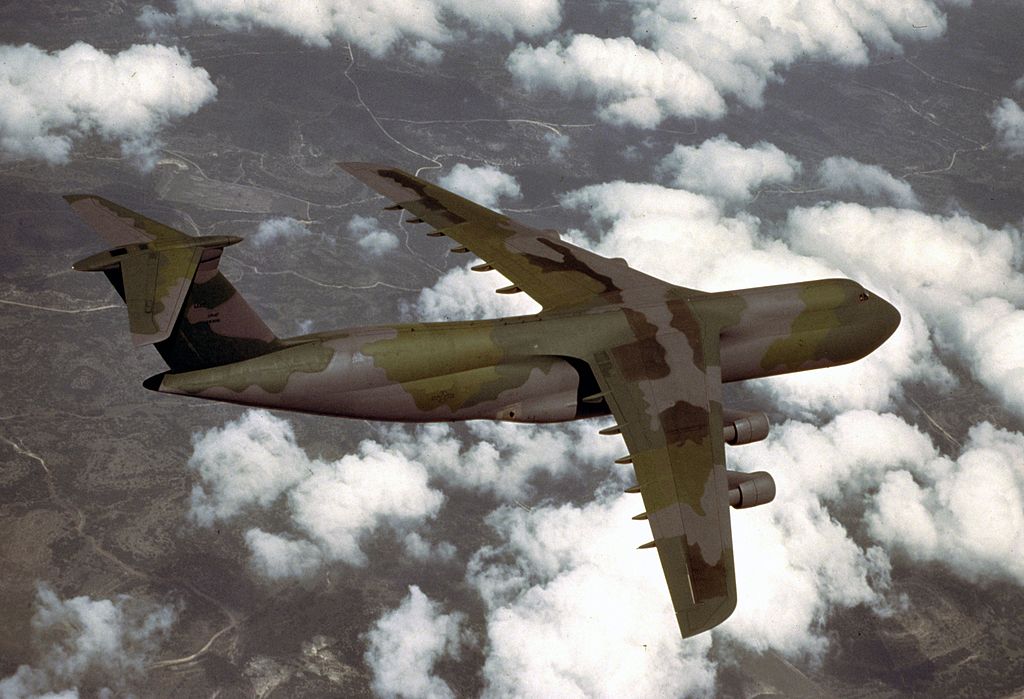
“The C-5 is marginally larger than a Boeing 747. I joked that if the 747 guys would keep their ‘little’ airplane out of my way, I’d keep my little wallet out of their way.” Jay Lacklen, former C-5 pilot
Jay Lacklen is a former C-5 pilot with 12,500 flying hours and the author of two books, Flying the Line: An Air Force Pilot’s Journey and Flying the Line: An Air Force Pilot’s Journey Volume Two: Military Airlift Command. He’s working on the last book of the trilogy.
In late August, I loaded up my 1977 Honda Accord and drove to Altus. I made Altus in two long days from Salisbury. I spent the first night in Memphis, TN, and completed the final segment of the trip to Altus the next day across Arkansas and the lower portion of Oklahoma. I thought I had reached the edges of Indian Territory in Lawton, but I still had 90 miles left to Altus.
The Oklahoma fall weather was as clear, bright, and comfortable as I have found anywhere on earth. The skies, like those of Montana, are “big” and stretch from horizon to horizon across the flat plain of south Oklahoma. In retrospect, a more current song that seems to capture the ambiance of the area is “Amarillo Sky” by Jason Aldean. I also recalled the musical Oklahoma from the 1950s and revisited it, finding its songs and story a perfect fit for the actual place: “Where the wind comes sweeping down the plain.”
The training course lasted three months, consisting of about a month of academics and two more months of C-5 flight training. On the first day, we were taken as a class out for a walk-around of the plane. I stood next to one of the nose tires, which stood chest-high to me, one example of the hugeness of all the Galaxy’s features. I felt immediate trepidation about my upcoming task of learning the nuts and bolts of such a mammoth machine.
The C-5 is marginally larger than a Boeing 747. I joked that if the 747 guys would keep their “little” airplane out of my way, I’d keep my little wallet out of their way.
One of the gee-whiz statistics of the plane’s length was that the Wright Brothers’ first flight could have taken place within it.
I had two fellow Dover reserve pilots in my class, Ed Poling and Paul Gillis. I would spend many happy evenings drinking and dining at the Gillis trailer with him and his wife, Carol. I would be paired with Ed for flight training.
C-5 flight training proved unexceptional. The plane flew like any other plane, except the landing picture resembled landing your house from the roof, which took some getting used to, especially since I had been landing a Beech 99 for the past two years. When I got back to the Beech 99, I swore I would rip the seat of my pants on the runway, so low did I have to go. Also, the cockpit seats were wide apart compared to my previous military aircraft. On the B-52, I could reach over and tap the other pilot on his outboard shoulder. In the C-5, I could just reach his nearest shoulder. As we flew, it seemed we were flying the cockpit alone with no obvious comprehension of the massive aircraft following behind the cockpit.
In the C-5, most of the aircraft systems are run by the flight engineer at his panel behind the copilot in the cockpit. The aircraft commander cedes some of his authority to the engineer to call the shots on system problems. One C-5 joke says, during an emergency, the pilot asks, “Damn, engineer, what do we do now?” While pilots are familiar with the limitations and workings of the systems, they must rely on engineers to manage them and recommend actions during emergencies. This puts the engineer in partial command of the aircraft.
This sharing of command almost always worked well, and the times it did not were often my fault.
One time that things went awry in the C-5 was a nose gear indicator failure, to be covered later. I got bewildering information from a rookie scanner, but I had to accept what he was saying and consider it. Another time both the stan-eval engineer instructor and I missed that the student engineer had made a 100,000-pound calculation error on landing speed. Somehow I missed the error as the copilot briefed a 110-knot approach speed, ten knots below the standard approach speed. Usually, either the pilot or engineer would catch such an error, but this time the two evaluators blew it.
The only mildly hilarious event during training occurred when Ed, taxiing out of the parking ramp, turned the potentially hurricane-force engine jet blast on a temporary wooden guard shack and rubber barrel barrier and sent them tumbling down the ramp.
On a positive note, Paul completed academics without missing a question. He bested a returning staff officer, a major, who predicted he alone would not miss a question in this second time through the course. To his deep chagrin and Paul’s joy, he did miss one.
On the cool bright autumn afternoons, I would run a three-mile course on the perimeter road that ran parallel to the runway. This was also the heyday of the computer arcade game, Ms. Pac-Man, which I played addictively. After hundreds of games, I had a pattern down to avoid the Pac-Men through four or five levels of the game. There was a Pac-Man arcade console in the back of the O’Club and I spent many hours there doing combat with the Pac-Men.
I noticed that an attractive dark-haired officer’s wife also enjoyed playing the game on this console. Once, she arrived at my right shoulder as I slammed the control stick frantically side-to-side and up-and-down on level four in desperate flight from several Pac-Men converging on me from different directions. They got me. I turned partially toward her and noticed she seemed slightly too close. “This game is really addictive,” I said.

She smiled and said softly, “I know.” She paused momentarily, then left. I don’t know if something else might have been in the offing, but it is just as well. I presume there was not.
Photo by Mike Freer – Touchdown-aviation via Wikipedia and U.S. Air Force

