

How the A-6E Outperformed the B-52 in Kuwait’s Kill Boxes
By late February 1991, the air war over Kuwait had shifted from deep strategic strikes — the kind that had seen F-117s drop the first bombs on Baghdad on the opening night — to something far more grinding and immediate: hunting Iraqi army units dug into the desert, grid square by grid square, under the Kill Box system. It was unglamorous work, but it was decisive. And in that unglamorous work, the Grumman A-6E Intruder proved itself not merely useful — but dominant.
Marine Captain Tom Uryga, flying with VMA(AW)-224 “Bengals,” said it plainly: two A-6s did more damage in a single Kill Box mission than a B-52 with a full internal load. That claim, made post-war and documented in Rick Morgan’s A-6 Intruder Units 1974–96, was not bravado. It was bomb-damage assessment talking.
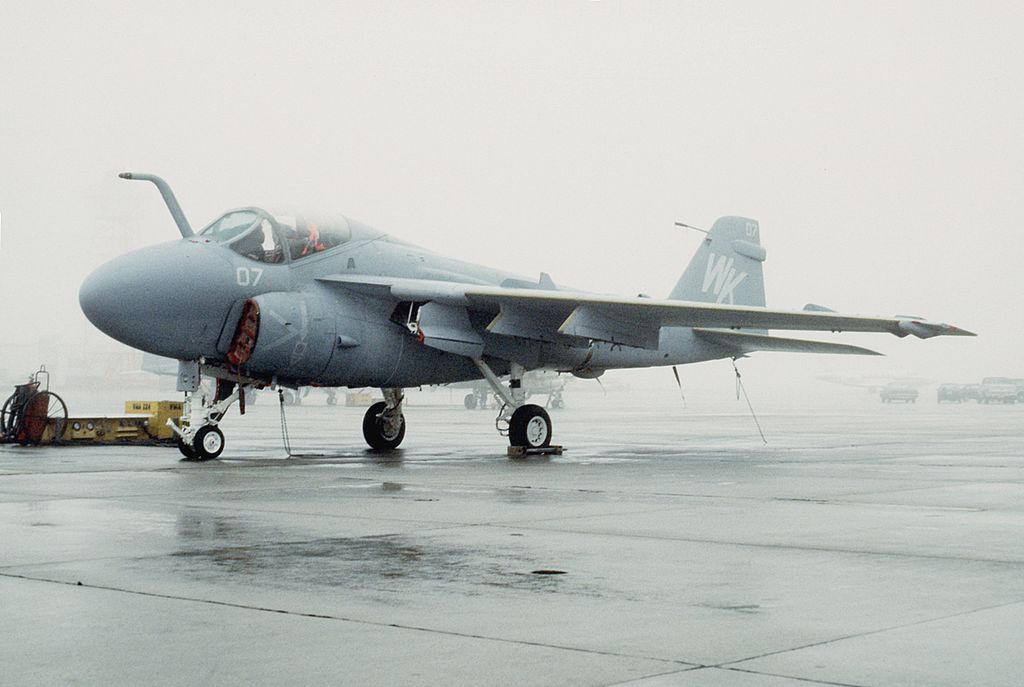
The Grumman A-6 Intruder entered U.S. Navy and Marine Corps service in 1963 as a purpose-built, all-weather, subsonic carrier attack aircraft. By 1991 it was the only platform in the American inventory capable of carrying heavy ordnance loads, loitering over a target, and delivering weapons accurately in poor weather — day or night — without relying on a fighter escort or a separate designator aircraft. It remained the most effective USMC strike aircraft of the Gulf War for precisely that reason.
The Kill Box System and What It Demanded
When coalition planners developed the Kill Box concept for the ground-war preparation phase of Desert Storm, they created a network of latitude/longitude grids — typically 30-by-30-nautical-mile squares — assigned to Forward Air Controllers (FACs) who knew their zones and could vector aircraft onto Iraqi positions as targets were identified. Beginning February 20, 1991, Marine A-6 units formally transitioned from deep-strike missions to Battlefield Air Interdiction (BAI) under this framework.
The system rewarded persistence. A Kill Box FAC needed an aircraft that could check in, receive targeting updates, make multiple passes if necessary, and stay on station long enough to be genuinely useful. What it did not reward was a single, unguided mass drop from altitude that scattered ordnance across a square mile of empty desert.
This distinction would define the Kill Box performance gap between the A-6 and the B-52.
The B-52’s Desert Storm Problem
The Boeing B-52G Stratofortresses tasked with Kill Box and Battlefield Air Interdiction missions during Desert Storm flew from Diego Garcia — a round trip of roughly 14,000 miles (22,500 km) that put crews in the air for ten hours or more per sortie. The aircraft themselves flew without the external underwing pylons they had used in Vietnam, which in that conflict had allowed the B-52D to carry up to 108 bombs in combined internal and external loads. In 1991, the B-52Gs were limited to their internal bays: 51 internally mounted bombs, typically 500-lb (227-kg) Mk 82s, though some accounts put the operational load at 56 weapons depending on the configuration.
The bomb-damage assessment photographs told the story clearly, and not favorably. Mile-long strips of craters, closely spaced, ran parallel to — but laterally displaced from — the intended target arrays. The culprit was the jet stream: 100-knot (185 km/h) winds at altitude were shifting entire salvos sideways before impact. The B-52 crews were not flying poorly; they were fighting physics. High-altitude carpet bombing, released in a single unguided salvo, had a dispersion problem that no amount of crew skill could correct without precision-guided munitions or lower-altitude delivery — neither of which was operationally available to the B-52Gs in this role during Desert Storm.
The result was noise, craters, and shaken earth — but not reliable destruction of dispersed Iraqi armor and artillery.
Why the A-6 Was Different
Captain Uryga’s VMA(AW)-224 was flying a fundamentally different kind of war. The A-6E, equipped with TRAM (Target Recognition Attack Multisensor) — a chin-mounted turret integrating a Forward Looking Infrared (FLIR) sensor and a laser designator — could identify individual vehicles, designate them, and drop weapons with stand-alone precision. The aircraft did not need a separate laser-designating aircraft or favorable weather to find its target.
More critically, the A-6E could carry a mixed load tailored to the mission. For the deep strikes Uryga flew in the opening days of the war against targets like Shaibah Airfield and Tallil, that meant 2,000-lb (907-kg) laser-guided bombs combined with conventional 2,000-lb “slick” bombs for targets within the laser basket. For Kill Box work against troops and armor in the open, the load shifted toward Mk 82 500-lb bombs, Rockeyes, or a mix — delivered not in a single unguided salvo but in controlled passes, one or two targets at a time, with the FLIR confirming hits before the aircraft departed.
The endurance advantage was equally decisive. No Marine A-6 during the Kill Box phase required a tanker, yet the aircraft routinely maintained more than 40 minutes of time-on-station (TOS) — even in northern Kuwait. This allowed FACs to vector the Intruder onto sequential targets within a single sortie, compounding the bomb damage in ways no single B-52 pass could replicate.
The Hornet Comparison: Efficiency vs. Payload
Capt. Uryga did not spare the McDonnell Douglas F/A-18 Hornet from his post-war assessment. The Hornet, flying from carriers in the Red Sea and Persian Gulf, typically carried four to six Mk 82s or Rockeye cluster munitions on Kill Box sorties. Without tanker support, a Hornet checking into Kuwaiti airspace had roughly ten minutes of useful TOS before fuel state forced it to depart.
The tactical solution adopted by some Hornet crews — fly in, drop two bombs, go feet-wet to a tanker, gas up, return, drop the remaining weapons, depart, and log two combat missions on a single flight — drew pointed criticism from the A-6 community. The Marine FAC post-war survey, quoted in Morgan’s account, was unambiguous: given the choice, the FACs’ first, second, and third preference for overhead CAS support was the Intruder. The reasoning was simple. The A-6 had more bombs and more gas, and it stayed.
The EA-6B NFO attached to an infantry unit summarized the preference starkly: if a target wasn’t ready when Hornets or Harriers checked in, they almost invariably went straight to the tanker. The A-6 waited.
The FAC’s View from the Ground
It is worth dwelling on what 40-plus minutes of TOS meant to a Marine infantry FAC in northern Kuwait in late February 1991. Iraqi forces, realizing they had no air cover and no prospect of escaping coalition air power, were nonetheless dug in, dispersed, and capable of inflicting casualties on any advancing ground force. The FAC’s job was to strip that capability away before the infantry moved.
A CAS platform that arrived, dropped its load in one pass, and departed left the FAC back at the radio calling for the next aircraft — which might be ten or fifteen minutes away. An A-6 that checked in, received a target description, made a FLIR-confirmed pass on the first vehicle, then methodically worked through the FAC’s target list before departing on bingo fuel, was qualitatively different. It was less a strike aircraft and more a persistent, precision artillery battery overhead.
That persistence, multiplied across dozens of Kill Box sorties flown by VMA(AW)-224 and the Navy’s carrier-based A-6 squadrons in the final days before the ground assault, contributed directly to the Iraqi army’s collapse on February 24 — and to the ground war’s 100-hour conclusion.
Quantifying the Claim
The specific assertion — that two A-6s outperformed a single B-52 in Kill Box operations — rests on bomb-damage assessment data that the crews reviewed post-mission. The B-52 sorties from Diego Garcia produced BDA photographs showing those laterally displaced crater fields: impressive in scale, poor in accuracy. The A-6’s TRAM imagery showed destroyed vehicles and collapsed revetments.
No official DOD study released publicly has published a clean head-to-head ordnance-effectiveness comparison from Desert Storm Kill Box operations. The Gulf War Air Power Survey (GWAPS), published in 1993, did note the significant accuracy limitations of unguided high-altitude bombing and acknowledged that the B-52’s contribution was more psychological — demoralizing Iraqi troops — than strictly destructive of equipment. The tactical aircraft, including the A-6E with TRAM, were responsible for the preponderance of confirmed vehicle kills.
Captain Uryga’s claim, in that context, is consistent with the GWAPS findings, if expressed with rather more directness than the official survey’s language.
Specific FAQ
How many sorties did Marine A-6 squadrons fly during Operation Desert Storm? Marine A-6E units — including VMA(AW)-224 “Bengals,” VMA(AW)-533 “Hawks,” and VMA(AW)-121 “Green Knights” — flew hundreds of combat sorties between January 17 and February 28, 1991, spanning deep strikes, Battlefield Air Interdiction, and Kill Box CAS missions. Exact sortie counts varied by squadron and were documented in post-war after-action reports. Navy and Marine Corps A-6E Intruders combined to fly over 4,700 combat sorties during Operation Desert Storm.
Why didn’t the B-52 use precision-guided munitions in Kill Box operations during Desert Storm? B-52Gs in the Desert Storm theater were not yet integrated with GPS-guided Joint Direct Attack Munition (JDAM) technology — that capability came later in the 1990s. In 1991, delivering precision weapons from high altitude required laser guidance and a designating aircraft in close coordination, a concept of operations that the B-52 was not configured for during this conflict. Unguided Mk 82s released from high altitude remained highly susceptible to wind dispersion.
What was the operational history of the A-6 Intruder? The A-6 Intruder entered service in 1963 and flew combat missions in Vietnam, Lebanon (1983), Libya (1986), and the Persian Gulf — both during the Tanker War of 1987–88 and Operation Desert Storm in 1991. The type was retired from Navy service in 1997 and from Marine Corps service in 1993 with the transition to the F/A-18D. Its all-weather precision strike role was subsequently divided between the F/A-18C/D with FLIR pods and, eventually, the F/A-18E/F Super Hornet.
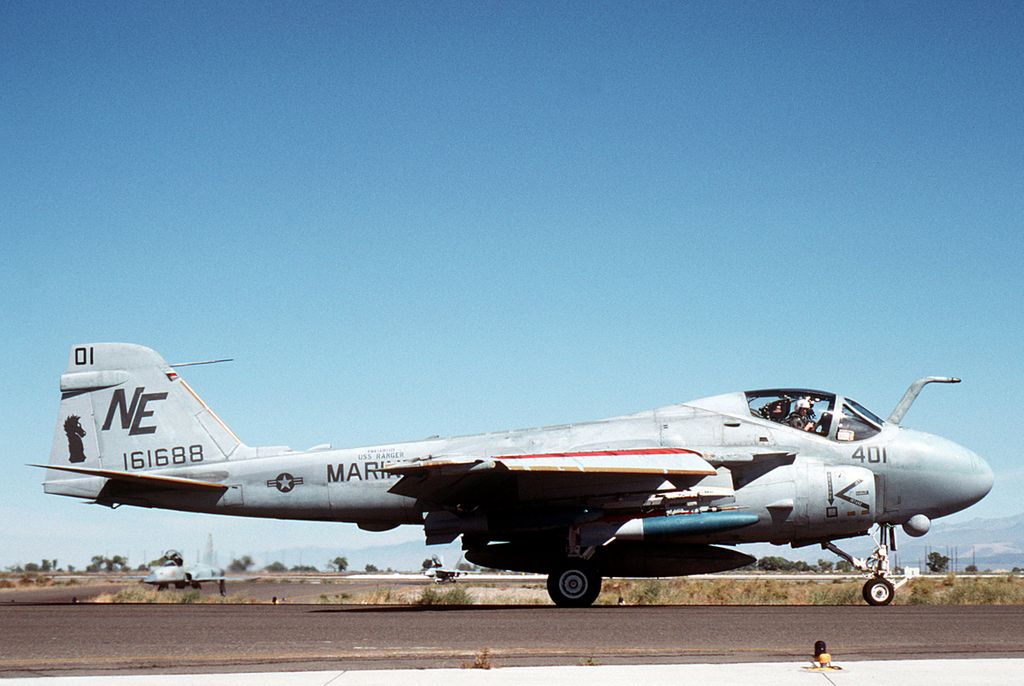
What are the key features of the A-6 Intruder aircraft? The A-6E, the primary combat variant of the Intruder, featured a two-seat side-by-side cockpit, twin Pratt & Whitney J52-P-408 turbojets producing 9,300 lb (41.4 kN) of thrust each, and a maximum weapons load of approximately 18,000 lb (8,165 kg) across five hardpoints. Its TRAM turret integrated FLIR and a laser designator for autonomous precision weapons delivery — a capability unique in carrier aviation until the widespread adoption of targeting pods in the late 1990s. Combat radius exceeded 1,000 nautical miles (1,850 km) with a standard strike load.
The Kill Box missions of Operation Desert Storm represent the A-6 Intruder’s finest sustained performance in combat — and its clearest vindication as a weapons system philosophy. In a campaign that showcased precision air power’s potential, the Intruder’s combination of heavy payload, genuine all-weather targeting, and exceptional endurance made it irreplaceable at the point where air power met the ground war. The comparison with the B-52, however bluntly stated by the men who flew it, was not unfair: carpet bombing and precision interdiction are different tools, and in the Kill Box, only one of them worked.
Modeler’s Corner
For modelers, the Italeri 1:72 A-6E Intruder offers a solid representation of the type in Desert Storm-era markings. The Fujimi 1:72 A-6E with TRAM turret is the preferred choice for accuracy to the late-production aircraft flown by VMA(AW)-224 in 1991; VMA(AW)-533 “Hawks” desert scheme markings are available as aftermarket decals from Caracal Models.
Further Reading
- Morgan, Rick. A-6 Intruder Units 1974–96. Osprey Publishing, 2022.
- Gulf War Air Power Survey (GWAPS), Volume IV: Weapons, Tactics, and Training. U.S. Government Printing Office, 1993.
- Mersky, Peter B., and Norman Polmar. The Naval Air War in Vietnam. Nautical & Aviation Publishing, 1981. (For context on the A-6’s origins as the “Main Battery” of carrier aviation.)
Photos by U.S. Marine Corps, U.S. Navy

