

‘The tremendous thrust with one engine in full afterburner and the other in idle was eye-opening!’ Stormy Boudreaux, SR-71 Blackbird pilot.
Captured on November 1, 1981, by Ken Hackman, a Scene Camera Operator for the US Air Force (USAF), the intriguing photographs in this post showcase an SR-71 Blackbird flying with only one engine in full afterburner, relying on just a single rudder. What is the reason for this?
‘That is what we called a “single-engine go-around,”’ says Stormy Boudreaux, SR-71 Blackbird pilot. ‘It was a practiced emergency procedure. It simulated what you had to do if you were making a single-engine approach to land, and for a variety of reasons, something made the runway or the landing impossible, so you “went around” on only one engine. The tremendous thrust with one engine in full afterburner and the other in idle was eye-opening! To counter the yaw from that engine required full rudder as well as banking the aircraft into a good engine in order to maintain your flight direction down the runway.
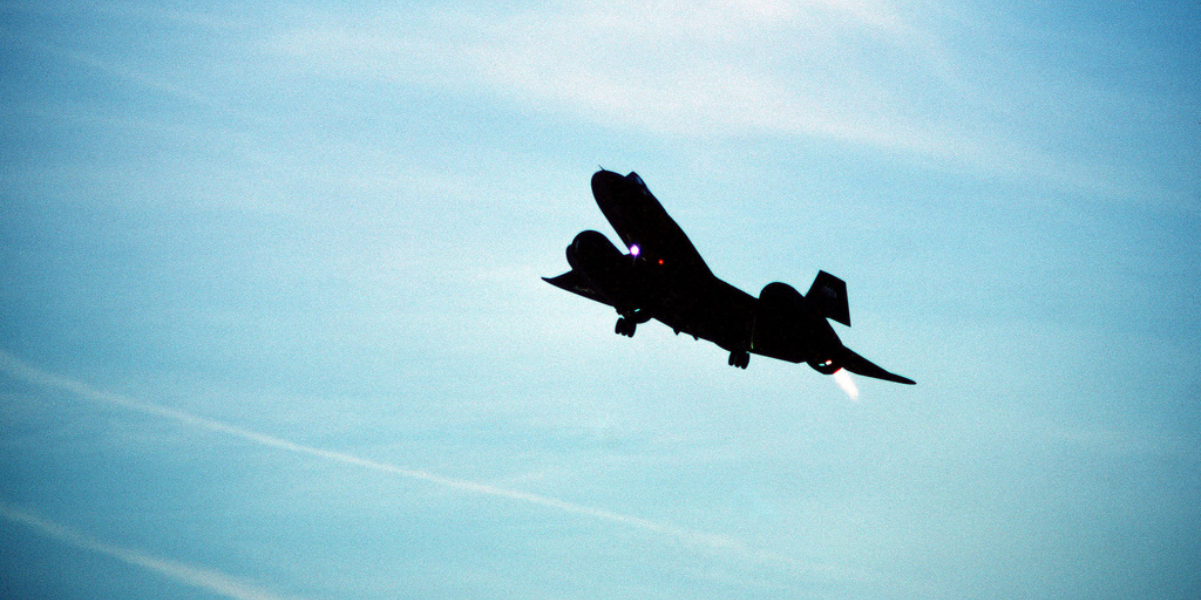
‘Most twin-engine aircraft have to do something similar, but it’s darn right frightening the first time you try it in the SR-71. That one engine in AB is really pushing the nose around, trying to turn the jet away from that engine, and the amount of bank angle when at low speed makes you glad you are strapped tightly in the seat. It’s almost a knife-edge pass!’
Boudreaux is echoed by David Peters, another SR-71 pilot.
‘As Stormy said, the picture[s] indicate a single-engine go-around. Thrust was never an issue. What became imperative was the ability to point the airplane. Under most conditions, full opposite rudder and a slight bank into the operating engine were enough. By under certain conditions, other factors came into play. Minimum control speed being the most important.
‘We had a couple of missions out of Mildenhall that went hot to the tankers. That required a heavy takeoff using a 65,000-pound yo-yo fuel load. In the wintertime with freezing temperatures in England, min control speed was a huge factor. Once the burners were lit, if you lost an engine on takeoff, once the burners were lit your only option was to eject. Why, you ask?
‘Well, the runway there is only 8,000 feet. There was so much thrust developed in the cold, heavy air climate that your speed, combined with gross weight, would not allow you to abort, since you couldn’t stop the airplane. There was plenty of thrust available to fly on one engine, but there was so much thrust that you could not control it below min control speed, which in those cases was generally around 260 knots. So, the only thing you could do was pull both engines to idle, pop the chute, and eject.
‘I always felt that was perhaps our most dangerous operation.’
Check out Habubrat’s Facebook page for further Blackbird photos and stories.
Photo by Scene Camera Operator Ken Hackman / U.S. Air Force


