

The Flogger
The Soviet-built MiG-23 “Flogger” was developed as a successor to the widely used MiG-21. Its sophisticated radar and fire-control system enabled it to launch missiles against targets beyond visual range. Like the General Dynamics F-111 Aardvark, the MiG-23 featured variable-sweep wings, while its sturdy landing gear allowed it to operate from short, unimproved runways. Pilots could adjust the wing sweep for low-speed takeoffs and landings or high-speed supersonic flight.
More than 5,000 MiG-23s were produced across all variants.
As these photos show, the Israel Air Force (IAF) had to wait 23 years before gaining another opportunity to conduct an in-depth engineering assessment of a frontline Arab fighter. Like the MiG-21, the MiG-23 arrived through a defection—though this time, the event caught Israel by surprise. On October 11, 1989, Syrian Air Force Major Adel Bassciii, also known as Bassem, flew his MiG-23MLD “Flogger-G” to Israel and sought political asylum. Flying aircraft 2786, Bassem was leading a two-aircraft training mission when he suddenly broke formation near the Golan border, descended sharply, and accelerated toward Israeli territory.
Syrian MiG-23 defecting to Israel
Although IAF air-defense radars were tracking the Syrian formation, Bassem descended to between 90 and 150 feet (25–45 meters), causing the MiG-23 to disappear from radar. He then crossed the border at 550 knots with the afterburner engaged. After spotting Megiddo, a northern airfield that was still used as a civilian airport, he made a rapid landing.
Barry B. Ferris, a former U.S. Army flight surgeon who served in Vietnam, had immigrated to Israel from the United States in 1977 with his wife and their two children. He had flown them there in a Cessna 210 and was in a unique position to spot the Syrian MiG-23 on the morning of Bassem’s defection.
At the time, he was living in Rosh Pinna in Israel’s Upper Galilee. An active aviator based at Rosh Pinna Airport, he was personally acquainted with the airport’s tower staff. The village lies on the eastern slope of the Galilee mountains, overlooking the north–south Jordan Valley, with the airport at an elevation of approximately 1,000 feet and his home at about 1,500 feet.
That morning, while washing in a bathroom with a window facing east toward the Jordan Valley and the Golan Heights, he saw a MiG flying at eye level. The aircraft appeared to pose no threat and was estimated to be traveling south at roughly 300 knots, following the valley floor at approximately 500 feet above ground level.
No evil intention
The Rosh Pinna tower was contacted, and the controller—whom Ferris knew—was informed, with evident astonishment, that a MiG had just flown past. The controller had not seen the aircraft and, as far as Ferris knew, did not pass the report up the chain of command.
Soon afterward, the MiG landed at the Megiddo crop-dusting strip beside Ramat David Air Base in the Jezreel Valley. The reason the pilot chose the strip’s unusually short runway instead of the nearby airbase remains unknown, as both facilities are clearly visible from the air. One possibility is that he feared Israeli forces might shoot first and ask questions later.
Ferris concluded that the pilot belonged to the Druze religious community and initially lived anonymously in a Druze village near Haifa. Ferris intended to visit him, but the pilot died of natural causes before the meeting could take place.
The entire incident took only seven minutes. Bassem’s actions were motivated by dissatisfaction with his position in Syria. As explained by Bill Norton in his book Air War On The Edge: A History of the Israel Air Force and its aircraft since 1947, the MiG-23 was moved to the security of Tel Nof and as already explained here, a comprehensive test program revealed the performance of the airplane and its systems, as well as its vulnerabilities. Trials included air combat drills against IAF frontline fighters.
The entire episode lasted just seven minutes. Bassem reportedly defected because he was unhappy with his situation in Syria. As Bill Norton explains in Air War on the Edge: A History of the Israel Air Force and Its Aircraft Since 1947, the MiG-23 was subsequently transferred to Tel Nof for safekeeping. A thorough evaluation then assessed the aircraft’s performance, onboard systems, and weaknesses, including air-combat exercises against frontline IAF fighters.
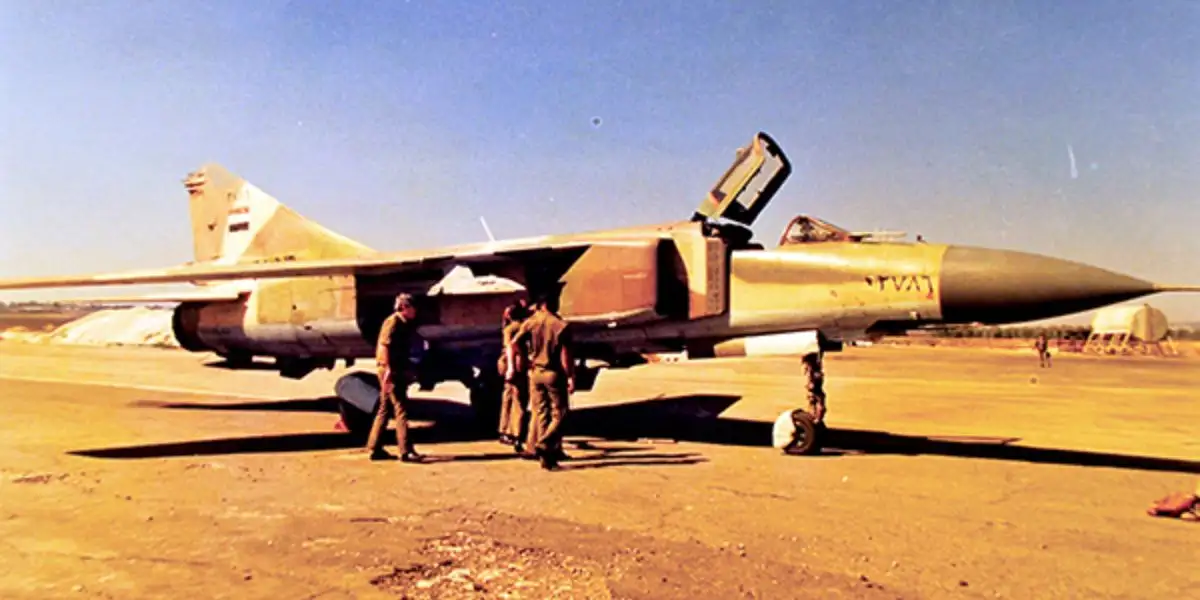
Photo by Israel Air Force

