

The B-58 Hustler
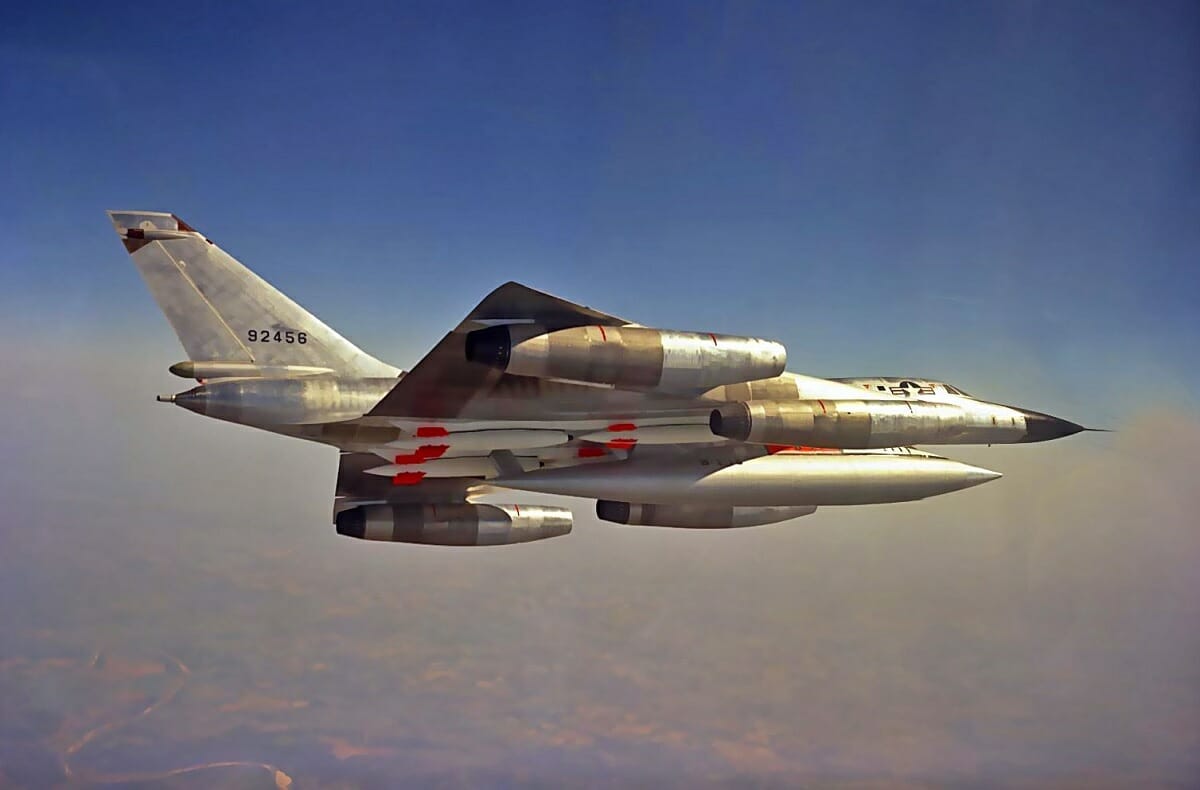
The B-58 Hustler, a four‑engine delta‑wing bomber, entered service with the U.S. Air Force’s Strategic Air Command at the start of the 1960s and represented cutting‑edge technology for its time. Capable of flying at supersonic speeds even when fully loaded, it was purpose‑built to deliver nuclear weapons and provide a rapid response to a potential Soviet strike, which during the 1950s Cold War era was viewed as a constant danger.
B-58 Hustler Accident Rate
As recounted by Peter E. Davies in his book B-58 Hustler Units, the bomber’s initially poor safety record—six major fatal accidents in its first 10,000 hours of SAC operations—improved significantly over time. Even so, mishaps in the early 1960s still claimed the lives of six crew members. The first operational loss was B-58A 58-1020, which suffered a ruptured fuel manifold in flight on Dec. 27, 1961, leading to fuel starvation and engine flameout. Less than two months later, on Feb. 15, 1962, a crew from the 43rd Bomb Wing ejected safely near Lawton, Oklahoma, from B-58A 59-2447 RAPID RABBIT after the flight control system developed a Mach trim malfunction. They survived an inverted-spin ejection, although the pilot, Maj. John Irving, was injured because of a loose seat harness.
The crew of 43rd Bomb Wing aircraft 59-2459 was not as fortunate on Mar. 5, 1962. A severe flight control system failure caused the jet to crash on takeoff from Carswell, killing Capts. Robert Harter and Jack Jones and 1st Lt. James McKenzie. McKenzie had managed to eject but came down in the burning wreckage. All B-58s were subsequently grounded for a month while investigators examined the cause. Navigator Capt. Duane Hickey was the only fatality in the crash of 59-2462, which went down following another flight control system failure near Bunker Hill AFB on Apr. 12, 1962.
Similar sequence of failures
A comparable chain of malfunctions caused 305th Bomb Wing aircraft 61-2057 to break apart during a supersonic flight on Sept. 14, 1962. The jet went into violent yaw, effectively sliding sideways at nearly Mach 2. Its pod and tail section both separated, and the remaining structure disintegrated. All three crew members—Lt Col John Trevisani and Capts Arthur Freed and Reinardo Moure—were killed. At such extreme speeds, there was essentially no time to address any flight control or engine issues, with disastrous results for the crew. On a less dramatic, but just as deadly, occasion, a hard landing at Bunker Hill destroyed 61-2063 on Aug. 26, 1963, leaving pilot Maj William Brandt as the sole survivor.
Another near-fatal incident occurred during a practice bomb run by a 305th Bomb Wing B-58, which was being intercepted by an ADC F-106A flying at Mach 2. As the fighter closed in from behind, the bomber’s right main landing gear suddenly deployed. Although the doors were torn off and the aircraft suffered control difficulties, the Hustler crew still managed to bring it back to Bunker Hill—leaving the F-106A pilot baffled by this highly unusual way of bleeding off speed and dodging interception.
Circumstances in which the Stanley capsule could not save the aircrew
There were situations in which even the sophisticated Stanley escape capsule could not save the crew. On Dec. 8, 1964, nuclear-armed B-58A 60-1116 was taxiing at Bunker Hill for a minimum-interval takeoff (MITO) drill when its left main wheels struck a metal electrical fixture at the runway’s edge. Unable to see the obstacle, pilot Capt. Leary Johnson assumed the aircraft had simply rolled into soft ground and advanced the throttles. The added stress caused the left landing gear to collapse, rupturing a wing fuel tank and triggering a major fire.
Although he knew the escape capsule was not certified for use at ground speeds below 100 knots, navigator Capt. Manuel “Rocky” Cervantes understood that the flames would reach his cockpit first and chose to eject. The capsule launched him 400 ft into the air, and he came down hard in a snowbank; the low forward speed prevented his main parachute from deploying properly. Cervantes died an hour later. Johnson and DSO Capt. Roger L. Hall climbed down ropes from the burning jet and ran clear before it exploded.
Parachute deployment problem
A second mishap on Jun. 14, 1967, exposed another issue with parachute deployment. Maj. Clint Brisendine was flying B-58A 61-2061 over Lipscomb County, Texas, when a severe hailstorm damaged his windscreen. He sealed his capsule doors and kept flying the aircraft, though he no longer had access to the throttles. Realizing he could not open the capsule again, he ordered the crew to eject. Brisendine and DSO Capt. Gary M. Cechett ejected safely, but navigator Capt. William R. Bennett was killed when his main parachute’s automatic deployment system failed, and a defect in the manual system prevented him from deploying it before impact.
Undercarriage problems
Landing gear issues continued into the mid-1960s. B-58A 60-1121 lived up to its “Can Do” nickname on Sep. 10, 1964, when its right main gear collapsed on touchdown at Carswell AFB. After briefly righting itself, the bomber dropped its right wing and the outer nacelle began scraping along the runway in a shower of sparks. The pilot’s canopy hatch was blown off, quickly followed by the other two, as the aircraft skidded on, sparks now streaming from both right engine nacelles. With the wings and nacelles flexing alarmingly, the jet finally ground to a halt on the grassy strip beside the runway. The navigator quickly exited using his escape rope and ran ahead of the wreck, while the other two crew members stayed standing in their cockpits (the pilot tossing his helmet onto the grass) as emergency vehicles and a fire-suppression helicopter arrived. There was no fire, and the B-58 was repaired and returned to service for another five years.
After 1965, accident rates for the 305th Bomb Wing dropped, with only aircraft 59-2437 lost in that period. Another casualty of the B-58’s delicate landing gear, this Hustler suffered a cylinder failure in the right main gear during takeoff. The crew (Maj George Tate and Capts Ray Walters and Mosson) were forced to land with the right gear partially collapsed. They all survived, but although the airframe remained largely intact, it was not repaired.
Attrition remains high
Attrition in the 43rd Bomb Wing nonetheless remained severe, with no fewer than seven Hustlers lost through various causes, including pilot error. On Nov. 13, 1967, B-58A 61-2065 (which also served with the 305th BW) stalled on takeoff from Bunker Hill when the pilot, Maj. Galen Dultmeier, on his first solo in the type, over-rotated and kept pulling back on the control column in an effort to get the aircraft airborne. The Hustler stalled and crashed, killing all three crew members—Dultmeier, navigator Capt. Ronald Schmidt, and DSO Capt. Leroy Hanson.

The B-58 was not a forgiving bird
As Col. Phil Rowe, a DSO who flew with both the 43rd and 305th Bomb Wings in the early 1960s, noted, “The B-58 was not a forgiving airplane. It required constant focus. Strictly following procedures and keeping the fuel system correctly configured was essential. So was avoiding overstressing the jet by pulling too many g’s. That mattered so much that an automatic control system limited elevon movement up and down.” A detailed check of this g-limiting system was therefore a crucial part of every pre-flight routine.
Another Hustler, 60-1119 City of Kokomo, and its crew—pilot Maj. Richard F. Blakeslee, navigator Capt. Floyd E. Acker, and DSO Capt. Clarence D. Lunt—were lost on Dec. 12, 1966, when the aircraft suddenly and inexplicably pitched nose-down from 500 ft during a low-level night bombing run. Residents of McKinney, Kentucky, were jolted awake by a huge flash and explosion; in daylight, a crater 100 ft wide and 30 ft deep was visible in a nearby field.
In other incidents, 59-2443 Bye Bye Birdie landed short on arrival at Le Bourget on Jun. 15, 1965, killing its pilot, Lt. Col. Charles Tubbs. In the last major accident involving the B-58 fleet, aircraft 61-2056 was abandoned on Apr. 18, 1969, near Danville, Illinois, after the crew reported “suspected systems anomalies.” Over the aircraft’s final four years in service, only four losses were attributed to mechanical failure, and one of those, 59-2454, was actually repaired and returned to flying condition after suffering a structural failure in the forward fuselage while taxiing at Little Rock.
B-58 Hustler High Accident Rate behind its Early Withdrawal?
Claims that the B-58’s early retirement was mainly due to its high accident rate are really only supported by the ten losses that occurred between December 1958 and September 1962, when mechanical failures were indeed the primary factor. In total, 26 of the 116 aircraft built were lost, but as with many highly advanced designs, most of these accidents happened during flight testing or the initial period of operational use.

B-58 Hustler Units is published by Osprey Publishing and is available to order here.
Photo by U.S. Air Force

